
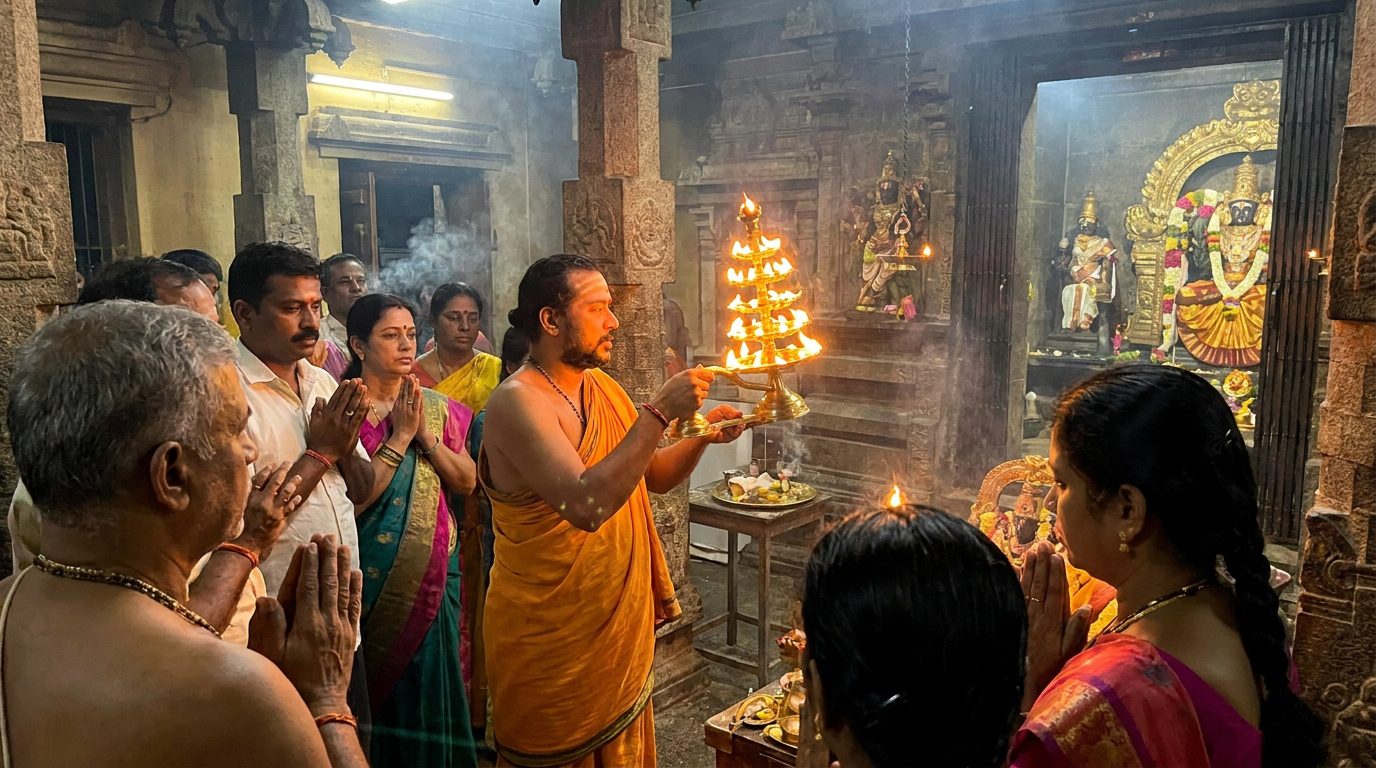
In the quiet hours before sunrise, when the world is still soft and silent, a sacred invitation is offered: come closer to God.
This invitation is called Mangala Arati.
For many people walking the path of Bhakti Yoga, Mangala Arati is one of the most beautiful and life-giving spiritual practices. It is a morning worship ceremony filled with song, prayer, incense, lamps, devotion, and community. It is a time to begin the day not with anxiety, urgency, or distraction, but with remembrance of the Divine.
Whether you are new to Bhakti, returning after some time away, or already familiar with temple worship, this guide is here to help you understand Mangala Arati in a simple, practical, and heartfelt way.
You do not need to be born into any particular culture or tradition to receive the blessings of this practice. Bhakti Yoga is the path of love. It welcomes every sincere heart.
Mangala Arati is a sacred morning worship ceremony offered to the Lord, usually before sunrise.
The word “mangala” means auspicious, blessed, or spiritually favorable. “Arati” refers to a devotional offering of light and other sacred items before the form of the Lord, often accompanied by singing, prayer, and musical instruments.
So, Mangala Arati means “the auspicious offering of worship.” It is considered one of the most spiritually powerful times of the day to remember God, chant His names, and awaken the heart.
In many Bhakti Yoga communities, Mangala Arati is offered to Sri Sri Radha and Krishna, Sri Chaitanya Mahaprabhu, Lord Jagannath, or other worshipable forms of the Divine. The ceremony usually includes the singing of traditional prayers, the offering of lamps and incense, and the chanting of the Hare Krishna maha-mantra:
Hare Krishna Hare Krishna
Krishna Krishna Hare Hare
Hare Rama Hare Rama
Rama Rama Hare Hare
This mantra is a prayer. “Hare” calls upon the Divine energy of the Lord. “Krishna” means the all-attractive Supreme Person. “Rama” means the reservoir of spiritual joy. In simple words, the mantra means: “O Lord, O Divine Mother, please engage me in Your loving service.”
Why Is It Held So Early?
Mangala Arati often begins around 4:30 a.m., though times may vary from temple to temple or home to home.
This early morning period is called brahma-muhurta in Sanskrit. “Brahma” means spiritual, and “muhurta” means a period of time. Brahma-muhurta is generally understood as the time before sunrise, when the atmosphere is peaceful and the mind is naturally more receptive to spiritual practice.
In the Bhagavad-gita, Krishna explains that a yogi seeks balance and discipline in daily life. Waking early for spiritual practice is not meant to be a harsh rule. Rather, it is a loving opportunity to give the first and best part of the day to God.
Before phones begin buzzing, before responsibilities rush in, before the mind becomes filled with plans, Mangala Arati gently places the soul in the center of the day.
Is Mangala Arati Only for Temple Residents?
Not at all.
While Mangala Arati is a central part of daily temple worship, anyone can participate according to their capacity. Some people attend a temple regularly. Others watch a live broadcast from home. Some offer a small lamp and sing prayers before a home altar. Some simply wake early, chant softly, and pray.
Bhakti is not about external perfection. It is about sincerity.
If you cannot wake at 4:00 a.m., begin with what is possible. If you cannot attend the full ceremony, attend part of it. If you do not know all the songs, listen and absorb. If you feel shy, just stand quietly and offer your heart.
Krishna says in the Bhagavad-gita 9.26:
“If one offers Me with love and devotion a leaf, a flower, fruit, or water, I will accept it.”
The key is love and devotion.
The Spiritual Meaning of Mangala Arati
Mangala Arati is more than a ritual. It is a living exchange of love between the soul and God.
In Bhakti Yoga, God is not understood as distant, abstract, or unreachable. Krishna is the Supreme Person, full of beauty, kindness, playfulness, wisdom, and love. The soul is eternally connected with Him. Spiritual life means reawakening that loving relationship.
Mangala Arati helps us remember who we are and who we belong to.
Waking the Body, Awakening the Soul
When we rise early for Mangala Arati, we are not only waking the body. We are awakening the soul.
The body may feel tired. The mind may resist. The blankets may seem very persuasive. But when we step into the sacred space of prayer and chanting, something shifts.
We remember: I am not merely this body. I am not only my work, my worries, my history, my mistakes, or my roles in the world. I am an eternal soul, a beloved servant of God.
This is one of the foundational teachings of the Bhagavad-gita. Krishna tells Arjuna that the self is eternal, never destroyed by the death of the body. Bhakti practice helps that truth become not just a philosophy, but a lived experience.
Offering Light to the Lord
During arati, a lamp is offered before the Lord. This offering of light has deep meaning.
The lamp represents our desire to serve. It also represents the light of devotion that removes the darkness of forgetfulness. As the flame moves in graceful circles before the Deity, we can pray, “Please let my heart become illumined. Please let my life revolve around You.”
After the lamp is offered, it is often brought to the devotees, who cup their hands over the flame and touch that warmth to their heads. This is a way of receiving the Lord’s mercy.
We are reminded that all true light comes from God. We do not create spiritual light by our own power. We receive it.
Seeing the Lord First
One of the beautiful principles of Mangala Arati is to see the Lord early in the morning.
In temple worship, the Deities are revealed at the start of the ceremony. Devotees gather eagerly for darshan. “Darshan” means seeing and being seen by the Lord.
This is a tender concept. We come to see Krishna, but even more importantly, Krishna sees us. We bring our imperfect hearts, and He receives us with compassion.
To begin the day with darshan means to begin with relationship. Before seeing our messages, duties, or problems, we see the beautiful form of the Lord. We allow divine beauty to shape our consciousness.
What Happens During Mangala Arati?
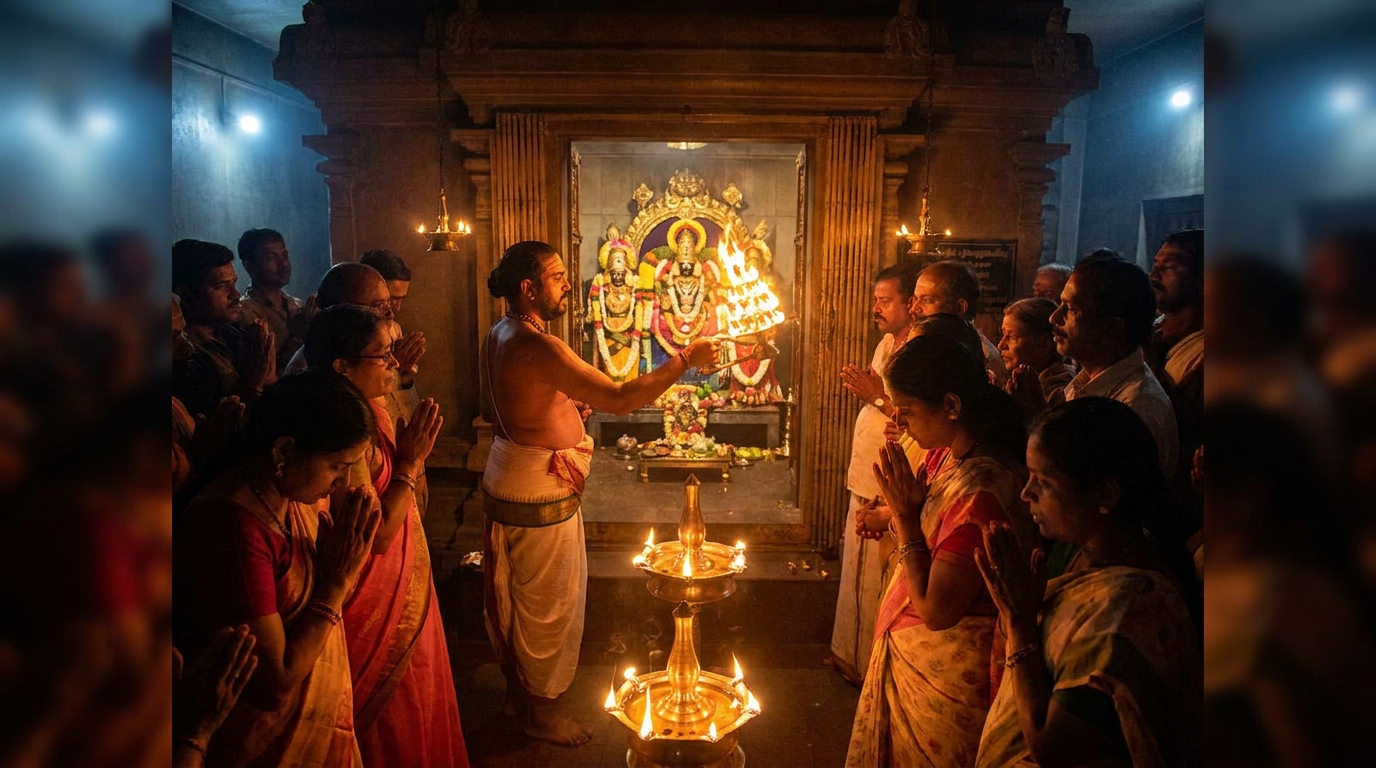
Every temple or Bhakti community may have slight differences, but the heart of Mangala Arati is usually similar: gathering, singing, offering, praying, and chanting.
For someone attending for the first time, the ceremony may feel unfamiliar. There may be Sanskrit prayers, bells, drums, incense, and devotees bowing. Please do not worry about understanding everything at once. You are welcome to simply observe with respect and participate as you feel comfortable.
The Temple Room Opens
Mangala Arati often begins when the altar curtains open.
Devotees may bow down as a gesture of humility and reverence. Bowing is not forced. It is a physical prayer that says, “I am not the center. I offer myself to You.”
In Bhakti Yoga, humility is not self-hatred. It is honesty. We recognize that everything we have—our breath, intelligence, relationships, abilities, and spiritual opportunities—is a gift.
The Arati Offering
A priest or pujarī offers sacred items to the Lord.
“Pujarī” means one who performs worship. The items may include incense, a ghee lamp, water, cloth, flowers, a yak-tail whisk, and a peacock fan, depending on the tradition and setting.
Each item represents love and honor. Just as we might welcome a dear guest with fragrance, light, refreshments, and comfort, the pujari offers these items to the Lord.
In Bhakti, Krishna is not treated as a symbol. He is treated as a beloved person. The Deity form is worshiped with care because the Lord kindly agrees to be present in a visible way so we can serve Him.
Singing the Gurvastakam Prayers
In many Gaudiya Vaishnava temples, the Mangala Arati ceremony includes the singing of Sri Gurvastakam, eight prayers glorifying the spiritual master.
A “guru” is a spiritual teacher who helps guide the soul toward God. “Astakam” means eight verses.
These prayers, written by Srila Vishvanatha Chakravarti Thakura, express gratitude for the mercy of the spiritual teacher. The guru is honored not as God, but as God’s dear servant, who helps us learn how to love and serve.
One famous line from these prayers describes the spiritual master as being engaged in worshiping Radha and Krishna and inspiring others in devotional service.
For newcomers, this may raise questions. Why begin by honoring the guru? Because in Bhakti, spiritual growth comes through grace. We learn devotion from those who practice devotion. We receive sacred sound, scripture, example, and encouragement through a living tradition.
Kirtan: Congregational Chanting
During Mangala Arati, devotees sing together in kirtan.
“Kirtan” means glorification, especially through chanting the names of God. It is one of the most accessible and powerful practices of Bhakti Yoga.
There may be traditional instruments such as the mridanga, a clay drum, and karatalas, small hand cymbals. The singing may be joyful, meditative, soft, or energetic.
The beauty of kirtan is that everyone can participate. You do not need a trained voice. You do not need to know music theory. You simply bring your heart and chant.
The Srimad-Bhagavatam, one of the central scriptures of Bhakti Yoga, teaches that chanting the holy names cleanses the heart. Just as a mirror covered with dust cannot reflect clearly, the heart covered by anxiety, selfishness, or forgetfulness cannot fully reflect divine love. Chanting gently cleanses that mirror.
Check out our latest articles at https://thebhaktihouse.org/blog.
The Benefits of Mangala Arati
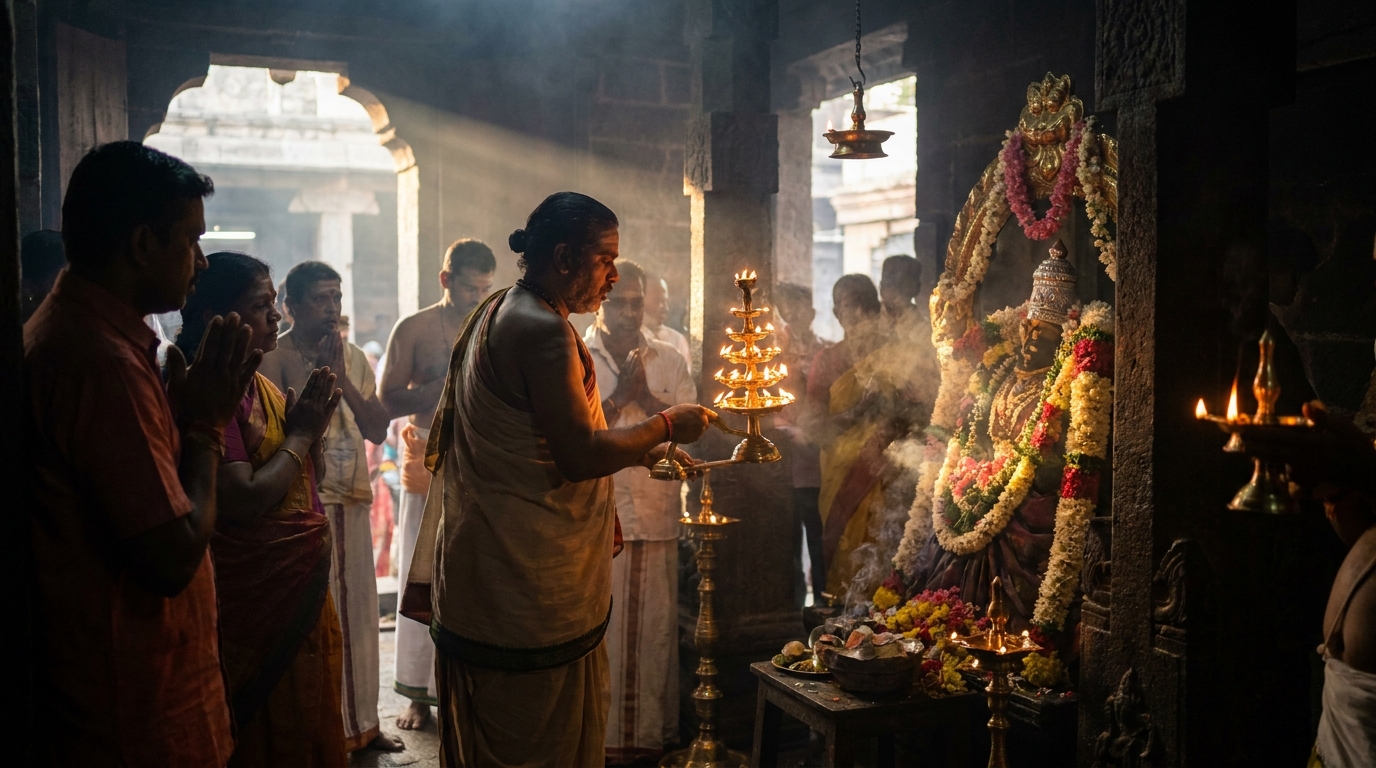
Mangala Arati offers spiritual, emotional, and practical benefits. These benefits unfold gradually through regular practice.
It is important to approach this not as a performance or spiritual competition, but as a relationship. The goal is not to prove we are advanced. The goal is to come closer to God.
It Gives the Day a Sacred Foundation
How we begin the day matters.
If we begin with scrolling, stress, or rushing, the mind often carries that mood forward. If we begin with chanting, prayer, and sacred vision, the day becomes rooted in remembrance.
Mangala Arati gives us a spiritual anchor. Even if the rest of the day becomes busy, that early connection remains in the heart.
A person may go to work, care for children, study, commute, cook, serve, or face difficulty—but the morning offering creates inner strength.
It Trains the Mind with Love
The mind can be restless. It runs toward plans, fears, memories, desires, and distractions. Bhakti Yoga does not ask us to violently suppress the mind. It invites us to lovingly redirect it toward Krishna.
Mangala Arati helps train the mind through sacred routine.
We wake. We bathe or freshen up. We enter a holy space. We hear bells and chanting. We see the Lord. We sing. We pray.
Over time, these practices create spiritual impressions. The mind begins to associate early morning with peace, beauty, and devotion.
It Deepens Community
Mangala Arati is also a shared practice.
Standing together with others in the early morning creates a special kind of spiritual friendship. We may not know everyone’s life story, but we are united by a common prayer: “Please let me remember God. Please let me serve with love.”
In a world where many people feel isolated, sacred community is healing.
The Bhakti tradition teaches that association with sincere devotees is deeply powerful. We become influenced by the company we keep. When we spend time with people who are trying to chant, serve, forgive, and grow, our own spiritual life becomes nourished.
It Helps Purify the Heart
Purification may sound intense, but in Bhakti it is gentle and hopeful. It means the heart becomes clearer.
We begin to notice habits that keep us away from love. We become more aware of pride, anger, greed, envy, or selfishness—not to feel shame, but to offer these things to Krishna for healing.
Mangala Arati creates space for this healing.
In the Chaitanya-charitamrita, Lord Chaitanya Mahaprabhu teaches that chanting the holy name cleanses the mirror of the heart. This does not happen by force. It happens through grace-filled repetition, humility, and sincere prayer.
It Awakens Joy
Many people are surprised that a 4:30 a.m. ceremony can be joyful.
But spiritual joy is different from ordinary pleasure. It does not depend only on comfort or convenience. Sometimes we may arrive sleepy, but leave grateful. Sometimes we may come burdened, but leave lighter.
The sound of kirtan, the sight of the lamp, the fragrance of incense, the company of devotees, and the presence of the Lord work together to awaken the soul’s natural joy.
How to Prepare for Mangala Arati
Preparation can help us receive Mangala Arati more deeply.
Still, please remember: if you are new, you do not need to have everything perfect. Come as you are. Learn gradually. Let devotion grow naturally.
Rest the Night Before
The first preparation for Mangala Arati often begins the previous evening.
If we stay up very late, waking early becomes difficult. A simple, earlier bedtime can become part of our devotional practice.
This does not mean everyone’s schedule will be the same. Parents, caregivers, night-shift workers, students, and people with health conditions may have different realities. Bhakti is personal. Do what is sustainable and sincere.
If you want to attend Mangala Arati, try preparing the night before. Set out your clothes. Place your beads nearby. Reduce screen time before bed. Offer a simple prayer: “Krishna, if You like, please help me rise to remember You.”
Bathe or Freshen Up
Traditionally, devotees bathe before attending Mangala Arati. Cleanliness supports clarity and respect.
If a full bath is not possible, wash your face, hands, and mouth. Wear clean clothing. The principle is to come before the Lord with care.
Cleanliness in Bhakti is not about judgment. It is about honoring sacred space and preparing the body and mind for worship.
Arrive with a Humble Heart
When entering the temple room or your home worship space, pause for a moment.
You might offer a simple prayer:
“Dear Lord, I do not know how to love You properly, but I want to try. Please accept my small offering.”
This mood is very dear in Bhakti. We do not come to impress God. We come to be transformed by love.
Learn the Songs Gradually
Do not feel discouraged if you do not know the prayers.
Many Sanskrit and Bengali prayers used in Bhakti temples are learned over time simply by hearing and singing along. You may read translations to understand the meaning.
Start with the Hare Krishna maha-mantra. Then slowly become familiar with the Mangala Arati prayers, such as Sri Gurvastakam. Understanding even a few lines can make the ceremony feel more personal.
Bring Your Attention Back Again and Again
During Mangala Arati, your mind may wander. This is normal.
When you notice it, gently return to the sound of the chanting, the sight of the Deities, or the meaning of the prayers. Spiritual practice is not about never being distracted. It is about returning.
Every return is an act of devotion.
How to Practice Mangala Arati at Home
Not everyone lives near a temple. Not everyone can attend daily. Thankfully, Bhakti Yoga can be practiced anywhere.
A home Mangala Arati can be simple, sincere, and powerful.
Create a Small Sacred Space
You may create a small altar with pictures of Krishna, Radha, Lord Chaitanya, Lord Jagannath, your spiritual teachers, or other forms of the Lord you feel connected to.
Keep the space clean and respectful. You might place a flower, a candle, a small lamp, or a cup of water.
The purpose of an altar is to help the heart focus. It reminds us that our home can become a place of devotion.
Offer a Lamp or Candle
If safe and appropriate, you can light a candle or ghee lamp and offer it before the Lord.
Move it gently in circles while chanting or praying. If you are unsure of formal procedures, keep it simple. Offer with love.
You might say:
“My Lord, please accept this light. Please bring Your light into my heart and home.”
Always be careful with fire, especially around children, pets, curtains, or small spaces.
Chant the Holy Names
Chanting is the heart of Bhakti.
You can sing the Hare Krishna maha-mantra softly or aloud. You can chant on japa beads. “Japa” means personal mantra meditation, usually repeated quietly while touching beads one by one.
Even five or ten minutes of sincere chanting in the morning can change the direction of the day.
If possible, listen to a recording of Mangala Arati prayers and sing along. Over time, the words will become familiar.
Read a Verse of Scripture
After your home arati or chanting, you may read one verse from the Bhagavad-gita or Srimad-Bhagavatam.
Do not worry about reading a large amount. Even one verse, read with attention, can nourish the heart.
You might ask:
“What is Krishna teaching me here?”
“How can I apply this today?”
“How can I serve with more love?”
Bhakti scripture is not meant only for scholars. It is meant to guide daily life.
Offer Your Day
Before leaving your sacred space, offer your day to God.
You might pray:
“Krishna, please guide my thoughts, words, and actions today. Let me be of service. Let me remember You in whatever comes.”
This simple offering transforms ordinary life into spiritual practice.
Cooking, working, parenting, studying, cleaning, listening, encouraging, and caring can all become part of Bhakti when offered with love.
Common Questions About Mangala Arati
Mangala Arati can raise many questions, especially for those who are new. Questions are welcome. Bhakti grows through sincere inquiry.
Do I Have to Be Hindu to Attend Mangala Arati?
No.
Bhakti Yoga is a spiritual path open to everyone. While it comes through ancient Vedic and Vaishnava traditions from India, its essence is universal: the soul’s loving relationship with God.
People of many backgrounds attend Mangala Arati—different cultures, ages, professions, and life stories. Some come with deep faith. Some come with curiosity. Some come with pain. Some come simply because they felt drawn.
All are welcome.
What Should I Wear?
Wear clean, modest, comfortable clothing.
In many temples, devotees may wear traditional clothing such as saris, dhotis, or kurtas, but this is not required for visitors. The main principle is respect.
If you are unsure, choose clothing that allows you to sit, stand, bow, and participate comfortably.
What If I Do Not Know the Etiquette?
It is okay.
You can observe others, ask a kind devotee, or simply stand respectfully. Most communities are happy to help newcomers.
Some basic tips:
Remove shoes before entering the temple room if that is the custom.
Avoid pointing your feet toward the altar while sitting.
Speak softly in sacred spaces.
Participate at your own pace.
Ask questions humbly when appropriate.
No one learns everything in one day.
What If I Feel Unworthy?
Many sincere people feel this way.
But Bhakti does not begin with worthiness. It begins with mercy.
Krishna is not waiting for us to become perfect before we approach Him. He invites us to come closer so that His love can purify and uplift us.
In the Bhagavad-gita 18.66, Krishna says, “Abandon all varieties of dharma and simply surrender unto Me. I shall deliver you from all sinful reactions. Do not fear.”
This is one of the most compassionate teachings in all scripture. Krishna is saying, “Come to Me. I will protect you. Do not be afraid.”
If you feel unworthy, bring that feeling as part of your prayer.
What If I Cannot Wake Up Every Day?
Begin gently.
Maybe you attend once a week. Maybe you wake early one day a month. Maybe you practice at home for ten minutes. Consistency is wonderful, but guilt is not the goal.
Spiritual growth often happens step by step.
Celebrate sincere effort. Ask for help. Adjust your schedule. Keep going.
The Lord sees the heart.
Mangala Arati and the Heart of Bhakti Yoga
Mangala Arati is one expression of the larger path of Bhakti Yoga.
“Bhakti” means devotion or loving service. “Yoga” means connection. Bhakti Yoga is the path of reconnecting with God through love.
It is practical, personal, and deeply transformative.
Chanting as a Daily Shelter
Chanting the holy names is central to Bhakti Yoga.
In this age, the scriptures especially recommend nama-sankirtana, the congregational chanting of God’s names. “Nama” means name, and “sankirtana” means chanting together.
Lord Chaitanya Mahaprabhu, who appeared in India over 500 years ago, taught that the holy name of Krishna is the most merciful gift for all people. Through chanting, anyone can connect with God, regardless of social position, education, nationality, or past mistakes.
Mangala Arati gives us a sacred setting for this chanting.
Prayer as Honest Relationship
Prayer in Bhakti does not need to be polished.
We can speak to Krishna honestly. We can thank Him, ask for guidance, confess our struggles, or simply sit in silence.
A simple prayer may be:
“Please help me remember You.”
“Please help me serve others.”
“Please remove what blocks my love.”
“Please let me become an instrument of Your compassion.”
Prayer makes spiritual life personal.
Service as Love in Action
Bhakti is not only what happens in the temple room. It continues in service.
“Seva” means service. In Bhakti Yoga, service is the natural expression of love.
After Mangala Arati, devotees may cook, clean, chant japa, study scripture, welcome guests, care for the temple, or go into the world carrying a devotional mood.
Service can be simple. Washing a cup. Offering food. Listening to someone. Sharing prasadam. Helping set up cushions. Supporting a community. Smiling with kindness.
“Prasadam” means mercy, especially food offered to Krishna with love and then shared. Receiving and distributing prasadam is a beautiful form of devotion.
Spiritual Growth as a Lifelong Journey
Mangala Arati is not a quick fix. It is part of a lifelong journey.
Some mornings will feel inspired. Some will feel dry. Some will be full of tears. Some will be sleepy. All can be offered.
In Bhakti, progress is not always dramatic. Sometimes it looks like becoming a little more patient. A little more grateful. A little more honest. A little more willing to serve.
These small changes matter.
Krishna receives every sincere step.
A Simple Mangala Arati Routine for Beginners
If you are new and want to begin, here is a gentle routine you can try at home or use to prepare for attending a temple.
The Night Before
Choose a realistic wake-up time.
Set your alarm.
Place your clothes and beads nearby.
Avoid heavy late-night distractions if possible.
Offer a short prayer before sleeping.
In the Morning
Wake and freshen up.
Enter your sacred space or temple room quietly.
Offer respects in your own way.
Light a candle or lamp if appropriate.
Chant the Hare Krishna mantra.
Listen to or sing Mangala Arati prayers.
Read one verse of scripture.
Offer your day to Krishna.
If You Only Have Five Minutes
Even five minutes can be sacred.
You can sit, breathe, and chant the maha-mantra slowly. You can offer one heartfelt prayer. You can look at a picture of Krishna and say, “Please guide me today.”
Do not underestimate small beginnings.
A seed is small, but with care it can become a great tree.
Bringing Mangala Arati Into Daily Life
The real fruit of Mangala Arati is seen in how we live after the ceremony.
If we chant in the morning but speak harshly all day, we can pray to become more integrated. If we offer a lamp to Krishna but forget to see others as His children, we can ask for deeper vision.
Mangala Arati teaches us to carry sacred consciousness into ordinary moments.
Remembering Krishna at Work and School
You can silently chant during a commute.
You can pause before a meeting and pray for humility.
You can offer the results of your work to God.
You can treat coworkers, clients, classmates, and strangers with respect.
This is practical Bhakti.
Serving Family and Community
Home life can become a temple when filled with service.
Preparing food with love, speaking gently, forgiving, caring for children or elders, and creating space for prayer are all meaningful offerings.
Bhakti does not require us to abandon responsibility. It teaches us to spiritualize responsibility.
Returning When You Forget
We will forget. That is part of the human condition.
The gift of daily practice is that it helps us return.
Mangala Arati is like a sunrise in the heart. Each morning, Krishna gives us another chance to remember, another chance to serve, another chance to love.
The Inner Mood of Mangala Arati
The outer ceremony is beautiful, but the inner mood is the essence.
We can ask ourselves: What am I offering? Am I offering only a flame, or am I offering my heart? Am I singing only with my voice, or am I trying to call out sincerely? Am I attending out of habit, or am I asking to grow in love?
These questions are not meant to create pressure. They are invitations.
Gratitude
Mangala Arati begins the day with thankfulness.
Thank You for life.
Thank You for breath.
Thank You for another chance.
Thank You for the holy name.
Thank You for the devotees.
Thank You for Your patience with me.
Gratitude softens the heart.
Humility
Humility allows us to receive grace.
We do not need to pretend to be advanced. We can come honestly, with our strengths and weaknesses, and ask for help.
This honesty is beautiful to Krishna.
Longing
At the deepest level, Mangala Arati awakens longing.
The soul longs for God. Beneath all our searching, achieving, consuming, and wandering, there is a sacred hunger for eternal love.
Mangala Arati gives that longing a voice.
Through song, flame, prayer, and silence, the heart says: “I want to come home to You.”
Everyone Is Welcome
Mangala Arati is a doorway.
It is a doorway into the morning, into sacred sound, into community, into discipline, into tenderness, into the loving presence of God.
You may come with strong faith or many questions. You may know the songs or not know a single word. You may feel peaceful or restless, joyful or heavy, confident or uncertain.
Please come anyway.
The path of Bhakti Yoga is not reserved for the perfect. It is for the sincere. It is for those willing to take one step, however small, toward love.
If Mangala Arati calls to your heart, begin gently. Visit a temple. Join a kirtan. Wake a little earlier. chant the holy names. Offer a candle. Say a prayer. Serve someone with kindness. Read one verse. Take one sincere step toward God.
At The Bhakti House, all are welcome. Wherever you are from, whatever your background, whatever your story, Krishna’s love is available to you. May your mornings become blessed, your heart become bright, and your life become an offering of devotion.
Everyone is welcome to take one sincere step toward God.
FAQs
What is Mangala arati?
Mangala arati is a traditional Hindu ritual of offering worship to the deities early in the morning, usually before sunrise. It is considered an auspicious way to start the day and is performed in temples and households.
What is the significance of Mangala arati?
Mangala arati is believed to invoke blessings from the deities for a successful and auspicious day. It is also seen as a way to express gratitude and devotion to the divine.
How is Mangala arati performed?
Mangala arati typically involves the offering of incense, lamps, flowers, and food to the deities. It is accompanied by the singing of devotional songs and the ringing of bells. The ritual is usually performed by a designated priest or pujari.
What are the benefits of participating in Mangala arati?
Participating in Mangala arati is believed to bring peace of mind, spiritual upliftment, and blessings for a successful day. It is also seen as a way to cultivate a sense of discipline and devotion.
Can anyone participate in Mangala arati?
Yes, Mangala arati is open to all individuals, regardless of their age, gender, or background. It is a communal ritual that welcomes the participation of anyone seeking to connect with the divine in a spirit of devotion and reverence.

