
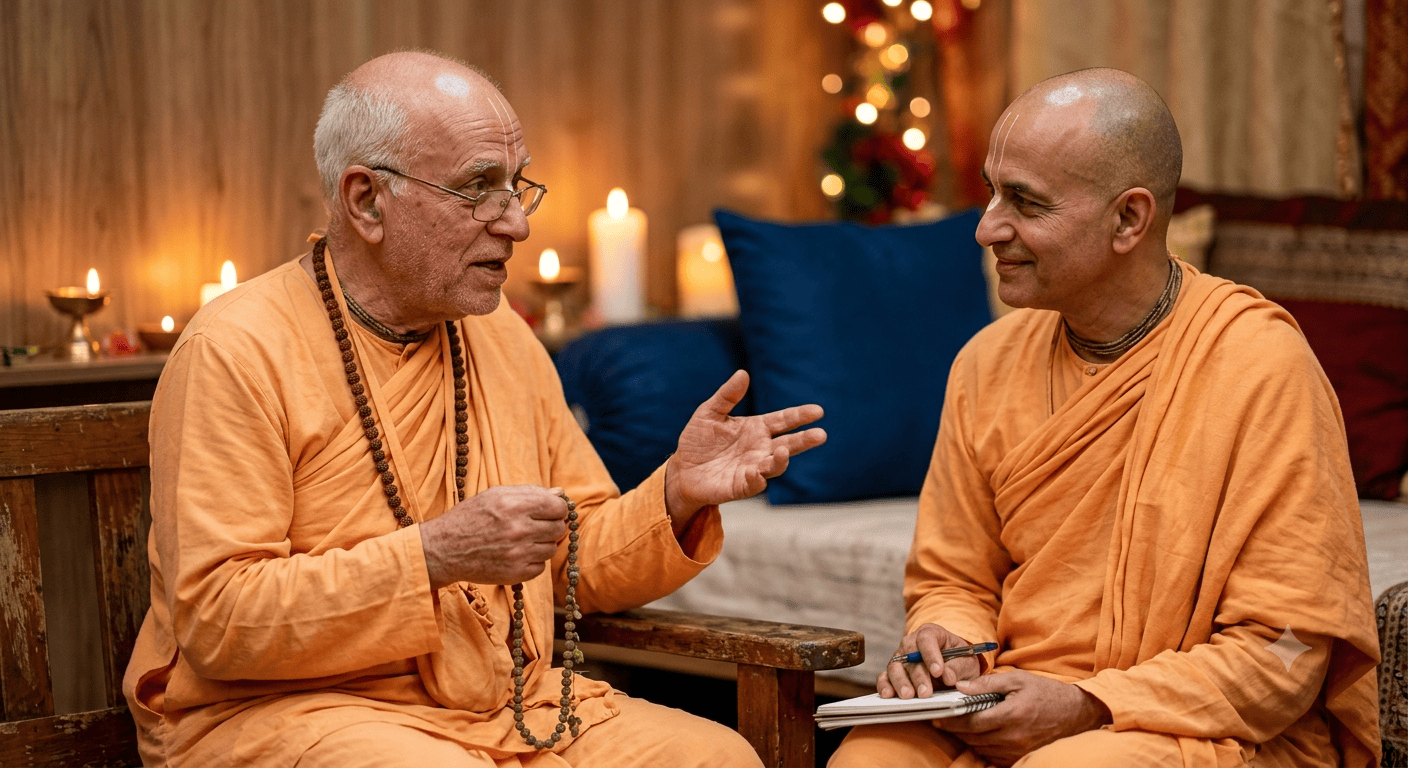
Every spiritual community, no matter how loving or well-intentioned, eventually faces a tender question: What do we do when someone in our circle stops showing up — not just physically, but in heart, effort, and care?
This is not a question about judgment. It is a question about love. And in the tradition of Bhakti Yoga — the path of devotion, where love for God and love for each other are inseparable — this question deserves a thoughtful, compassionate, and honest answer.
At The Bhakti House, we believe that community (sangha) is one of the most powerful vehicles for spiritual growth. But community only thrives when its members are genuinely participating, contributing, and caring for one another. When participation fades, the whole community feels it — and so does the person who has withdrawn.
Let us explore together how the Bhakti path offers wisdom for navigating this delicate balance between compassion and consequences, between patience and healthy boundaries.
In Bhakti Yoga, we do not walk alone. The scriptures consistently remind us that spiritual life flourishes in the company of sincere seekers. The Bhagavata Purana (also known as the Srimad Bhagavatam) beautifully states:
> “The value of a moment’s association with a devotee of the Lord cannot even be compared to the attainment of the heavenly planets or liberation from matter, and what to speak of worldly benedictions in the form of material prosperity.” (Srimad Bhagavatam 1.18.13)
This tells us something profound: the company we keep has extraordinary spiritual power. When we gather to chant God’s holy names (kirtan), share sacred meals (prasadam), study scripture together, and serve side by side, something happens that cannot happen in isolation. We soften. We grow. We heal.
The Role of Sangha in Daily Devotion
Sangha simply means “spiritual community” or “association of seekers.” It is not a club with membership fees. It is a family of hearts oriented toward the Divine. In sangha, we find:
- Encouragement when our faith wavers
- Accountability when our habits slip
- Mirrors that lovingly reflect our blind spots
- Joy that multiplies when shared in devotion
When even one person withdraws from this circle, the fabric of sangha is affected. Not because we are keeping score, but because genuine connection requires presence — both physical and emotional.
What Authentic Participation Looks Like
Participation in a Bhakti community is not about perfection. It is about sincerity. It can look like:
- Showing up for kirtan even when you do not feel like singing
- Offering a simple act of service, like helping clean up after a gathering
- Checking in on a fellow devotee who is struggling
- Being honest about your own struggles rather than hiding behind a smile
- Chanting your daily prayers (japa) with attention, even when the mind wanders
The Bhagavad Gita reminds us that even small efforts on this path are never wasted: “In this endeavor there is no loss or diminution, and a little advancement on this path can protect one from the most dangerous type of fear.” (Bhagavad Gita 2.40)
Understanding Why People Stop Participating
Before we ever address non-participation, we must first seek to understand it. The Bhakti path teaches us to lead with empathy. People step back from community for many reasons, and most of them come from a place of pain rather than apathy.
Personal Struggles and Life Transitions
Sometimes life simply overwhelms a person. Illness, financial hardship, family crises, mental health challenges, grief — these can drain someone’s energy so completely that even showing up feels impossible. A person battling depression may not have the strength to attend a single gathering, let alone contribute actively.
In these moments, the community’s role is not to demand but to gently reach out. A simple message — “We miss you. How can we help?” — can be a lifeline.
Spiritual Doubt and Discouragement
The Bhakti path is not always a smooth road. There are seasons of doubt, dryness, and questioning. A devotee may feel disconnected from God, disillusioned with spiritual practice, or unworthy of being part of the community. The Bhagavad Gita acknowledges this struggle openly. Arjuna himself, the great warrior-devotee, was paralyzed by confusion and despair on the battlefield of Kurukshetra.
If Arjuna — a direct friend of Krishna — could experience such doubt, surely we can extend grace to anyone in our community who feels lost.
Interpersonal Conflict and Hurt Feelings
Let us be honest: sometimes people leave because they have been hurt. Perhaps they felt judged, excluded, overlooked, or misunderstood. Community is made of imperfect human beings, and even devotional spaces can cause wounds.
When someone withdraws after a conflict, the mature response is not to ignore the absence but to humbly investigate whether the community itself may have contributed to their pain.
Simple Complacency and Distraction
And sometimes, truthfully, people drift away because the pull of material life is strong. The demands of career, entertainment, social media, and personal comfort can gradually replace the hunger for spiritual nourishment. This is not something to condemn — it is something to understand. The Bhagavad Gita describes how even a wise person can be carried away by the powerful senses (Bhagavad Gita 2.60).
The Delicate Balance Between Compassion and Accountability
Here is where the conversation becomes truly nuanced. How do we hold space for someone’s struggles while also honoring the health and integrity of the community?
Compassion without accountability can become enabling. Accountability without compassion can become cruelty. The Bhakti tradition calls us to hold both with great care.
Compassion as the Foundation
The starting point must always be love. In the Chaitanya Charitamrita, Sri Chaitanya Mahaprabhu — the great 15th-century saint who ignited a massive Bhakti revival — taught that a devotee should be “more humble than a blade of grass, more tolerant than a tree, ready to offer all respect to others, and expecting no respect for oneself.” (Siksastakam, Verse 3)
This is the spirit in which we approach a community member who has withdrawn. We do not begin with accusations. We begin with humility and genuine concern.
When Gentle Consequences Become Necessary
However, there are times when compassion also means being honest. If a community member has committed to a role of service — perhaps leading a study group, coordinating meals, or managing logistics — and consistently fails to follow through without communication, the impact ripples outward. Others pick up the slack. Trust erodes. Resentment can quietly build.
In these cases, a loving but direct conversation is an act of care, not punishment. It might sound like:
- “We value you and your gifts. We have also noticed your absence and want to understand what is happening.”
- “Is the commitment you made still something you feel called to? It is okay if your season has changed.”
- “How can we support you while also making sure the community’s needs are met?”
Releasing Without Rejecting
Sometimes the most loving thing we can do is release someone from their responsibilities without releasing them from our hearts. A person may need to step back from active service while still being welcomed with open arms whenever they walk through the door.
This is not exile. This is grace. It says, “Your worth is not measured by what you do for us. But the community also deserves honesty and reliability.”
Sure, here is the sentence with the clickable link:
Check out our website for more bhakti articles.
Practical Steps for Community Leaders and Members
Navigating these situations requires both spiritual maturity and practical wisdom. Here are some approaches rooted in the Bhakti spirit that communities can adopt.
Create a Culture of Open Communication
From the very beginning, foster an environment where honest conversation is safe. Normalize phrases like, “I am struggling,” or “I need to step back for a while.” When people feel they can be vulnerable without being judged, they are far less likely to disappear silently.
Check In Regularly and Personally
Do not wait until someone has been absent for months. A brief, personal message after a week or two of absence can make an enormous difference. Not a guilt-laden message, but a warm one: “We noticed you have not been around. Just want you to know you are missed and loved.”
Establish Clear and Kind Expectations
When someone takes on a role within the community, gently clarify what is expected — and create an easy, shame-free way for them to communicate if they need to step down. This prevents the awkward cycle of overcommitment and silent withdrawal.
Practice Forgiveness as a Discipline
In Bhakti, forgiveness is not optional — it is essential. People will let the community down. The community will sometimes let people down. The practice of kshama (forgiveness) keeps the heart soft and the relationships repairable.
Pray for Those Who Have Withdrawn
This may be the most powerful step of all. When someone drifts away, bring them into your prayers and your chanting. Trust that the holy names carry a power far beyond our limited understanding. As the Hari Bhakti Vilasa and other devotional texts affirm, sincere prayer for another’s well-being is one of the highest forms of service.
What the Bhakti Scriptures Teach Us About Patience and Persistence
The great Bhakti texts are filled with stories of people who wandered away from the path and then returned — sometimes after years, sometimes after lifetimes. The message is always the same: God never gives up on anyone.
In the Bhagavad Gita, Krishna makes one of the most reassuring promises in all of scripture: “My devotee is never lost.” (Bhagavad Gita 9.31) This verse is a reminder that even when someone seems to have abandoned the path entirely, the seeds of devotion planted in their heart do not perish.
The Story of the Prodigal Devotee
While the Bhakti tradition does not use that exact phrase, the sentiment is deeply present. Time and again, we see that God runs toward the soul who takes even one sincere step back. Our role in community is to reflect that same divine eagerness — to welcome, not to withhold.
Trusting the Process of Growth
Not everyone grows at the same pace. Not everyone is ready for the same level of commitment. A person who seems disengaged today may become the most dedicated member of the community tomorrow. Our job is not to rush anyone’s journey, but to keep the door open and the lamp lit.
Building a Community That People Want to Belong To
Ultimately, the best way to address non-participation is to build a community so full of genuine love, authentic practice, and sincere devotion that people are naturally drawn to participate.
Make Gatherings Nourishing, Not Obligatory
If people feel drained after a community event rather than uplifted, something needs to change. Every kirtan, every study session, every shared meal should leave participants feeling closer to God and to each other.
Celebrate Small Contributions
Not everyone can lead a kirtan or give a talk. But everyone can offer something. Celebrate the person who quietly washes dishes after the feast. Acknowledge the one who sends an encouraging text. Bhakti is not measured in grand gestures — it is found in the small, sincere offerings of the heart.
Model the Participation You Hope to See
As leaders and long-time members, our own sincerity, humility, and consistency set the tone. When people see that we show up with joy rather than obligation, they are inspired to do the same.
A Gentle Invitation to Take One Step
If you have read this far, perhaps something here resonated with your own experience — either as someone who has stepped back from community or as someone wondering how to lovingly respond to another’s absence.
Wherever you are in your journey, please know this: you are welcome at The Bhakti House.
You do not need to have all the answers. You do not need to be perfect. You do not need to arrive with a flawless track record of participation or a heart free from doubt.
All you need is one sincere step. One honest prayer. One moment of opening your heart to the possibility that God is closer than you think and that a loving community is ready to walk with you.
The Bhagavad Gita promises: “Whatever you do, whatever you eat, whatever you offer or give away, and whatever austerities you perform — do that as an offering to Me.” (Bhagavad Gita 9.27)
Start small. Start today. Chant one holy name with feeling. Reach out to one person you have been avoiding. Show up to one gathering you have been putting off. Offer one kind word, one prayer, one act of service.
God sees every sincere effort, and so does the community that loves you.
You belong here. Come as you are.

