
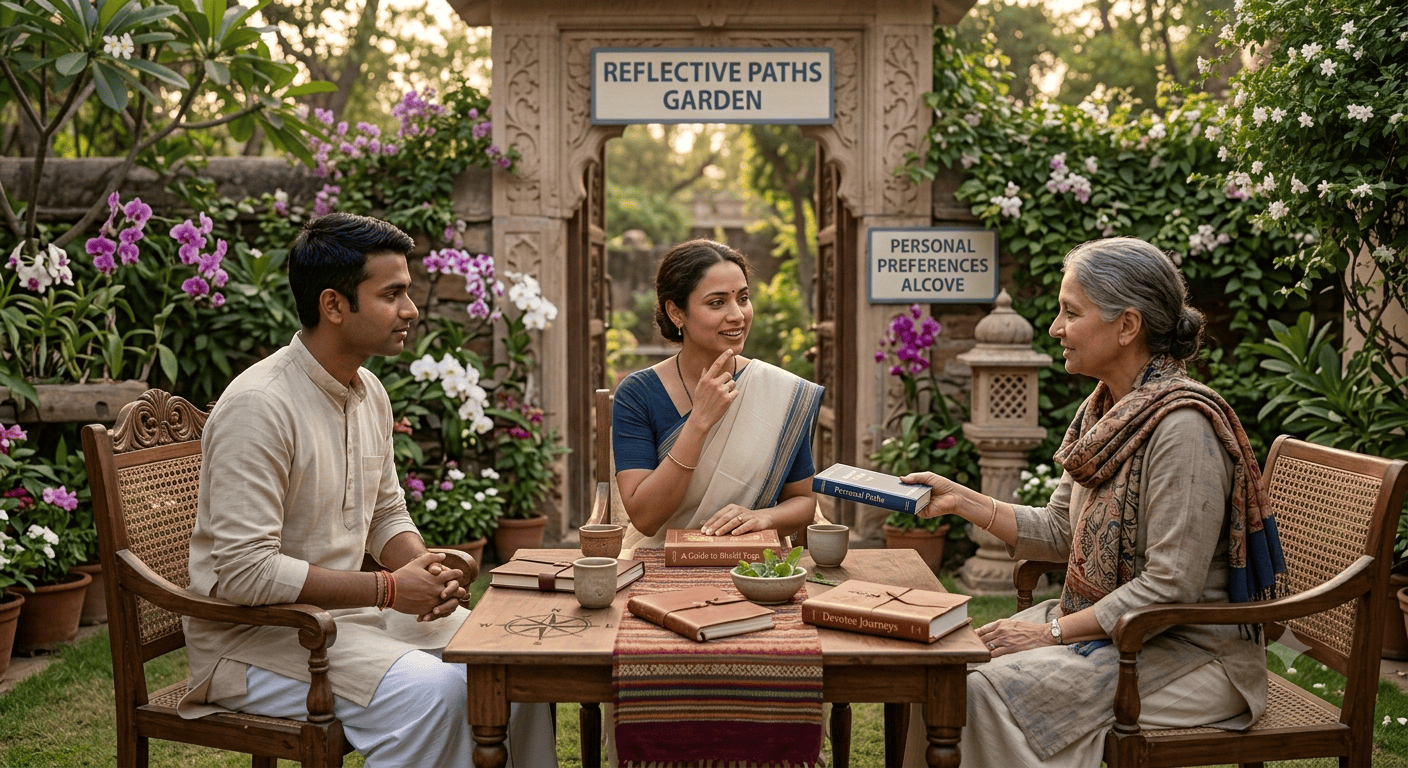
We all come to the spiritual path carrying a lifetime of experiences, tastes, habits, and opinions. And that’s perfectly okay. In fact, one of the most beautiful things about a Bhakti community — a community rooted in devotional love — is that it welcomes every kind of heart, exactly as it is. But let’s be honest: living and practicing alongside others who see the world differently than we do isn’t always easy.
Whether it’s the style of kirtan (devotional chanting) we prefer, the way we cook and eat, the pace at which we like to learn, or even the volume of the mridanga drum during a celebration, personal preferences can sometimes become unexpected obstacles on the path of love. This article is a gentle exploration of how we can honor who we are while staying open to the beautiful diversity of a spiritual family. Wherever you are on your journey, we hope these reflections offer some warmth and practical wisdom.
One of the first steps in navigating personal preferences within a spiritual community is learning to distinguish between what is a matter of taste and what is a matter of genuine spiritual principle.
Preferences Are Natural and Human
We all have them. You might love slow, meditative chanting, while your friend feels most alive during fast, rhythmic kirtan. You might prefer studying scripture in the morning, while someone else connects more deeply in the evening. These differences are natural expressions of our individual natures.
In the Bhagavad Gita (18.21), Krishna describes the quality of understanding that sees the many varieties among living beings. Diversity is woven into the very fabric of creation. So when we notice that our preferences differ from someone else’s, that’s not a problem — it’s a reflection of how wonderfully varied God’s creation truly is.
Principles Are the Foundation We Share
Spiritual principles, on the other hand, are the deeper truths that hold a community together: sincerity, kindness, truthfulness, devotion, and love for God and all living beings. These aren’t matters of personal taste. They are the ground we walk on together.
When we can tell the difference between “I prefer this” and “this is a core value of our path,” we gain so much freedom. We stop turning small differences into big conflicts, and we start appreciating the rich variety of expressions within our spiritual family.
A Simple Practice
Before reacting to something that bothers you in community life, try pausing and asking yourself: “Is this about a principle, or is this about my preference?” That one honest question can save a lot of unnecessary friction and open the door to grace.
Why Personal Preferences Can Become So Charged
It might seem strange that something as simple as a preferred chanting melody or a style of cooking prasadam (sanctified food offered to God) could cause tension. But preferences often carry more emotional weight than we realize.
Our Identity Gets Wrapped Up in Our Tastes
As human beings, we naturally identify with our likes and dislikes. The Bhagavad Gita (3.34) acknowledges this honestly, noting that attachment and aversion are seated in relation to the senses and their objects. When someone challenges or simply differs from something we feel strongly about, it can feel like they’re challenging us. But with a little awareness, we can learn to hold our preferences lightly, without losing our sense of self.
Cultural and Personal History Matters
Many of us come to a Bhakti community from very different backgrounds — different countries, different religions, different family cultures. What feels warm and familiar to one person might feel foreign or uncomfortable to another. This is completely understandable. Part of spiritual growth is learning to see beyond our conditioning while being compassionate with ourselves and others as we do so.
The Ego Wants to Be Right
Let’s be lovingly honest here: the ego — that deep sense of separateness that the Bhakti tradition calls ahankara — loves to be right. It loves to turn “I prefer this” into “this is the right way.” When we catch ourselves doing this, it’s not a reason for shame. It’s actually a beautiful moment of awareness. We can smile at the ego’s little game and gently return our attention to what really matters: love, connection, and devotion.
The Bhakti Approach: Love as the Great Harmonizer
Bhakti Yoga, the path of loving devotion, offers a uniquely beautiful framework for navigating differences. At its heart, Bhakti isn’t about uniformity — it’s about unity in love.
The Example of Vrindavan
In the sacred stories of Vrindavan, we see an extraordinary variety of devotees. The cowherd boys related to Krishna as their best friend. The gopis (cowherd maidens) loved Him with the deepest intimacy of the heart. Mother Yashoda loved Him as her child. The elderly Vrajavasis honored Him with parental affection and village warmth. Every single relationship was unique, yet they were all connected by the same thread of pure, selfless love.
This is the model for spiritual community. We don’t all need to love God in the same way, chant with the same melody, or express our devotion through the same service. What matters is the sincerity behind it all.
Chaitanya Mahaprabhu’s Inclusive Spirit
Sri Chaitanya Mahaprabhu, the great 15th-century saint who revived the Bhakti movement, embraced people from every background, every social standing, and every temperament. He didn’t ask people to become someone they weren’t. He asked them to chant the holy names with sincerity and to treat every living being with kindness. His movement was — and still is — a celebration of diversity united by devotion.
In the Siksastakam (verse 3), He beautifully prays for the humility to be “more tolerant than a tree” and to “offer all respect to others.” This spirit of genuine humility and respect is the master key for navigating every personal preference that might arise in community life.
Service Dissolves Differences
One of the most practical and powerful aspects of Bhakti is seva — selfless service. When we serve together, something magical happens. The walls of “my way” and “your way” start to soften. We begin to see each other not as competitors with clashing opinions, but as teammates offering our unique gifts to something greater than ourselves.
If you’ve ever been in a kitchen preparing prasadam alongside people you barely know, you’ve probably experienced this. There’s a sweetness in working side by side that transcends personal preferences and reveals the deeper bond we share.
Sure, here is the sentence with the clickable link:
Check out our website for more bhakti articles.
Practical Wisdom for Everyday Community Life
Philosophical understanding is wonderful, but we also need practical tools. Here are some gentle, real-world suggestions for navigating preferences in a Bhakti community.
Communicate with Kindness and Humility
When something bothers you, speak up — but do it with the spirit of Chaitanya Mahaprabhu’s prayer. Use “I” statements instead of accusations. Say “I feel a little overwhelmed when the music is very loud” rather than “You always play too loud.” This small shift keeps the conversation in the realm of sharing rather than blaming.
Listen with a Genuinely Open Heart
When someone shares a preference that differs from yours, resist the urge to immediately defend your position. Take a breath. Listen. Try to understand where they’re coming from. You might be surprised to find that their perspective enriches your own.
The Bhakti tradition deeply values sadhu-sanga — the association of sincere devotees. Real association means truly hearing each other, not just occupying the same room.
Be Willing to Compromise
Compromise isn’t a sign of weakness. It’s a sign of spiritual maturity. Maybe the community alternates between different styles of kirtan. Maybe the festival schedule accommodates different schedules. Maybe you take turns choosing which scripture to study. These small acts of flexibility create an atmosphere where everyone feels valued.
Pick Your Battles Wisely
Not every preference needs to become a conversation. Some things we can simply let go of with a smile. If the flower arrangement on the altar isn’t exactly what you would have chosen, perhaps that’s an opportunity to practice appreciating someone else’s offering rather than wishing it were different.
Celebrate What Makes Others Unique
Instead of merely tolerating differences, try actively celebrating them. When someone brings a new melody to kirtan, let yourself be curious. When a community member shares a tradition from their cultural background, receive it as a gift. This is how a community becomes truly alive.
Growing Through Differences: The Hidden Gift
Here’s something that might surprise you: the moments when personal preferences clash are often among the most valuable moments on the spiritual path.
Friction Reveals What Needs Healing
When we feel irritated or defensive, those feelings are showing us where we’re still holding on tightly. They’re pointing to attachments, insecurities, or pride that we might not have noticed otherwise. In Bhakti, we understand that God often works through these everyday interactions to soften our hearts and help us grow.
Relationships Are the Real Practice
It’s relatively easy to feel spiritual when we’re alone in meditation or lost in the bliss of our favorite kirtan. The real test — and the real opportunity — comes when we’re navigating the beautiful, messy, unpredictable reality of community life. Every interaction is a chance to practice patience, generosity, humility, and love.
As the Srimad Bhagavatam (11.20.8) gently teaches, the wise person who desires spiritual progress learns to navigate the dualities of this world — including the duality of like and dislike — with an even, peaceful mind.
Tolerance Becomes Transcendence
When we practice tolerance not as teeth-gritting endurance but as a genuine, loving choice to honor the personhood of others, something shifts inside us. We start to experience the kind of freedom that the Bhakti scriptures describe — a heart that isn’t tossed around by every fluctuation of likes and dislikes, but is anchored in something much deeper.
Building a Community Where Everyone Belongs
Ultimately, navigating personal preferences is about building something precious: a spiritual community where every single person feels they belong.
Creating Space Without Losing Structure
A healthy Bhakti community has structure — regular practices, shared values, a rhythm of worship and service. But within that structure, there’s room for individual expression. Think of it like a beautiful garden: the garden has boundaries and a design, but within it, a thousand different flowers bloom.
Welcoming Newcomers with Extra Sensitivity
If you’ve been part of a community for a while, remember what it felt like to walk in for the first time. Newcomers are often navigating a world of unfamiliar terms, practices, and social dynamics. Being extra patient and welcoming with people who are just beginning their journey is one of the most important services any community member can offer.
Leaders Set the Tone
Those who lead kirtan, give classes, organize events, or manage community spaces carry a special responsibility. When leaders model humility, flexibility, and genuine respect for diverse preferences, the entire community feels it. When leaders are rigid or dismissive, the community feels that too.
Remembering Our Shared Purpose
Whenever tensions arise around preferences, it helps to return to the simple, beautiful purpose that brought everyone together in the first place: to grow in love for God and for each other. That shared intention is infinitely bigger than any disagreement about chanting styles, dietary details, or event planning.
The spiritual path is not a journey we were ever meant to walk alone. It’s a journey we walk together — with all of our quirks, preferences, strengths, and growing edges. Every person in the community, including you, brings something irreplaceable to the table.
So wherever you are today, whatever your background, whatever your preferences, please know that you are welcome here. You don’t have to have it all figured out. You don’t have to fit a mold. All you need is a sincere heart and the willingness to take one small step toward the Divine.
Maybe that step is joining a kirtan and staying open to a melody you’ve never heard before. Maybe it’s cooking a meal for someone whose tastes are different from yours. Maybe it’s simply sitting quietly and letting the holy name wash over you: Hare Krishna, Hare Krishna, Krishna Krishna, Hare Hare / Hare Rama, Hare Rama, Rama Rama, Hare Hare.
Whatever your step looks like today, it matters. And you are not alone in taking it.
With love and gratitude,
The Bhakti House

