
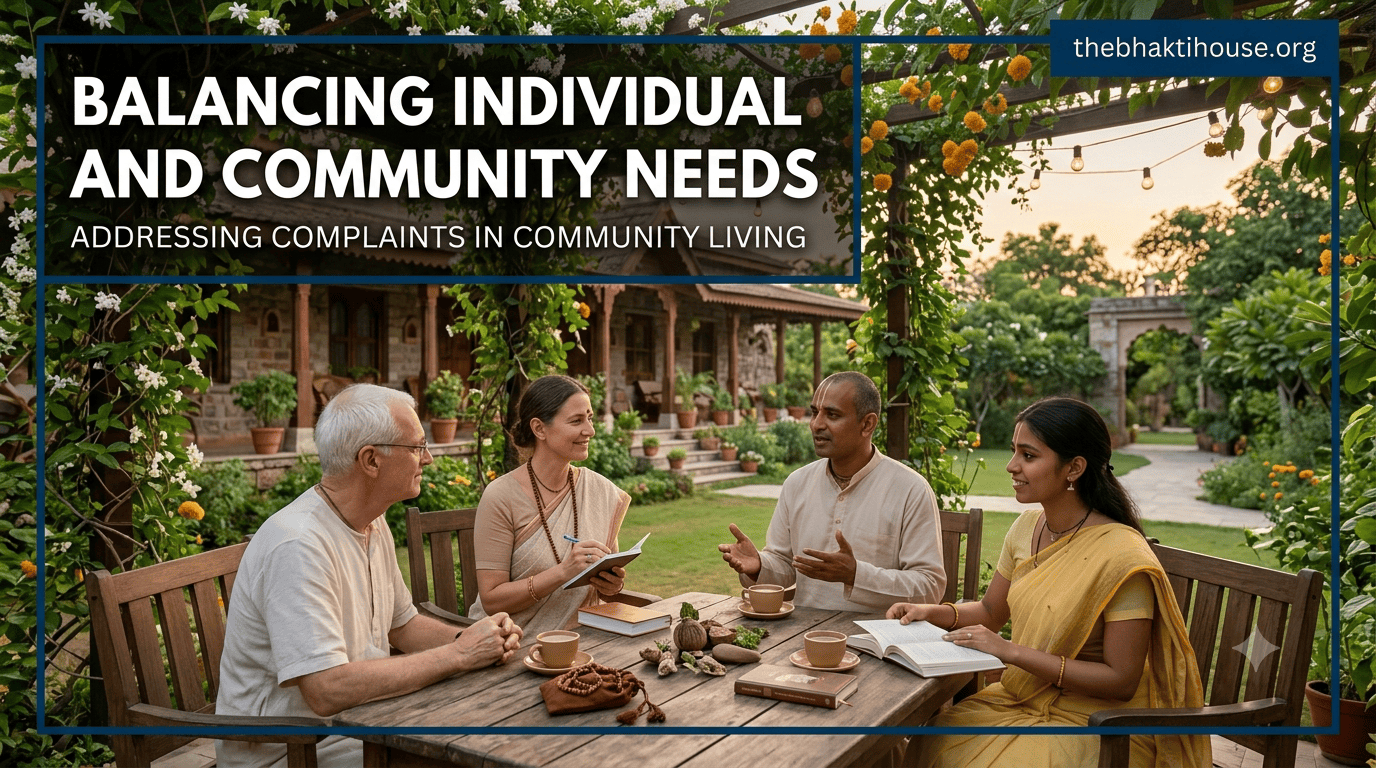
Living together in spiritual community is one of the most beautiful — and most challenging — expressions of devotion. When we choose to share our lives with others on the path of Bhakti Yoga, we open ourselves to incredible blessings: deep friendships, shared kirtan (devotional chanting), collective service, and the warmth of belonging to something greater than ourselves.
But let’s be honest — community living also means navigating differences. It means hearing complaints, feeling frustrated sometimes, and learning how to honor both our own needs and the needs of those around us. This is not a sign of failure. It is actually one of the most powerful arenas for spiritual growth.
In the Bhakti tradition, we understand that love is not just a feeling — it is a practice. And practicing love with the people we live beside, eat with, and serve alongside is where our devotion becomes real.
As the Srimad Bhagavatam (11.29.15) reminds us, a sincere devotee sees every living being with equal vision, offering respect to all. This beautiful ideal becomes our daily practice when we live in community, especially when tensions arise.
Whether you live in an ashram, a co-housing arrangement, a temple community, or simply share a home with fellow seekers, this article is for you. Let us explore, with humility and love, how to balance individual and community needs — and how to address complaints in a way that honors everyone involved.
The Gift of Sangha
In Sanskrit, the word sangha means “spiritual community” or “association.” The Bhakti scriptures place tremendous emphasis on the power of good association. Chaitanya Mahaprabhu, the great saint of devotional love, taught that the association of devotees is one of the most important factors in spiritual growth.
When we live in community, we are immersed in sangha. We wake up to the sound of kirtan, share prasadam (food offered with love to God), and support one another through life’s joys and difficulties. This daily immersion in devotional culture naturally purifies the heart and deepens our connection to the Divine.
The Mirror of Relationships
Community living also serves as a mirror. The people around us reflect back to us our own patterns — our impatience, our pride, our generosity, our capacity for forgiveness. This can feel uncomfortable, but it is an extraordinary gift.
When someone in the community does something that bothers us, we have an opportunity to look inward. Not to suppress our feelings, but to ask honestly: “What is God teaching me through this situation? How can I respond with both integrity and compassion?”
This doesn’t mean we ignore real problems. It means we approach them with a spirit of growth rather than blame.
Understanding the Root Causes of Complaints
Different Temperaments and Needs
Every person is unique. Some of us need quiet mornings to connect with God through japa (the gentle repetition of sacred mantras on beads). Others feel energized by lively conversation at breakfast. Some are early risers; others are night owls who do their deepest prayer in the late hours.
These differences are not flaws — they are part of the beautiful diversity of God’s creation. But when different temperaments share the same physical space, friction naturally arises. Understanding this is the first step toward compassion.
Unspoken Expectations
Many complaints in community living stem from expectations that were never clearly communicated. Perhaps someone assumes that shared spaces will always be kept a certain way, or that quiet hours are universally understood. When these assumptions go unspoken, disappointment and resentment can build silently.
The Bhakti path encourages satya — truthfulness spoken with kindness. Being honest about our needs and expectations, before they become grievances, is an act of love toward ourselves and our community.
Boundaries and Personal Space
Even the most devoted community members need personal space. In the Bhagavad Gita (6.16-17), Lord Krishna teaches about balance — not too much of anything, not too little. This wisdom applies beautifully to community life. We need togetherness, and we need solitude. We need shared purpose, and we need room to breathe.
When personal boundaries are repeatedly crossed — even unintentionally — complaints are the natural result. Honoring boundaries is not selfish; it is an essential part of sustainable, loving community.
Practical Approaches to Addressing Complaints With Grace
Creating Safe Spaces for Honest Communication
One of the most important things any community can do is create regular, structured opportunities for people to share their concerns. This might look like:
- Weekly or monthly community meetings where everyone has a chance to speak
- A designated listener or mediator — someone trusted who can receive concerns privately
- Anonymous feedback options for those who feel too vulnerable to speak openly at first
The key is that people feel genuinely safe. If someone fears being judged, dismissed, or punished for sharing a concern, they will either stay silent and grow bitter or leave the community altogether. Neither outcome serves anyone.
Listening as Seva (Service)
In the Bhakti tradition, seva means selfless service offered with love. We often think of seva as cooking, cleaning, or organizing events. But one of the highest forms of seva is simply listening — truly listening — to another person’s pain or frustration.
When someone brings a complaint, our first instinct might be to defend ourselves, explain why they’re wrong, or minimize their experience. But if we pause, take a breath, and simply listen with an open heart, something powerful happens. The other person feels seen. They feel valued. And from that place of feeling heard, real resolution becomes possible.
As Rupa Goswami, one of the great Bhakti teachers, explained, devotional relationships thrive on mutual care, trust, and attentiveness. This applies not only to our relationship with God but to our relationships with one another.
Separating the Person From the Problem
This is a crucial principle: when addressing complaints, we focus on behaviors and situations — not on attacking a person’s character. There is a world of difference between “You are so inconsiderate” and “When music plays late at night, I have difficulty sleeping and it affects my morning sadhana (spiritual practice).”
The Bhakti path teaches us to see the divine spark in every living being. Even when we are frustrated, we can choose to honor the person while honestly addressing the problem. This is not easy. But it is transformative.
Sure, here is the sentence with the clickable link:
Check out our website for more bhakti articles.
Building a Culture of Mutual Respect and Flexibility
Establishing Clear, Shared Agreements
Healthy communities don’t leave everything to assumption. They work together to create clear, shared agreements about practical matters:
- Quiet hours and shared space usage
- Cleanliness standards and responsibility rotations
- How food is prepared, shared, and stored
- Guest policies
- Financial contributions and transparency
- How decisions are made and by whom
These agreements should be created collaboratively, revisited regularly, and updated as the community evolves. When everyone has a voice in creating the guidelines, there is a much stronger sense of ownership and willingness to follow them.
Embracing Flexibility Without Losing Structure
At the same time, rigidity can be just as harmful as chaos. A community that insists on absolute uniformity leaves no room for individual needs, and people begin to feel unseen.
The wisdom of Bhakti teaches us that God relates to each soul uniquely, meeting every heart exactly where it is. Our communities can reflect this divine quality by holding structures with flexibility — having guidelines that serve people rather than controlling them.
For example, if the community holds morning arati (a devotional ceremony with light and prayer) at 5:00 AM, but a member is going through a health challenge, compassion might mean allowing them to join later without judgment. Structure provides rhythm; flexibility provides love.
Celebrating Individuality Within Unity
One of the most beautiful aspects of Bhakti philosophy is the concept of acintya-bhedabheda-tattva — the simultaneous oneness and difference between the soul and God. We are one in spiritual essence, yet each of us is a unique individual with our own relationship to the Divine.
This principle applies to community life as well. We are united in our shared devotion, yet each of us brings different gifts, perspectives, needs, and expressions of love. A healthy community celebrates this diversity rather than trying to erase it.
When individuals feel that their unique nature is welcome, complaints often decrease naturally — because people feel at home.
When Complaints Become Conflicts: Navigating Deeper Challenges
The Role of Compassionate Mediation
Sometimes, despite everyone’s best efforts, complaints escalate into deeper conflicts. Perhaps two community members have a persistent personality clash. Perhaps someone feels they have been treated unfairly by leadership. Perhaps a pattern of behavior is causing harm.
In these moments, having a compassionate mediator is invaluable. This could be a respected elder, a trained conflict resolution facilitator, or a senior community member known for their fairness and wisdom. The mediator’s role is not to take sides but to help both parties feel heard and to guide the conversation toward understanding and resolution.
Knowing When Professional Support Is Needed
It is important to acknowledge, with humility, that spiritual communities are not equipped to handle every situation on their own. Issues involving mental health crises, abuse, harassment, or serious interpersonal harm may require professional support — counselors, therapists, or even legal guidance.
Seeking outside help is not a sign of spiritual weakness. It is a sign of maturity and genuine care for every member of the community. Protecting the vulnerable is one of the highest expressions of dharma (righteous duty).
Forgiveness as a Spiritual Practice
The Bhakti scriptures are filled with stories of extraordinary forgiveness. Queen Kunti, Prahlada Maharaja, and countless other devotees demonstrated that forgiveness is not about condoning harm — it is about freeing our own hearts from the chains of resentment.
In community, forgiveness is often a daily practice. Small irritations, misunderstandings, and unintentional hurts are inevitable. When we cultivate a habit of forgiving freely — while still addressing problems honestly — we create a community culture where love is stronger than grievance.
The Heart of It All: Love in Action
Ultimately, balancing individual and community needs comes down to one thing: love in action. Not sentimental love that avoids hard conversations, and not harsh “truth-telling” that wounds people. But the courageous, patient, humble love that the Bhakti path calls us to embody.
The Bhagavad Gita (12.13-14) describes the qualities of a dear devotee: one who is not envious, who is friendly and compassionate, free from possessiveness, equal in happiness and distress, forgiving, always satisfied, and determined in devotion. These are not qualities we are expected to perfect overnight. They are qualities we practice, day by day, interaction by interaction, complaint by complaint.
Community living gives us a daily laboratory for this practice. Every moment of tension is an invitation to grow. Every resolved conflict is a victory for love. Every time we choose understanding over judgment, we draw closer to the heart of God.
You Are Welcome Here
Wherever you are on your spiritual journey — whether you have lived in community for decades or are just beginning to explore the possibility — please know that you are welcome. You don’t need to be perfect. You don’t need to have all the answers. You just need a sincere heart and a willingness to grow.
If you have been hurt in community, your pain is valid. If you long for community, that longing is sacred. If you are in community right now and struggling, take courage — the struggle itself is part of the path.
The great Bhakti teacher Srila Prabhupada often said that this process of devotion is so powerful that even a small effort is never lost. One sincere step toward God — one honest conversation, one moment of forgiveness, one prayer for the well-being of someone who frustrates you — changes everything.
You don’t have to figure it all out today. Just take one sincere step. God sees your heart, and that is more than enough.
With love and blessings from The Bhakti House — may your community life be a garden where devotion blossoms, where every soul feels honored, and where love grows stronger with each passing day.

