
There is a beautiful verse in the Bhagavad Gita where Lord Krishna gently reminds us that the highest expression of love is found not in grand gestures, but in humble, heartfelt service. He says, “Whatever you do, whatever you eat, whatever you offer or give away, and whatever austerities you perform — do that as an offering to Me” (Bhagavad Gita 9.27).
At The Bhakti House, we believe that seva — a Sanskrit word meaning selfless service — is one of the most powerful and transformative practices available to every single one of us. You don’t need to be a scholar, a monk, or someone with decades of spiritual experience. You simply need a willing heart and the desire to offer something, anything, with love.
Whether you come from a background rooted in Bhakti traditions or you are just beginning to explore what devotion means to you, seva has something extraordinary to offer. It softens the heart. It opens us up to connection. And it quietly, beautifully, draws us closer to God and to each other.
Let’s explore together what meaningful seva looks like, why it matters, and how it can genuinely empower the communities we are part of.
Seva, at its heart, is service performed without expecting anything in return. It is not volunteering for recognition or helping others so we can feel good about ourselves — though feeling good is a natural and wonderful side effect. True seva is an offering. It is an act of love directed toward God through the people, creatures, and world around us.
In the Bhakti tradition, we understand that every living being carries a spark of the Divine. The Bhagavata Purana, one of the most cherished Bhakti scriptures, teaches that serving others with devotion is inseparable from serving God. When we see the sacred in everyone we meet, our service becomes worship.
The Difference Between Service and Seva
You might wonder, isn’t seva just another word for volunteering? While there is certainly overlap, there is a subtle and important distinction. Volunteering is a generous and noble act. Seva goes a step deeper — it carries an intention of spiritual offering.
When we practice seva, we are not just giving our time. We are offering our ego, our comfort, and our energy at the feet of something greater than ourselves. This shift in intention, even if it is small and imperfect, changes everything. It transforms ordinary acts into spiritual practice.
Seva as a Form of Bhakti Yoga
Bhakti Yoga is the yoga of love and devotion. It is a path that invites us to connect with God through the heart rather than through intellectual analysis or extreme physical discipline alone. Chanting God’s holy names (kirtan), prayer, worship, and seva are all expressions of this path.
Seva is sometimes called the hands and feet of Bhakti. While kirtan may be the voice and prayer may be the whisper, seva is how devotion walks into the world and gets to work. It is love in action. And it is available to everyone, regardless of age, ability, or background.
The Spiritual Roots of Seva in Bhakti Tradition
The Bhakti scriptures are rich with stories and teachings that illuminate the power of selfless service. Understanding these roots helps us appreciate why seva is not just a nice idea — it is a sacred practice with deep spiritual significance.
Teachings from the Bhagavad Gita
In the Bhagavad Gita, Lord Krishna speaks extensively about the importance of selfless action. He teaches Arjuna — and through him, all of us — that we have a right to perform our duties but never to the fruits of our actions (Gita 2.47). This is the foundation of seva. We serve because it is the right and loving thing to do, not because we are calculating what we will receive.
Krishna also shares that those who cook food only for themselves eat sin, but those who prepare food as an offering and share it with others are freed from all faults (Gita 3.13). This is why prasadam, or sanctified food distribution, has been one of the most enduring and beloved forms of seva in the Bhakti tradition for centuries.
Lessons from the Lives of Great Devotees
Throughout Bhakti history, we find extraordinary examples of devotees whose seva transformed not only their own hearts but entire communities. Hanuman, the great devotee of Lord Rama, is perhaps the most beloved example. His entire life was an offering of service — not because he was obligated, but because his love for Rama was so deep that service was his joy.
We also find inspiration in more recent teachers and saints who established communities of seva, feeding the hungry, caring for the sick, and offering spiritual shelter to anyone who came with an open heart. Their lives remind us that seva is not something we do on the side. It can become the very center of a meaningful, God-connected life.
How Seva Empowers and Transforms Communities
When seva is practiced collectively, something remarkable happens. It stops being just a personal spiritual discipline and becomes a force that lifts entire communities. This is where the real magic of seva reveals itself.
Building Genuine Connection
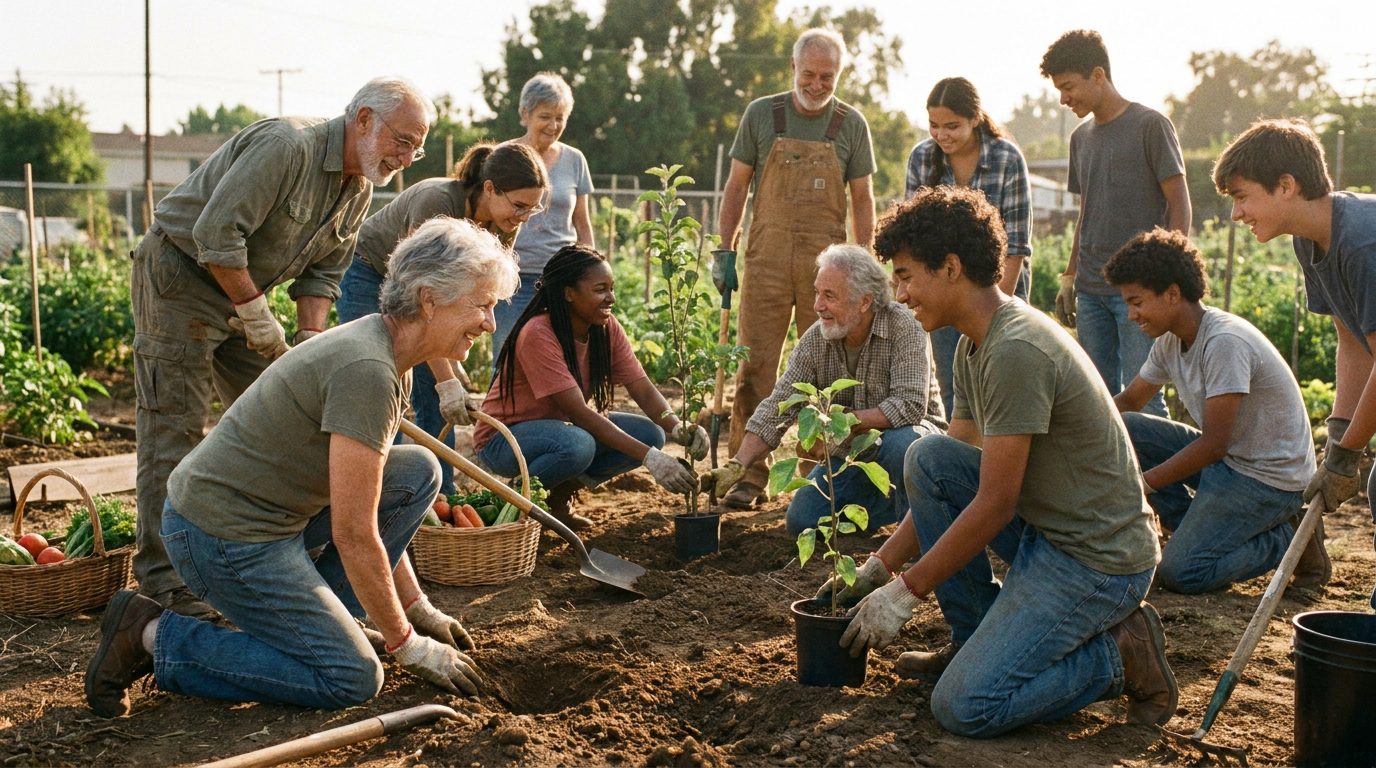
In a world that often feels isolated and fragmented, coming together to serve creates bonds that go far deeper than casual socializing. When you stand side by side with someone, chopping vegetables for a community meal or cleaning a sacred space together, walls come down. Differences in background, education, income, and culture begin to dissolve. What remains is our shared humanity and our shared desire to offer something good.
At The Bhakti House, we have witnessed this again and again. People who might never have crossed paths in their daily lives find themselves laughing together, supporting each other, and forming friendships rooted in something real and lasting.
Creating a Culture of Care
When seva becomes a regular part of community life, it creates what we might call a culture of care. People begin to look out for one another not because there is a program requiring it, but because the habit of loving service has reshaped how they see the world.
This culture ripples outward. Someone who regularly practices seva at their local Bhakti community often finds that they become more generous and attentive in their workplace, their family, and their neighborhood. Seva does not stay contained within the walls of a temple or community center. It overflows into every area of life.
Addressing Real Needs with Love
Meaningful seva is not abstract. It meets people where they are with what they actually need. This might mean preparing and distributing wholesome meals to those experiencing food insecurity. It might mean visiting elderly community members who are lonely. It might mean organizing kirtan gatherings in spaces where people are struggling — hospitals, shelters, recovery centers — and bringing the healing power of God’s holy names to those who need it most.
When we address real, tangible needs with a spirit of devotion, we honor both the material and spiritual dimensions of human life. We acknowledge that a hungry person needs food before philosophy, and that a lonely person needs companionship before theology. And yet, because our service is rooted in devotion, it naturally carries a spiritual fragrance that touches people in ways we may never fully understand.
Sure, here is the sentence with the clickable link:
You can find more bhakti articles here.
Practical Ways to Practice Seva in Your Life
You might be reading this and thinking, “This sounds beautiful, but where do I start?” The good news is that seva does not require a grand plan. It begins with one small, sincere step.
Offering Your Time
One of the simplest and most powerful forms of seva is offering your time. This might mean helping set up or clean up after a kirtan gathering, assisting with a community event, or simply being present for someone who needs a listening ear. Your time is one of the most precious things you have, and offering it freely is a profound act of devotion.
Sharing Your Skills
Every one of us has been given unique gifts and abilities. Perhaps you are a skilled cook, a talented musician, a good organizer, or someone who is wonderful with children. Whatever your skills, they can be offered in service. At The Bhakti House, we have seen how beautifully a community flourishes when people bring their diverse gifts to the table — literally and figuratively.
Preparing and Sharing Prasadam
The practice of cooking food with devotion, offering it to God, and then sharing it with others is one of the oldest and most cherished forms of seva in the Bhakti tradition. There is something deeply sacred about nourishing another person’s body and spirit through sanctified food. If you are looking for a place to start, consider preparing a simple meal with love and sharing it with someone who could use a warm plate and a kind word.
Chanting for Others
This is a form of seva that is sometimes overlooked but is incredibly powerful. When we chant the holy names of God — whether it is the Hare Krishna maha-mantra or another sacred name — with the intention of blessing others, we are performing a profound service. The vibration of God’s names has the power to purify hearts, heal wounds, and awaken love. Chanting for the wellbeing of your community, your loved ones, or even the whole world is seva of the highest kind.
Supporting with Resources
If you are in a position to offer financial support or material resources to your spiritual community or to those in need, this too is meaningful seva. The Bhakti tradition teaches that our wealth, like everything else, ultimately belongs to God. When we use it in service to others, we free ourselves from the grip of attachment and experience the joy of generosity.
Overcoming Common Obstacles to Seva
Even when our hearts are eager, we sometimes encounter inner obstacles that hold us back from serving. Let’s address a few of these with honesty and compassion.
“I Don’t Have Enough Time”
This is perhaps the most common barrier, and it is completely understandable. Life is busy. Responsibilities are real. But seva does not have to mean adding hours to your already full schedule. It can be as simple as offering a sincere prayer for someone, holding the door open with genuine warmth, or dedicating ten minutes of your morning chanting to the wellbeing of others. Start where you are. God sees the intention behind even the smallest offering.
“I Don’t Feel Qualified”
The beautiful truth about seva is that it does not require qualifications. It requires sincerity. You do not need to be a perfect person to serve. In fact, one of the great blessings of seva is that it helps us grow into better versions of ourselves. We learn patience by serving. We learn humility by serving. We learn love by serving. Your imperfect, sincere offering is infinitely more valuable than a perfect offering that never happens because you were waiting to feel ready.
“I’m Not Sure I Belong”
If this thought has ever crossed your mind, please hear this clearly: you belong. The path of Bhakti is radically inclusive. It does not matter where you come from, what you have done, what you believe, or how much you know. The doors of seva and devotion are open to everyone. Lord Chaitanya, one of the most beloved teachers in the Bhakti tradition, demonstrated this by embracing people from every walk of life and inviting them into the joy of chanting and service. That same invitation extends to you right now.
The Ripple Effect: How Your Seva Changes the World
It is easy to underestimate the impact of our small acts of service. We might think that one meal prepared, one kirtan attended, or one afternoon spent in community cleanup is just a drop in the ocean. But as Mother Teresa so wisely expressed, the ocean is made up of drops.
Every sincere act of seva creates a ripple that extends far beyond what we can see. The person you served carries that kindness with them. They may pass it on to someone else. The atmosphere of a community shifts when even a few people are committed to serving with love. Hope grows. Trust deepens. Hearts open.
And perhaps most importantly, your own heart is transformed. Through seva, we gradually learn to see God everywhere — in the faces of strangers, in the needs of our neighbors, in the quiet moments of offering that no one else witnesses. This is the real empowerment that seva brings. Not power over others, but the power of a heart that has learned to love freely.
Wherever you are on your journey, whatever brought you to this page today, we want you to know that you are welcome here. You are welcome at The Bhakti House, you are welcome on the path of Bhakti, and you are welcome to take one sincere step toward God through service, chanting, prayer, or simply opening your heart a little wider.
You don’t have to have it all figured out. None of us do. But together, through meaningful seva and genuine devotion, we can build communities that reflect the love we are all searching for.
Take that one step today. It is enough. God meets us exactly where we are.

