
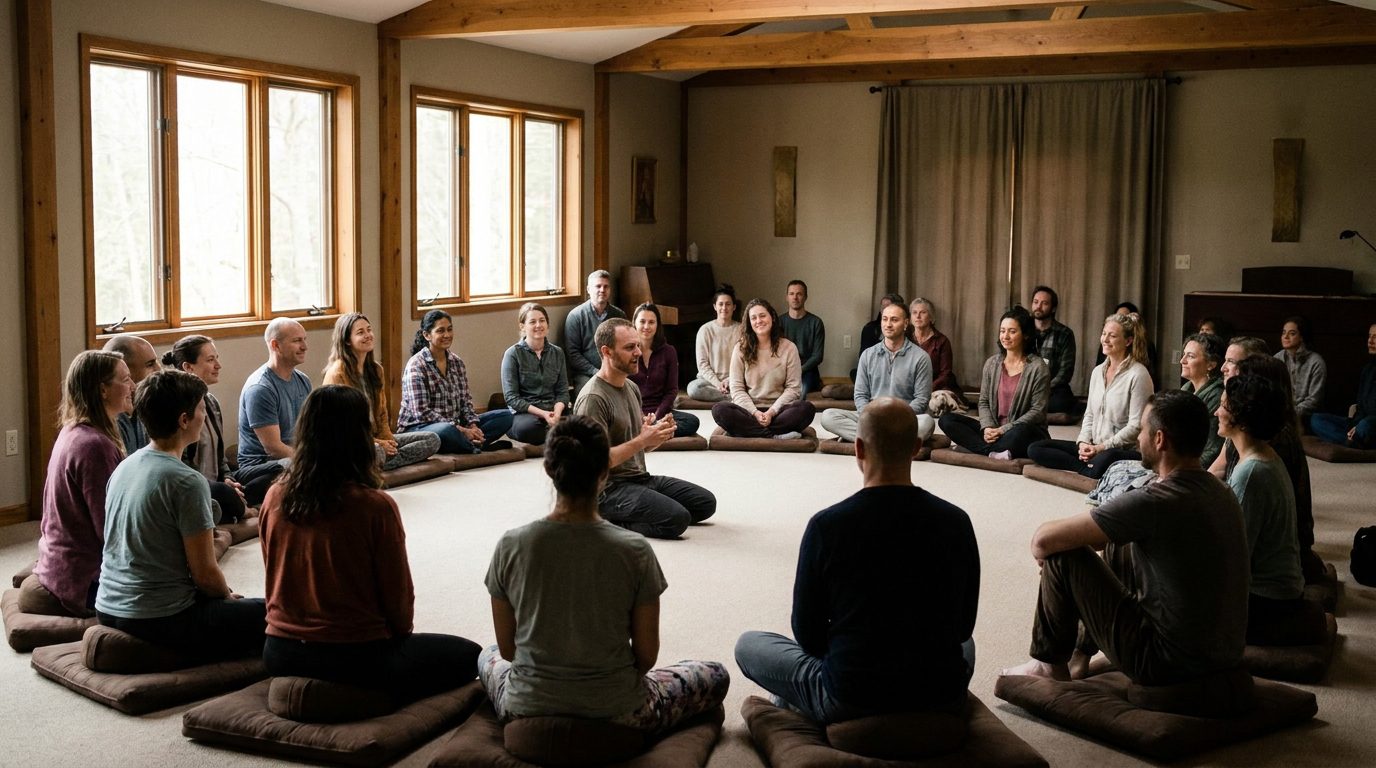
There is a beautiful truth that runs through the heart of the Bhakti tradition: we were never meant to walk this spiritual path alone. From the very beginning, the great saints, teachers, and lovers of God have gathered together — to chant, to pray, to share wisdom, and to remind one another of what matters most. This gathering is called satsaṅga, and it is one of the most powerful, transformative, and accessible practices available to anyone who sincerely longs to grow closer to the Divine.
Whether you are brand new to spirituality or have been walking this path for decades, satsaṅga has something precious to offer you. It doesn’t require perfection. It doesn’t require advanced knowledge. It simply requires a willing heart and the humility to show up.
At The Bhakti House, we believe that satsaṅga is not just an event — it’s a living, breathing expression of love. And we’d love to share with you why it matters so deeply.
The word satsaṅga comes from two Sanskrit words: sat, meaning “truth” or “that which is eternal,” and saṅga, meaning “association” or “company.” So satsaṅga literally means “the association of truth” or “being in the company of those who seek truth.”
In the Bhakti tradition, satsaṅga refers to gathering with others who love God — to chant the holy names, to hear and discuss sacred scriptures, to pray together, and to support one another on the spiritual journey. It can happen in a temple, in someone’s home, in a park, or even online. The outer form can vary, but the inner essence remains the same: sincere souls coming together to remember God.
Satsaṅga in the Scriptures
The importance of satsaṅga is celebrated throughout the Bhakti scriptures. In the Śrīmad-Bhāgavatam (11.2.30), it is beautifully stated:
“The symptoms of a sādhu (saintly person) are that they are tolerant, merciful, and friendly to all living beings. They have no enemies, they are peaceful, they follow the scriptures, and all their characteristics are sublime. Such a sādhu is the best kind of association.”
This verse reminds us that satsaṅga is not just about being in a crowd of people — it’s about being in the company of those whose hearts are turned toward God, whose lives reflect kindness, humility, and devotion. When we spend time with such souls, their qualities naturally begin to rub off on us. Like a piece of iron placed near a magnet, our hearts are gently drawn toward the Divine.
The Bhagavad Gītā (10.9) also paints a warm picture of devotees in satsaṅga:
“The thoughts of My pure devotees dwell in Me, their lives are fully devoted to My service, and they derive great satisfaction and bliss from always enlightening one another and conversing about Me.”
This is satsaṅga at its sweetest — devotees sharing their love for God with one another, finding joy not in material gain, but in the simple act of remembering the Lord together.
Why Satsaṅga Is Essential for Spiritual Growth
We live in a world that constantly pulls our attention outward — toward screens, schedules, worries, ambitions, and countless distractions. Even when we sincerely want to grow spiritually, the currents of daily life can feel overwhelming. This is exactly why satsaṅga is so essential. It provides a sacred anchor, a place where we can reconnect with our deepest intentions and with the God who lovingly waits for us.
It Purifies the Heart
One of the most important effects of satsaṅga is the gradual purification of the heart. In the Śrīmad-Bhāgavatam (1.2.18), we find this encouraging progression:
“By regular attendance in classes on the Bhāgavatam and by rendering service to the pure devotee, all that is troublesome to the heart is practically destroyed, and loving service unto the Personality of Godhead is established as an irrevocable fact.”
Notice the gentleness of this process. It doesn’t say we must fix ourselves before coming to satsaṅga. Rather, it tells us that by simply showing up — by hearing, by serving, by being present — the knots of confusion, selfishness, and forgetfulness in our hearts are gradually untied. We don’t have to be perfect. We just have to be sincere.
It Strengthens Our Resolve
Spiritual life requires patience and perseverance. There will be days when chanting feels dry, when prayer feels distant, when doubts creep in. In those moments, satsaṅga becomes an anchor. When we see others continuing to practice with faith and love, it encourages us to keep going. When we hear stories of how others have overcome similar struggles, we realize we are not alone.
There is a beautiful saying: “A single coal, removed from the fire, quickly grows cold. But when placed among other burning coals, it stays ablaze.” This is the power of satsaṅga. Together, we keep the fire of devotion alive.
It Creates a Safe Space for Vulnerability
The spiritual path asks us to be honest — with God and with ourselves. That kind of honesty can be scary. But in genuine satsaṅga, we find a community where it’s safe to be vulnerable, where we can share our questions, our struggles, and even our doubts without judgment. This kind of open-hearted sharing is deeply healing and helps us grow in ways that solitary practice alone often cannot.
The Different Forms of Satsaṅga
Satsaṅga is wonderfully flexible. It meets us where we are, and it can take many beautiful forms. Here are some of the most common and cherished expressions of satsaṅga in the Bhakti tradition.
Kīrtana: Chanting Together
Kīrtana — the congregational chanting of God’s holy names — is perhaps the most beloved form of satsaṅga. When we come together to sing the names of the Lord with love and devotion, something extraordinary happens. The atmosphere becomes charged with spiritual energy, hearts open, and the boundaries between us seem to dissolve in the shared experience of divine sound.
The great saint Śrī Caitanya Mahāprabhu, who is revered as the father of the congregational chanting movement, declared that the chanting of the holy names is the most effective spiritual practice for this age. And he specifically emphasized that chanting together — in the company of other devotees — is especially powerful.
Even if you don’t know the melodies or the words, simply being present during kīrtana and letting the sacred sound wash over you is a profound form of satsaṅga.
Hearing and Discussing Scripture
Another treasured form of satsaṅga is gathering to hear and discuss the Bhakti scriptures — texts like the Bhagavad Gītā, the Śrīmad-Bhāgavatam, and the Caitanya Caritāmṛta. When these sacred texts are shared in the company of sincere seekers, the words come alive. Questions arise, insights are shared, and the teachings move from the page into the heart.
You don’t need to be a scholar to participate. Often, the most profound insights come from the simplest, most heartfelt questions. Everyone has something to offer, and everyone has something to learn.
Sharing a Meal Together (Prasādam)
In the Bhakti tradition, food that has been lovingly prepared and offered to God is called prasādam, which means “God’s mercy.” Sharing prasādam together is a beautiful and often overlooked form of satsaṅga. There is something deeply sacred about sitting down with fellow seekers, sharing a sanctified meal, and simply enjoying one another’s company. It nourishes the body and the soul.
Service Together (Sevā)
When devotees come together to serve — whether it’s cleaning a temple, preparing a feast, organizing an event, or serving the wider community — that, too, is satsaṅga. Working side by side in a spirit of love and offering creates bonds that go far beyond ordinary friendship. It’s a shared act of devotion that transforms both the servers and those who are served.
Sure, here is the sentence with the clickable link:
Check out the latest updates on the bhakti blog for insightful articles and resources.
How to Find or Create Satsaṅga in Your Life
You might be wondering, “This sounds wonderful, but where do I find satsaṅga?” The good news is that satsaṅga can be found — and created — in many ways, no matter where you live or what your circumstances are.
Visit a Local Bhakti Community
If there is a Bhakti temple, yoga studio, or devotional community near you, consider visiting. Most Bhakti communities are incredibly welcoming to newcomers. You don’t need to know anything in advance — just come with an open heart. At The Bhakti House, our doors are always open, and we would be honored to share satsaṅga with you.
Start Small at Home
If you don’t have access to a local community, you can create satsaṅga in your own home. Invite a friend or family member to chant with you for even fifteen minutes. Read a verse from the Bhagavad Gītā together and share what it means to you. Light a candle, offer a simple prayer, and be present with one another. It doesn’t have to be elaborate. God sees the sincerity of the heart, not the size of the gathering.
Connect Online
In today’s world, satsaṅga can also happen through online gatherings, live-streamed kīrtanas, virtual scripture study groups, and devotional podcasts. While in-person connection is irreplaceable, online satsaṅga can be a wonderful supplement — especially for those who may feel isolated or are just beginning their spiritual journey.
Seek Out Saintly Association
The scriptures emphasize that the quality of our association matters deeply. Seek out those whose lives reflect genuine devotion — people who are humble, kind, honest, and sincerely striving to love God. Even one such friend on the spiritual path is an immeasurable blessing.
As the Śrīmad-Bhāgavatam (11.2.30) teaches, the association of even one pure-hearted devotee can completely transform our lives.
The Ripple Effect of Satsaṅga
One of the most beautiful things about satsaṅga is that its effects extend far beyond the gathering itself. When we spend time in the company of devoted souls, we carry that energy with us into the rest of our lives. We become a little more patient with our family members. A little more compassionate toward strangers. A little more mindful in our daily choices. A little more inclined to turn toward God in moments of joy and difficulty alike.
In this way, satsaṅga doesn’t just change us — it changes the world around us. Every act of devotion, every shared prayer, every moment of genuine connection sends ripples of love outward. We become, in our own small way, instruments of God’s grace in the lives of others.
Satsaṅga as an Act of Grace
It’s worth pausing to acknowledge something humbling: the very desire for satsaṅga is itself a gift from God. The fact that your heart longs for spiritual company, that you are drawn to the chanting of holy names, that you feel a pull toward deeper truth — this is not an accident. It is grace calling you forward.
In the Bhagavad Gītā (7.19), Lord Kṛṣṇa says:
“After many births and deaths, one who is actually in knowledge surrenders unto Me, knowing Me to be the cause of all causes and all that is. Such a great soul is very rare.”
If you feel even a spark of desire for God’s company, treasure that spark. Satsaṅga is the gentle wind that fans it into a flame.
You Are Welcome Here
We want to close with a simple and sincere invitation. Wherever you are on your journey — whether you’ve been practicing Bhakti for years or you’re just discovering it today — you are welcome. You don’t need to have all the answers. You don’t need to know the Sanskrit. You don’t need to be “spiritual enough.” You just need to take one sincere step.
Come and chant with us. Come and listen. Come and ask your questions. Come and share a meal. Come as you are, and let the love of God — experienced in the company of fellow seekers — gently transform your heart.
As the great Bhakti saints have always taught, one moment of genuine satsaṅga can change the direction of an entire life. That moment could be today.
We are so grateful you’re here. May your journey be filled with the sweetness of good company, the beauty of the holy names, and the ever-deepening love of God.
With love and gratitude from all of us at The Bhakti House 🙏

