
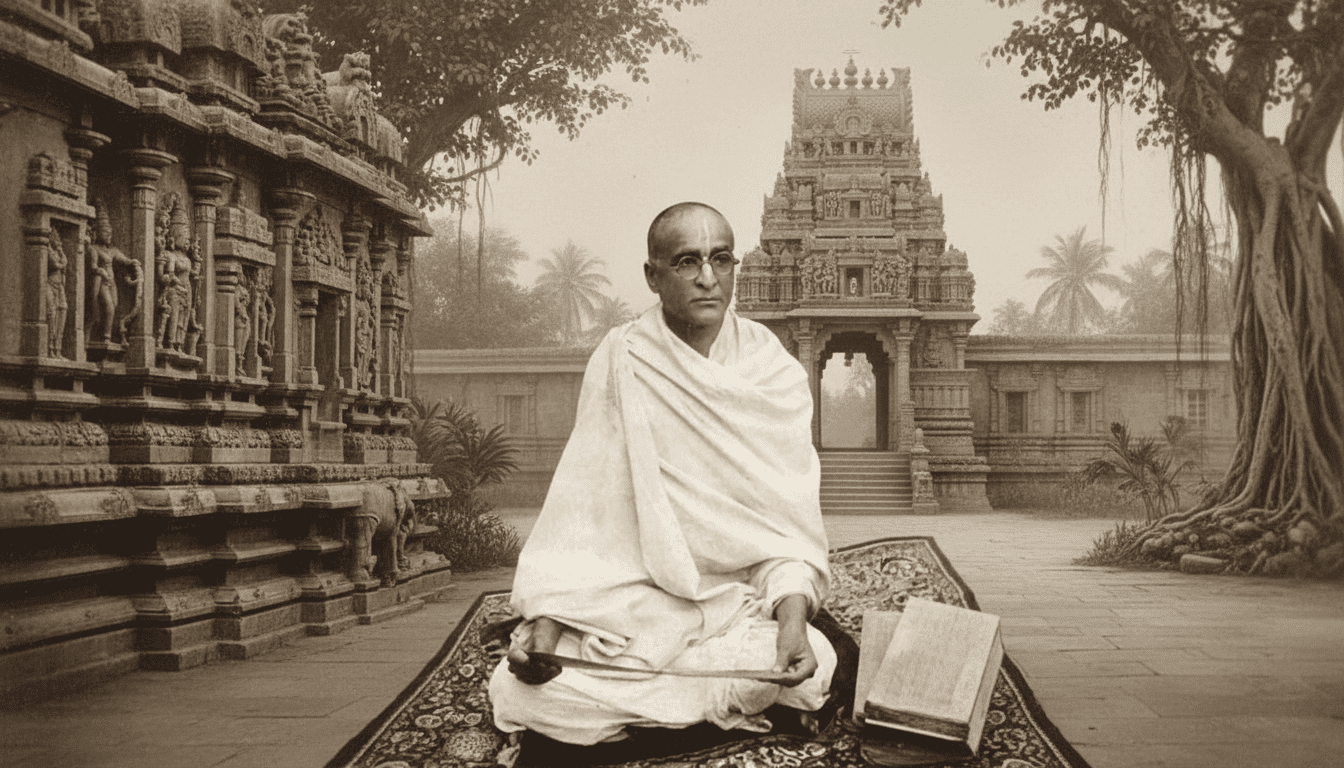
Few spiritual teachers shaped the modern expression of Gauḍīya Vaiṣṇavism as profoundly as Śrīla Bhaktisiddhānta Sarasvatī Ṭhākura Prabhupāda.
A brilliant scholar, disciplined practitioner, fearless preacher, prolific publisher, and institution builder, he inherited the devotional vision of his father, Śrīla Bhaktivinoda Ṭhākura, and transformed it into an organized spiritual mission capable of speaking to the modern world.
Bhaktisiddhānta Sarasvatī did not believe that modernization required watering down spiritual truth. Instead, he demonstrated that printing presses, newspapers, automobiles, public exhibitions, scholarly debate, international travel, and organized institutions could all be engaged in the service of Śrī Kṛṣṇa.
His mission helped restore intellectual credibility to the teachings of Śrī Caitanya Mahāprabhu, challenged social privilege based solely on birth, established dozens of Gauḍīya Maṭha centers, and inspired the movement that would eventually carry the chanting of the Hare Kṛṣṇa mahā-mantra around the world.
To understand the worldwide growth of Gauḍīya Vaiṣṇavism in the twentieth century, one must first understand the life and legacy of Bhaktisiddhānta Sarasvatī.
Who Was Bhaktisiddhānta Sarasvatī?
Bhaktisiddhānta Sarasvatī was born as Bimala Prasāda Datta on February 6, 1874, in Jagannātha Purī, Odisha. He was the son of Kedarnātha Datta, later celebrated as Śrīla Bhaktivinoda Ṭhākura, and Bhagavatī Devī. He departed from this world in Calcutta on January 1, 1937.
His followers commonly addressed him as Śrīla Prabhupāda, meaning one who has taken shelter at the lotus feet of the Lord and at whose feet other teachers may sit. He is also remembered as Ācārya-keśarī, the lionlike spiritual teacher, because of the extraordinary strength with which he defended Vaiṣṇava conclusions.
Bhaktisiddhānta Sarasvatī lived during a period of enormous change. India was under British colonial rule. Western education was transforming Bengal’s intellectual culture. Christian missionaries were challenging Hindu traditions, while reform movements were presenting new interpretations of Vedānta to educated Indians and Western audiences.
Within this atmosphere, Gauḍīya Vaiṣṇavism was frequently misunderstood. Some observers associated it with sentimentality, social backwardness, hereditary privilege, or groups that imitated the intimate pastimes of Rādhā and Kṛṣṇa without following the discipline of genuine devotional life.
Bhaktisiddhānta Sarasvatī responded by presenting Gauḍīya Vaiṣṇavism as a rigorous, philosophically coherent, ethically demanding, and universally accessible path of devotion.
Modern scholars now recognize him as an important religious thinker of colonial Bengal and the founder of an influential modern Vaiṣṇava institution. His movement addressed the social, intellectual, and religious challenges of late colonial India while remaining firmly committed to the personalistic theology of Śrī Caitanya Mahāprabhu.
Growing Up in the Mission of Bhaktivinoda Ṭhākura
Bhaktisiddhānta Sarasvatī’s spiritual formation began within the devotional environment created by his father.
Bhaktivinoda Ṭhākura was a government official, theologian, poet, author, and pioneering preacher who worked tirelessly to reestablish the teachings of Śrī Caitanya. He wrote in Bengali, Sanskrit, and English, published devotional journals, recovered important sacred places, and envisioned a future in which people throughout the world would chant the holy names of Kṛṣṇa.
Bimala Prasāda was therefore exposed from childhood to both traditional Vaiṣṇava learning and the emerging world of modern publishing.
When Bhaktivinoda published Sajjana-toṣaṇī, a Bengali journal devoted to Vaiṣṇava philosophy and practice, the young Bimala Prasāda assisted with proofreading. This early experience introduced him not only to theology but also to the practical work of editing, typesetting, printing, and distributing spiritual literature.
The lesson remained with him throughout his life: sacred teachings must be preserved, explained clearly, and carried beyond the walls of temples and āśramas.
Scholar of Astronomy, Sanskrit, and Philosophy
Bimala Prasāda received both Western-style and traditional Indian education. He studied Sanskrit, mathematics, philosophy, history, and jyotiṣa, the classical Indian discipline encompassing astronomy and calendrical calculation.
His mastery of astronomical calculation earned him the honorific title Siddhānta Sarasvatī. “Siddhānta” refers to established philosophical or scientific conclusions, while “Sarasvatī” invokes learning and eloquence.
His intellectual abilities were not an ornament separate from his spirituality. They became instruments of service.
He understood that educated audiences would not be reached through vague appeals to emotion. They needed careful reasoning, scriptural evidence, historical understanding, and coherent theology. Consequently, his later preaching drew upon Sanskrit texts, classical commentaries, logic, comparative philosophy, and detailed knowledge of Vaiṣṇava history.
Yet scholarship alone did not satisfy him.
The decisive transformation in his life came when intellectual knowledge was joined with surrender to a genuine spiritual master.
Meeting Gaura Kiśora Dāsa Bābājī
Under the guidance of Bhaktivinoda Ṭhākura, Bimala Prasāda approached Śrīla Gaura Kiśora Dāsa Bābājī Mahārāja, a deeply renounced Vaiṣṇava known for his absorption in the holy name.
Most scholarly accounts place Bhaktisiddhānta’s acceptance of Gaura Kiśora Dāsa Bābājī as his guru around 1900 or January 1901. He received the devotional name Śrī Vārṣabhānavī-devī-dayita Dāsa, identifying him as a servant of Śrī Kṛṣṇa, the beloved of Śrīmatī Rādhārāṇī, the daughter of King Vṛṣabhānu.
The relationship was striking. Bimala Prasāda was an accomplished scholar from an educated family. Gaura Kiśora Dāsa Bābājī lived as a materially destitute renunciant and possessed little interest in conventional academic recognition.
Through his guru, Bhaktisiddhānta Sarasvatī learned that spiritual truth is not conquered by intellectual power. It descends through humility, surrender, service, and attentive hearing.
He later explained that before meeting Gaura Kiśora Dāsa Bābājī, his understanding of religion had largely rested upon books and moral discipline. Contact with a realized practitioner revealed the living and practical dimension of devotion.
This encounter established a principle that would define his teaching:
Scholarship becomes spiritually fruitful when it leads to service rather than pride.
The Vow to Chant One Billion Holy Names
Bhaktisiddhānta Sarasvatī was not merely an institutional leader or public intellectual. His outward achievements rested upon extraordinary personal discipline.
Beginning around 1905, he undertook an intense vow to chant one billion names of Rādhā and Kṛṣṇa. Accounts describe him chanting approximately three hundred thousand holy names daily as part of this long spiritual observance, which continued for nearly ten years.
He performed much of this chanting in Māyāpur, the sacred birthplace of Śrī Caitanya Mahāprabhu.
This period is essential for understanding his later life. Before becoming widely known as a preacher, organizer, and founder of temples, he immersed himself deeply in nāma-bhajana—the worship of the Lord through attentive chanting of the holy name.
His later emphasis on publishing, organization, and public preaching was therefore not a substitute for inward spiritual practice. It grew from it.
For Bhaktisiddhānta Sarasvatī, chanting the holy name was not one devotional activity among many. It was the heart of the mission of Śrī Caitanya.
The Hare Kṛṣṇa mahā-mantra—
Hare Kṛṣṇa, Hare Kṛṣṇa,
Kṛṣṇa Kṛṣṇa, Hare Hare
Hare Rāma, Hare Rāma,
Rāma Rāma, Hare Hare
—was both the practitioner’s personal shelter and the spiritual medicine meant to be shared with the world.
Establishing Māyāpur as a Center of the Mission
Bhaktivinoda Ṭhākura had worked to identify and reestablish the birthplace of Śrī Caitanya Mahāprabhu at Śrī Māyāpur.
Bhaktisiddhānta Sarasvatī continued and expanded this work. Māyāpur became the spiritual center from which the teachings of Mahāprabhu would be studied, practiced, published, and distributed.
This development was more than a matter of preserving a sacred location. Bhaktisiddhānta understood Māyāpur as the fountainhead of a worldwide movement of nāma-saṅkīrtana.
A holy place, in his understanding, should not become merely a destination for tourism or inherited ritual. It should awaken remembrance, surrender, study, service, and the desire to share divine grace with others.
Māyāpur therefore served two complementary purposes:
It was a place of deep personal bhajana, and it was the headquarters of an active missionary movement.
Accepting Sannyāsa and Founding the Gauḍīya Maṭha
After the departure of Bhaktivinoda Ṭhākura in 1914 and Gaura Kiśora Dāsa Bābājī shortly thereafter, Bhaktisiddhānta Sarasvatī assumed increasing responsibility for the future of the Gauḍīya tradition.
In 1918, before an image of his departed guru, he formally accepted the renounced order of life. He then established Śrī Caitanya Maṭha in Māyāpur and developed the organized mission that became known as the Gauḍīya Maṭha.
His decision represented a significant institutional development. The renounced preacher was no longer expected merely to withdraw from society. Sannyāsa could be used for dynamic service—teaching, traveling, writing, training disciples, establishing temples, and awakening devotion in others.
The Gauḍīya Maṭha developed into a network of educational and missionary centers. Sources commonly credit Bhaktisiddhānta Sarasvatī with establishing sixty-four centers, including missions in India and locations such as Rangoon, London, and Berlin.
These centers provided structured environments for:
- Daily worship and kīrtana
- Scriptural study
- Training in devotional conduct
- Publication and distribution of literature
- Public lectures and debates
- Pilgrimages and festivals
- The preparation of traveling preachers
Although institutions can never replace personal realization, Bhaktisiddhānta recognized that institutions can preserve teachings, train practitioners, coordinate service, and carry a spiritual tradition beyond the lifespan of a single teacher.
Restoring the Intellectual Dignity of Gauḍīya Vaiṣṇavism
One of Bhaktisiddhānta Sarasvatī’s most important accomplishments was restoring Gauḍīya Vaiṣṇavism to the center of serious theological discussion.
He opposed the idea that the highest spiritual reality is ultimately impersonal. Following Śrī Caitanya Mahāprabhu, he taught that the Absolute Truth is fully personal and that Śrī Kṛṣṇa is the eternal, all-attractive Supreme Person.
The living being is neither absolutely identical with God nor completely separate from Him. The relationship is described through the doctrine of acintya-bhedābheda-tattva—inconceivable simultaneous oneness and difference.
The soul is one with Kṛṣṇa in spiritual quality because both are conscious. Yet the soul is eternally distinct in identity and remains a dependent servant of the unlimited Supreme.
This understanding makes loving devotion possible. Love requires unity, but it also requires relationship. The soul does not lose its individuality upon attaining perfection. Rather, its true individuality blossoms through loving service to Kṛṣṇa.
Bhaktisiddhānta presented this personalistic Vedānta as a serious alternative to the nondualistic interpretations of Hinduism that had become influential among many educated audiences in India and the West. His international mission sought to correct portrayals of Vaiṣṇava bhakti that he believed had been distorted by colonial scholars, sectarian critics, and insufficiently informed interpreters.
Challenging Spiritual Privilege Based on Birth
Bhaktisiddhānta Sarasvatī generated controversy by challenging claims that spiritual authority belonged exclusively to those born into particular families or castes.
He did not reject social organization or the scriptural concept of varṇāśrama. He rejected the assumption that biological birth alone proves spiritual realization.
In his understanding, a genuine Vaiṣṇava is recognized by devotion, character, realization, and service—not merely by ancestry.
In 1911, he participated in a major debate concerning the relationship between brāhmaṇas and Vaiṣṇavas. Questions included whether spiritually qualified Vaiṣṇavas born outside brāhmaṇa families could worship the śālagrāma-śilā and transmit sacred mantras. Bhaktisiddhānta argued from scripture that genuine Vaiṣṇava qualification transcends hereditary status.
He later awarded sacred threads to qualified disciples who had not been born into brāhmaṇa families. This directly challenged the power of hereditary religious elites and contributed to organized opposition against him. Scholars have identified his rejection of ritual status based solely on birth as one of the most socially disruptive aspects of his movement.
His position was not that everyone is automatically spiritually advanced. Rather, spiritual qualification must be cultivated through genuine initiation, disciplined practice, service, study, and transformation of character.
The door to bhakti is open to all, but entering deeply requires sincerity.
Opposing the Imitation of Elevated Spiritual Emotion
Bhaktisiddhānta Sarasvatī strongly opposed groups that attempted to imitate the intimate relationships of Rādhā and Kṛṣṇa while neglecting purification, discipline, and service.
Gauḍīya Vaiṣṇavism contains some of the world’s most exalted teachings about divine love. Yet Bhaktisiddhānta warned that these teachings can be misunderstood when approached through mundane psychology or sensual imagination.
Divine rasa is not material emotion intensified by religious language. It is revealed within a purified heart through the mercy of guru, Kṛṣṇa, and the Vaiṣṇavas.
Therefore, the practitioner should begin with foundational service:
- Hearing from authentic spiritual teachers
- Chanting the holy name attentively
- Studying scripture
- Serving the Vaiṣṇavas
- Regulating one’s conduct
- Rejecting exploitation and hypocrisy
- Cultivating humility and surrender
His approach is sometimes summarized as “service before imitation.”
One should not imagine oneself to be an advanced associate of Kṛṣṇa while remaining controlled by pride, selfish desire, anger, or the hunger for recognition.
Real advancement is not proclaimed. It is revealed through service.
The Guru as the Representative of Divine Service
Guru-tattva occupied a central place in Bhaktisiddhānta Sarasvatī’s teachings.
The genuine spiritual master does not compete with God. The guru represents the service of God.
A false teacher seeks followers for personal prestige. A genuine guru directs every soul toward Kṛṣṇa. The guru does not encourage the disciple’s illusion of independence but teaches the disciple how to hear, serve, chant, and surrender.
Bhaktisiddhānta frequently emphasized service to the transcendental sound descending through the disciplic succession. Spiritual understanding is not manufactured by the conditioned mind. It is received through submissive hearing and then realized through service.
This does not require blind sentimentality. Bhaktisiddhānta expected his disciples to think deeply, study carefully, and understand philosophical conclusions. But intellectual examination had to be joined with humility.
The purpose of knowledge is not to stand above truth as its judge. It is to become qualified to serve truth.
The Printing Press as the Bṛhat Mṛdaṅga
Among Bhaktisiddhānta Sarasvatī’s most enduring contributions was his revolutionary use of print media.
In 1913, he established a printing operation known as the Bhāgavata Yantra, or “God’s machine.” He used it to publish Vaiṣṇava scriptures, commentaries, essays, periodicals, and the writings of Bhaktivinoda Ṭhākura.
He compared the printing press to a bṛhat mṛdaṅga, a great or extended mṛdaṅga drum.
The traditional mṛdaṅga accompanies saṅkīrtana, and its sound can attract people within the surrounding streets. The printing press, however, can carry the message of the holy name across cities, nations, languages, and generations.
Under his leadership, the Gauḍīya Maṭha published material in Bengali, English, Hindi, Assamese, Odia, and Sanskrit. Publications associated with the mission included The Harmonist, Gauḍīya, Sajjana-toṣaṇī, Nadiyā Prakāśa, Kīrtana, Paramārthī, and Bhāgavata.
The Harmonist, published in English from 1927 through 1936 under his editorship, carried Gauḍīya theology into intellectual and international conversations. Its pages included philosophical essays, translations, editorials, responses to contemporary issues, and explanations of devotional practice.
Bhaktisiddhānta did not regard publishing as secondary publicity for temple activities. Publishing was itself sacred service.
A book could enter homes a traveling preacher might never visit. A journal could answer questions before a reader had met a devotee. A printed teaching could continue speaking long after the writer’s physical departure.
This vision would profoundly influence his disciple A.C. Bhaktivedanta Swami Prabhupāda, who later placed the writing, translation, publication, and distribution of spiritual literature at the heart of his worldwide mission.
Engaging Technology Without Becoming Materialistic
Bhaktisiddhānta Sarasvatī’s engagement with modern technology was grounded in the principle of yukta-vairāgya, appropriate renunciation.
True renunciation does not necessarily mean rejecting an object because it exists in the material world. It means rejecting the desire to enjoy that object independently of Kṛṣṇa.
A printing press can spread worldly propaganda or spiritual wisdom. A motorcar can transport someone toward personal indulgence or carry a preacher to a distant village. A building can display wealth or provide a place for hearing, chanting, worship, and service.
The spiritual value of the object depends upon its relationship to service.
Bhaktisiddhānta used printing presses, automobiles, photography, organized exhibitions, formal institutions, and Western-style clothing when these helped him communicate with particular audiences. His methods appeared radical to some traditionalists, but he distinguished eternal spiritual principles from changeable social conventions.
The message could not be altered. The means of responsibly communicating it could.
This remains one of his most relevant teachings for modern spiritual communities.
Websites, livestreams, podcasts, videos, online courses, digital libraries, and social media can become extensions of the bṛhat mṛdaṅga—provided they remain instruments of service rather than platforms for vanity, rivalry, or commercial exploitation.
Carrying Gauḍīya Vaiṣṇavism Beyond India
Bhaktivinoda Ṭhākura had envisioned the teachings of Śrī Caitanya spreading throughout the world. Bhaktisiddhānta Sarasvatī began transforming that vision into an organized international mission.
During the 1930s, he sent disciples to Europe, where they established activities in London and Berlin. Scholars describe this as the earliest organized attempt by a Vaiṣṇava institution to establish itself in Europe.
The mission engaged scholars, political figures, intellectuals, and members of European society. Its immediate numerical success was limited, but its historical significance was immense.
Bhaktisiddhānta had demonstrated that Gauḍīya Vaiṣṇavism did not belong exclusively to Bengal, India, or people born into Hindu families.
Kṛṣṇa is not the property of one nation.
The holy name does not require a particular ethnicity.
The soul is neither Indian nor European, neither Eastern nor Western. Every living being is an eternal servant of Kṛṣṇa.
His European initiative planted seeds that would mature dramatically through the work of one of his disciples.
Bhaktisiddhānta Sarasvatī and A.C. Bhaktivedanta Swami Prabhupāda
In 1922, Bhaktisiddhānta Sarasvatī met a young educated householder named Abhay Charan De in Calcutta.
During their first meeting, Bhaktisiddhānta urged him to present the teachings of Śrī Caitanya in the English language. Abhay later received formal initiation from him in 1933 and became known as Abhay Caraṇāravinda Dāsa.
That instruction shaped the rest of Abhay’s life.
He began writing in English, assisted the Gauḍīya Maṭha, launched Back to Godhead magazine in 1944, translated and commented upon sacred texts, and eventually journeyed to the United States in 1965.
In New York City in 1966, he established the International Society for Krishna Consciousness. Over the following years, he became internationally known as His Divine Grace A.C. Bhaktivedanta Swami Prabhupāda.
Through Śrīla Prabhupāda’s work, the mission of Bhaktivinoda Ṭhākura and Bhaktisiddhānta Sarasvatī expanded across the world.
The Hare Kṛṣṇa mahā-mantra was sung in cities throughout North America, Europe, Africa, Asia, Australia, and beyond. Temples, āśramas, farms, restaurants, publishing houses, schools, and devotional communities appeared in numerous countries.
Śrīla Prabhupāda consistently identified himself as a servant carrying out the order of his spiritual master. He credited Bhaktisiddhānta Sarasvatī with inspiring his books and his mission to bring Kṛṣṇa consciousness to English-speaking audiences.
Thus, millions of people who have encountered kīrtana, japa meditation, Bhagavad-gītā study, Kṛṣṇa prasāda, or the teachings of Śrī Caitanya have been touched—directly or indirectly—by the legacy of Bhaktisiddhānta Sarasvatī.
The Crisis Following His Departure
Bhaktisiddhānta Sarasvatī departed from this world on January 1, 1937.
After his passing, disagreements concerning leadership, authority, property, and institutional succession emerged within the Gauḍīya Maṭha. The dispute eventually entered the colonial court system, and the original institution fragmented into multiple missions.
This history should not be ignored.
It demonstrates that even a spiritually powerful movement can face serious difficulties when personal ambition, institutional attachment, and unclear succession arrangements enter devotional life.
Yet the fragmentation did not erase Bhaktisiddhānta’s influence.
Many of his disciples continued teaching independently and established their own maṭhas and missions. Although these organizations developed different cultures and emphases, they continued carrying forms of the theological, missionary, monastic, and publishing vision he had established.
His lineage eventually produced numerous Gauḍīya institutions, including the worldwide movement founded by A.C. Bhaktivedanta Swami Prabhupāda.
The organizational tree divided, but the devotional current continued flowing.
The Essential Principles of His Legacy
Bhaktisiddhānta Sarasvatī’s legacy cannot be reduced to the number of temples he opened or books he published. Its deepest significance lies in several enduring principles.
Bhakti Is Both Universal and Demanding
Devotional service is available to everyone, regardless of nationality, race, social position, gender, education, or family background.
Yet universality does not mean superficiality. Genuine bhakti requires sincerity, discipline, purification, and surrender.
The Holy Name Is the Foundation
Public preaching must arise from personal spiritual practice.
Without attentive chanting, theological discussion can become intellectual pride. Without hearing and service, institutions can become empty structures.
Spiritual Qualification Is Not Inherited
Birth may provide social opportunity, but it does not automatically produce devotion.
A genuine Vaiṣṇava is known through surrender, conduct, realization, compassion, and service.
Philosophy Protects Devotion
Sentiment without proper understanding can easily become imitation, exploitation, or confusion.
Siddhānta—clear spiritual conclusion—protects the practitioner and allows devotion to grow upon a stable foundation.
Modern Tools Can Serve Eternal Truth
Technology is not inherently spiritual or materialistic. Its character depends upon its use.
Every available medium can become an instrument for sharing hari-kathā when used responsibly and without selfish motive.
The Guru Teaches Service, Not Self-Worship
A genuine spiritual master does not seek to replace Kṛṣṇa. The guru reveals how every thought, word, possession, and ability can be offered to Kṛṣṇa.
Preaching Is an Expression of Compassion
Spiritual life is not intended only for one’s private liberation.
A devotee naturally wishes to share the holy name, prasāda, sacred knowledge, and opportunities for service with others.
What Bhaktisiddhānta Sarasvatī Teaches Modern Practitioners
The modern world offers unprecedented access to spiritual information. Thousands of lectures, books, translations, teachers, communities, and sacred texts can be reached within seconds.
Yet access does not guarantee transformation.
Bhaktisiddhānta Sarasvatī’s example teaches us to move from information to surrender.
We can honor his legacy by:
- Chanting the holy name consistently and attentively
- Studying Bhagavad-gītā, Śrīmad-Bhāgavatam, and Caitanya-caritāmṛta
- Hearing from trustworthy teachers within an authentic lineage
- Serving devotees without seeking recognition
- Avoiding the imitation of advanced spiritual realization
- Rejecting prejudice based on birth or social background
- Using our education, profession, technology, and resources in Kṛṣṇa’s service
- Supporting the publication and distribution of spiritual literature
- Creating welcoming communities centered on nāma-saṅkīrtana
- Sharing bhakti with courage, humility, and compassion
His life reminds us that tradition does not mean spiritual inactivity.
To preserve a living tradition is to embody it, explain it, defend it when necessary, and carry it to those who have not yet encountered its mercy.
Why His Legacy Still Matters
Bhaktisiddhānta Sarasvatī stood at the meeting point of ancient revelation and modern communication.
He refused two opposite errors.
The first was to abandon the depth of the tradition in order to appear modern.
The second was to reject every modern tool in the name of preserving tradition.
Instead, he showed how eternal spiritual principles could move confidently through a changing world.
He was traditional without being stagnant.
He was innovative without being spiritually compromised.
He was scholarly without making scholarship an idol.
He was renounced without becoming indifferent to the suffering of conditioned souls.
He honored solitary chanting while building a public mission.
He defended the highest teachings of divine love while warning against premature imitation.
He established temples, yet understood that the true temple must be constructed within the purified heart.
Frequently Asked Questions
When was Bhaktisiddhānta Sarasvatī born?
He was born as Bimala Prasāda Datta on February 6, 1874, in Jagannātha Purī, Odisha.
Who was his father?
His father was Śrīla Bhaktivinoda Ṭhākura, the influential Gauḍīya Vaiṣṇava theologian, author, publisher, and teacher who helped revive the teachings of Śrī Caitanya in the modern period.
Who was his spiritual master?
His initiating spiritual master was Śrīla Gaura Kiśora Dāsa Bābājī Mahārāja, a deeply renounced Vaiṣṇava absorbed in chanting the holy name.
Why was he called Siddhānta Sarasvatī?
The title recognized his exceptional mastery of Sanskrit learning, mathematics, astronomy, philosophical conclusions, and traditional calendrical sciences.
What was the Gauḍīya Maṭha?
The Gauḍīya Maṭha was the organized missionary and educational institution developed by Bhaktisiddhānta Sarasvatī to teach Gauḍīya Vaiṣṇavism, train practitioners, publish sacred literature, establish temples, and spread nāma-saṅkīrtana.
How many centers did he establish?
He is commonly credited with establishing sixty-four Gauḍīya Maṭha centers in India and abroad.
What did he mean by the bṛhat mṛdaṅga?
The bṛhat mṛdaṅga, or “great drum,” was his description of the printing press. A physical drum can be heard locally, but books and magazines can carry the message of Kṛṣṇa across the world and into future generations.
How was he connected to A.C. Bhaktivedanta Swami Prabhupāda?
Bhaktisiddhānta Sarasvatī was Śrīla Prabhupāda’s spiritual master. He instructed him to teach the message of Śrī Caitanya in English, an instruction that eventually inspired Śrīla Prabhupāda’s worldwide mission.
Why is Bhaktisiddhānta Sarasvatī important today?
His life offers a model for combining deep personal practice, philosophical clarity, social inclusivity, organized service, technological innovation, and compassionate outreach without compromising the essential teachings of bhakti.
Conclusion: A Life Offered to the Mission of Mahāprabhu
The legacy of Śrīla Bhaktisiddhānta Sarasvatī Ṭhākura is visible wherever the teachings of Śrī Caitanya are studied seriously, wherever the holy name is chanted without concern for birth or nationality, and wherever modern resources are offered in the service of eternal truth.
He received the vision of Bhaktivinoda Ṭhākura, strengthened it through intense sādhana, organized it through the Gauḍīya Maṭha, broadcast it through the bṛhat mṛdaṅga, and entrusted it to disciples who carried it beyond India.
His life teaches that authentic spiritual tradition is neither a museum artifact nor a private possession.
It is a living current of grace.
That current flows through guru, śāstra, sādhus, and the holy name. It enters the heart through hearing and becomes visible through service.
Bhaktisiddhānta Sarasvatī dedicated his intelligence, speech, austerity, leadership, technology, and entire life to that service. His greatest legacy is therefore not simply what he built.
It is the standard he established:
Chant deeply. Study carefully. Serve humbly. Preach courageously. Use everything for Kṛṣṇa.
FAQs
Who was Bhaktisiddhānta Sarasvatī?
Bhaktisiddhānta Sarasvatī (1874–1937) was a prominent spiritual leader and the founder of the Gaudiya Math, a spiritual institution in India. He was a prominent figure in the Gaudiya Vaishnavism tradition and played a significant role in the revival of the teachings of Chaitanya Mahaprabhu.
What were Bhaktisiddhānta Sarasvatī’s teachings?
Bhaktisiddhānta Sarasvatī emphasized the importance of spreading the teachings of Chaitanya Mahaprabhu and the practice of Krishna consciousness. He also stressed the need for a disciplined and organized approach to spiritual practice, and he encouraged his followers to engage in preaching and spreading the message of Gaudiya Vaishnavism.
What was Bhaktisiddhānta Sarasvatī’s impact on Gaudiya Vaishnavism?
Bhaktisiddhānta Sarasvatī’s teachings and leadership had a significant impact on the Gaudiya Vaishnavism tradition. He played a key role in establishing the Gaudiya Math and in spreading the teachings of Chaitanya Mahaprabhu both in India and internationally. His disciples and followers continue to carry on his legacy and teachings.
What is the significance of Bhaktisiddhānta Sarasvatī’s contributions?
Bhaktisiddhānta Sarasvatī’s contributions are significant in the revival and propagation of Gaudiya Vaishnavism. His emphasis on the importance of spreading the teachings of Chaitanya Mahaprabhu and the practice of Krishna consciousness has had a lasting impact on the tradition.
How is Bhaktisiddhānta Sarasvatī remembered today?
Bhaktisiddhānta Sarasvatī is remembered today through the continued practice and propagation of his teachings by his disciples and followers. His legacy is also honored through various festivals, events, and institutions dedicated to the promotion of Gaudiya Vaishnavism.

