
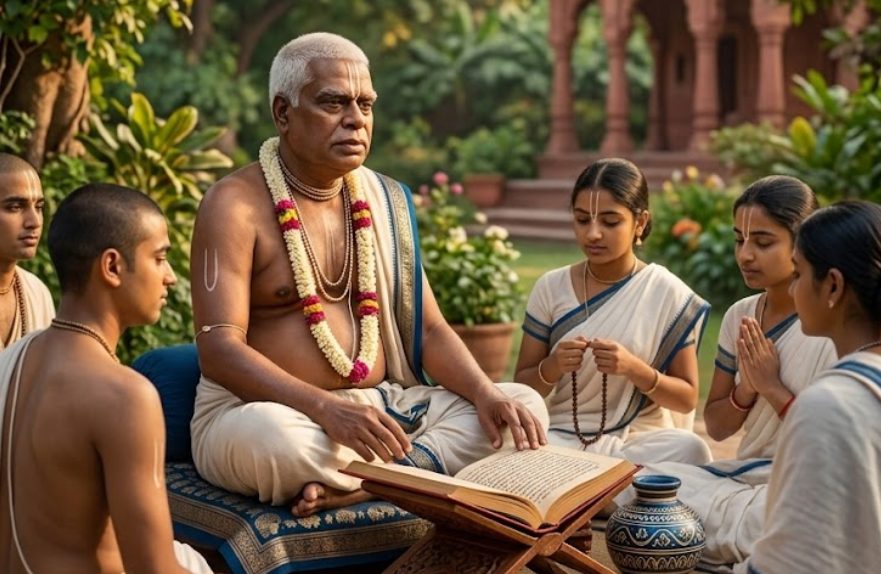
Few figures have shaped the modern understanding and global transmission of Gauḍīya Vaiṣṇavism as profoundly as Śrīla Bhaktivinoda Ṭhākura. A householder, government official, theologian, poet, editor, social critic, pilgrimage researcher, and pioneering spiritual organizer, he helped carry the devotional teachings of Śrī Caitanya Mahāprabhu from the inherited religious world of nineteenth-century Bengal into the intellectual, technological, and global conditions of the modern age.
Born Kedarnath Datta in 1838, Bhaktivinoda lived during a period of extraordinary change. British colonial rule was transforming Bengal’s educational institutions, legal systems, print culture, economy, and religious life. Western philosophy and Christian missionary criticism challenged inherited Hindu traditions, while reform movements such as the Brahmo Samaj questioned image worship, scriptural authority, caste, and popular devotional practices. At the same time, Gauḍīya Vaiṣṇavism was represented by many different hereditary lineages, village communities, ascetic groups, temple traditions, and popular devotional movements—some respected, others publicly associated with practices that educated Bengali society regarded as corrupt or superstitious.
Bhaktivinoda did not respond by simply rejecting modernity or abandoning tradition. He undertook the more difficult task of recovering the theological depth of Caitanya Vaiṣṇavism, distinguishing its essential teachings from what he considered later distortions, and presenting bhakti in a form capable of addressing modern historical, philosophical, ethical, and social questions. Scholars consequently regard him as a central architect of the nineteenth-century Gauḍīya revival, although his thought developed over time and cannot be reduced to a simple opposition between “tradition” and “modernity.”
His legacy lives through his books, songs, theological categories, vision of congregational outreach, promotion of Śrī Māyāpura, and the spiritual movements that arose through his descendants and disciples. Yet his importance is not limited to institutional history. Bhaktivinoda’s writings continue to address the inner life of the practitioner: how to chant attentively, how to surrender without becoming passive, how to distinguish genuine devotion from imitation, how to live as a householder without abandoning spiritual aspiration, and how to discover the eternal identity of the soul within ordinary human life.
Why Bhaktivinoda Ṭhākura Matters
Bhaktivinoda Ṭhākura stands at a decisive point between the inherited Gauḍīya Vaiṣṇava world and its modern international expression.
He was not the founder of Gauḍīya Vaiṣṇavism. Its theological and devotional foundations had been established centuries earlier through Śrī Caitanya Mahāprabhu, Nityānanda Prabhu, Advaita Ācārya, the Six Gosvāmīs of Vṛndāvana, Kṛṣṇadāsa Kavirāja Gosvāmī, Narottama Dāsa Ṭhākura, Viśvanātha Cakravartī Ṭhākura, Baladeva Vidyābhūṣaṇa, and many other teachers.
Bhaktivinoda’s distinctive contribution was recovery, interpretation, organization, and transmission.
He recovered neglected texts and sacred geography. He interpreted Gauḍīya theology in conversation with the intellectual problems of his time. He organized devotional outreach through print, local congregations, traveling teachers, and household networks. He transmitted Caitanya Mahāprabhu’s teachings beyond Bengal through English-language writing and international correspondence.
His life made possible a chain of influence that would extend through his son Bhaktisiddhānta Sarasvatī Ṭhākura, the Gauḍīya Maṭha, A.C. Bhaktivedanta Swami Prabhupāda, and the worldwide Hare Krishna movement. Other branches of Bhaktivinoda’s family and disciplic influence also continued through Lalita Prasāda Ṭhākura and additional Gauḍīya teachers. His legacy therefore belongs to a broader devotional family rather than to only one modern institution.
Childhood in a Changing Bengal
Kedarnath Datta was born on September 2, 1838, in Ula—later known as Birnagar—in Bengal’s Nadia district. He was born into a socially prominent Bengali family at a time when the region was becoming one of the principal centers of colonial education and intellectual debate. He later studied in Calcutta and encountered Western literature, logic, history, philosophy, and Christian and Unitarian thought.
This education would permanently shape his method. Unlike a teacher formed exclusively within a traditional Sanskrit scholastic environment, Kedarnath understood the questions raised by modern education from the inside. He knew why educated people doubted Purāṇic cosmology, questioned inherited customs, and resisted forms of religion that appeared irrational or socially harmful.
His later writings reveal neither an uncritical acceptance of Western thought nor a fearful refusal to engage with it. He examined different systems, adopted useful analytical categories, challenged reductionist conclusions, and attempted to demonstrate that the mature theology of bhakti could withstand serious intellectual scrutiny.
This willingness to enter dialogue without surrendering devotional conviction became one of the defining qualities of his work.
Loss, Responsibility, and Spiritual Searching
Bhaktivinoda’s early life was not a sheltered progression toward religious authority. His autobiographical reflections describe financial uncertainty, illness, family responsibilities, intellectual doubt, emotional struggle, and a long search for spiritual clarity. His path developed gradually through study and experience rather than through a single uncomplicated conversion.
He became a teacher and later entered government service. Over approximately twenty-eight years, he served in a variety of judicial and administrative postings in Bengal, Bihar, and Orissa, eventually holding responsibilities as a deputy magistrate and deputy collector. His career placed him directly within the colonial administrative system, where he dealt with disputes, criminal cases, public order, revenue matters, and local social conditions.
This public career is important for understanding his devotional identity. Bhaktivinoda was not primarily a secluded renunciant. He knew the pressures of employment, household finances, marriage, children, illness, public criticism, and administrative responsibility. His theology of bhakti emerged from a life in which spiritual aspiration had to be maintained amid demanding worldly obligations.
For modern practitioners—especially householders—this makes his example unusually relevant. He demonstrated that a serious devotional vocation can develop within responsibility rather than only outside it.
The Discovery That Redirected His Life
Although Kedarnath explored many religious and philosophical traditions, he struggled for years to obtain reliable copies of the principal biographies and scriptures of the Caitanya tradition. In 1868, while serving in Dinajpur, he acquired the Caitanya-caritāmṛta and a copy of the Śrīmad-Bhāgavatam. His study of these works profoundly redirected his life.
The Caitanya-caritāmṛta presented Śrī Caitanya not merely as an emotional religious figure but as the embodiment and teacher of a sophisticated theology of divine love. The Bhāgavatam offered a vision of ultimate reality in which the Absolute is fully personal, relational, beautiful, and accessible through devotion.
For Kedarnath, these texts helped resolve the tension between reason and revelation, moral seriousness and ecstatic devotion, universal religion and particular spiritual practice. He increasingly came to see the Gauḍīya Vaiṣṇava tradition as capable of answering the philosophical questions that had occupied him since youth.
His embrace of Caitanya Vaiṣṇavism did not end his intellectual inquiry. It gave that inquiry a devotional center.
The Bhāgavata: An Early Statement of His Vision
In 1869, Bhaktivinoda delivered an English-language address later published as The Bhāgavata: Its Philosophy, Its Ethics and Its Theology. This work is significant because it shows him presenting the Śrīmad-Bhāgavatam to an educated modern audience before he had assumed the mature devotional identity for which he later became known.
He argued that sacred texts should not be dismissed merely because some passages appear strange to readers formed by different historical assumptions. He encouraged readers to seek the essential spiritual intention of revelation rather than becoming trapped in either blind literalism or superficial rejection.
This approach is often associated with the term sāra-grāhī, meaning one who seeks or accepts the essence.
For Bhaktivinoda, the essence-seeking reader was neither gullible nor hostile. Such a reader approached scripture with sympathy, reason, humility, and a willingness to discover its transformative purpose.
This principle became central to his legacy. He wanted devotion to be intellectually responsible without reducing revelation to whatever happened to be acceptable to nineteenth-century rationalism.
Kṛṣṇa in the Light of History
One of Bhaktivinoda’s most discussed works is Kṛṣṇa-saṁhitā, published in 1879. In it, he attempted to present Kṛṣṇa’s identity and activities in a manner that could engage readers shaped by historical criticism and modern theories of religious development.
The work has sometimes been described as a modernist reinterpretation of Kṛṣṇa’s līlā. More recent scholarship offers a more complex reading. Bhaktivinoda did use developmental and historical categories, but he did not simply replace sacred history with secular reconstruction. He sought to protect the theological reality of Kṛṣṇa while explaining how scriptural narratives might be approached by readers at different levels of faith, understanding, and spiritual qualification. His later writings also revised or qualified elements of his earlier presentation.
This willingness to revisit his own formulations is part of what makes him an important theologian. His thought was not static. It matured as his scriptural study, devotional commitments, and relationships within the Vaiṣṇava community deepened.
Initiation and the Authority of Tradition
Around 1880, Kedarnath received Vaiṣṇava initiation from Bipin Bihari Goswami, a respected hereditary teacher connected with the lineage of Jāhnavā Devī, the consort of Nityānanda Prabhu. He maintained an association with Bipin Bihari for many years, although later Gauḍīya lineages have differed in how they interpret the importance and eventual tensions within that relationship.
He also received important spiritual inspiration from Jagannātha Dāsa Bābājī, an elderly and highly revered Vaiṣṇava ascetic. Traditions descending through Bhaktisiddhānta Sarasvatī particularly emphasize Jagannātha Dāsa Bābājī’s role as an instructing spiritual authority in Bhaktivinoda’s life.
These relationships illuminate a major development in his thought. His early writings often emphasized universal religion and independent discernment. His mature works gave greater importance to revelation, guru, disciplined practice, and the interpretive authority of the Vaiṣṇava community.
This did not erase his universal concerns. It placed them within a more clearly defined devotional structure.
The Emergence of “Bhaktivinoda”
In 1886, Vaiṣṇavas reportedly honored Kedarnath Datta with the title Bhaktivinoda, commonly understood as “one who finds joy in devotion” or “the delight of bhakti.” By then, he had become widely recognized as a defender, interpreter, and teacher of Caitanya Vaiṣṇavism.
The title “Ṭhākura,” later attached to his name in devotional usage, indicates reverence rather than a government or academic office. His followers remember him as Saccidānanda Bhaktivinoda Ṭhākura, and some Gauḍīya traditions honor him as the seventh Gosvāmī because of his perceived role in recovering and systematically presenting the teachings of the Vṛndāvana Gosvāmīs.
Such titles belong to devotional memory. Historically, his authority developed through an unusual combination of theological writing, personal practice, public service, publishing, organizational leadership, and the recognition of other Vaiṣṇavas.
A Magistrate with a Spiritual Conscience
Bhaktivinoda’s government service occasionally placed him in direct conflict with religious figures he considered exploitative or fraudulent. One well-known episode occurred during his service in Orissa, when he acted against a self-proclaimed divine incarnation named Biṣakiṣen who had gathered followers and challenged public order.
He also wrote critically about corruption, negligence, ritualism, and social abuses associated with certain religious establishments in Puri. His concern was not to attack sacred tradition itself but to distinguish living devotion from institutional hypocrisy.
This distinction runs throughout his work. He opposed both the dismissal of all traditional religion and the acceptance of every practice performed in religion’s name.
For Bhaktivinoda, a devotional institution had to be evaluated by its truthfulness, scriptural integrity, moral discipline, service, and capacity to awaken genuine love of God.
The Printing Press as an Instrument of Bhakti
Bhaktivinoda understood that the future of Gauḍīya Vaiṣṇavism would depend partly upon the printed word.
The nineteenth century brought an expanding Bengali reading public, improved printing technology, new educational networks, and increasing circulation of newspapers, journals, pamphlets, and books. Bhaktivinoda used these developments as instruments of devotional renewal.
He wrote or edited more than one hundred works in Bengali, Sanskrit, and English. These included philosophical treatises, scriptural commentaries, novels, essays, biographies, poems, song collections, ritual manuals, travel narratives, social criticism, and works of practical spiritual instruction.
In 1881, he founded the Bengali Vaiṣṇava journal Sajjana-toṣaṇī, meaning “that which brings satisfaction to saintly persons.” It became a major vehicle for theology, news, textual publication, community formation, debate, and the promotion of devotional projects. He continued guiding the journal for much of the period between 1881 and 1909.
Through print, Bhaktivinoda could reach readers far beyond a single temple, village, lineage, or lecture hall. He created what might be called a distributed devotional community—people connected through shared texts, practices, songs, questions, and ideals.
Editor, Translator, and Textual Preserver
Bhaktivinoda was not only an original writer. He also worked to recover, edit, annotate, and circulate earlier Gauḍīya texts.
His editorial method could be careful and comparative. In preparing a 1901 edition associated with the Padma Purāṇa, for example, he reportedly compared multiple manuscripts and preserved awareness of variant passages rather than concealing textual differences.
This matters because religious revival requires more than enthusiasm. It requires access to sources.
Bhaktivinoda helped move important devotional literature from fragile manuscripts and restricted circles into reproducible editions that could be studied by householders, urban readers, teachers, and later international communities.
His work helped create the textual infrastructure upon which twentieth-century Gauḍīya missions would build.
Caitanya-śikṣāmṛta: Bhakti for the Modern World
Published in 1886, Caitanya-śikṣāmṛta—“The Nectarine Teachings of Caitanya”—is one of Bhaktivinoda’s broadest theological and social works.
It discusses the soul, God, the material world, human development, religious psychology, social duties, spiritual qualification, devotional practice, and the progressive realization of divine love. It also engages philosophical and religious ideas circulating in modern Bengal.
A major concern of the work is the distinction between temporary social identity and the eternal nature of the soul. Human beings have bodily, familial, occupational, national, and cultural responsibilities, but these do not constitute the deepest identity of the living being.
The eternal nature of the soul is loving service to the Supreme.
Bhaktivinoda did not necessarily advise everyone to abandon ordinary social life. He taught that ordinary life should be reordered so that it supports spiritual realization rather than conceals it.
Jaiva-dharma: The Religion of the Soul
Among Bhaktivinoda’s most influential books is Jaiva-dharma, a theological novel serialized beginning in the 1890s.
Rather than presenting philosophy only through abstract propositions, Bhaktivinoda used conversations among teachers, renunciants, householders, and spiritual seekers. Through their questions, the book explains the nature of the soul, the stages of devotion, Vaiṣṇava conduct, initiation, the holy name, spiritual emotion, and the advanced theology of divine relationship.
The central term, jaiva-dharma, means the inherent or eternal function of the living being.
A material object possesses a characteristic nature: fire gives heat, water flows, and sugar is sweet. Similarly, Bhaktivinoda teaches that the soul’s essential nature is loving service. This nature may become obscured by ego and material conditioning, but it is not manufactured by religion. It is awakened through bhakti.
This is one of Bhaktivinoda’s most important contributions to modern devotional language. Religion is not presented merely as affiliation, belief, ritual membership, or inherited identity. It is the recovery of the soul’s eternal relational nature.
The Daśa-mūla: Ten Foundational Truths
Bhaktivinoda systematized Gauḍīya theology through what became known as the Daśa-mūla, or ten root principles.
These teachings summarize the authority of revelation, Kṛṣṇa’s supreme identity, His infinite energies, the spiritual nature of the individual soul, the soul’s conditioned and liberated states, the simultaneous unity and difference between God and creation, pure devotion as the means of spiritual realization, love of Kṛṣṇa as the final goal, and the relationship between spiritual practice and divine grace.
The Daśa-mūla expresses the Gauḍīya doctrine of acintya-bhedābheda-tattva—inconceivable simultaneous difference and non-difference.
The soul is one with God in spiritual quality but never equal to God in totality. The world depends upon the Divine and exists through divine energy, yet the Divine is not limited to the world. Love becomes possible because unity and distinction coexist.
Without connection, relationship would be impossible. Without distinction, lover and beloved would disappear into undifferentiated identity.
Bhaktivinoda presented this doctrine not merely as metaphysical speculation but as the foundation of devotional relationship.
The Holy Name at the Center
For Bhaktivinoda Ṭhākura, the congregational and personal chanting of the divine names was not one practice among many. It was the central spiritual method taught by Śrī Caitanya for the present age.
His mature teaching on chanting appears especially in Hari-nāma Cintāmaṇi, published around 1900. The text examines the nature of the holy name, the stages of chanting, the ten offenses, inattentiveness, the dawning reflection of the name known as nāmābhāsa, and the awakening of pure devotional love.
Bhaktivinoda teaches that the name of Kṛṣṇa is not merely a symbolic label. In pure spiritual realization, the divine name and the Divine Person are understood to be non-different.
Yet simply moving the lips is not the same as pure chanting. The practitioner must gradually confront distraction, pride, criticism, selfish desire, exploitation, and the tendency to treat chanting as a mechanical obligation.
His practical emphasis remains strikingly relevant: chant clearly, listen attentively, seek humility, avoid harming others, and pray for service rather than spiritual prestige.
The Problem of Inattention
Bhaktivinoda identified inattention as a major obstacle in chanting. The mouth may repeat the mantra while the mind remains occupied with plans, memories, fears, resentments, or ambitions.
His remedy was not despair.
Attention grows through disciplined hearing, regular practice, prayer, suitable association, simplicity of life, and conscious resistance to distractions. The practitioner repeatedly returns to the sacred sound.
This teaching protects chanting from two opposite errors.
The first is perfectionism: “Because my mind wanders, my chanting is worthless.”
The second is complacency: “Because chanting is inherently powerful, my attention and conduct do not matter.”
Bhaktivinoda rejects both. The holy name is merciful, and the practitioner must respond to that mercy with sincerity.
Bhajana-rahasya: The Inner Structure of Devotional Practice
Bhajana-rahasya, published in 1902, presents a more contemplative map of devotional life. Its eight divisions correspond to periods of the day and are connected with the eight verses of Śrī Caitanya’s Śikṣāṣṭaka. The text gathers scriptural verses and meditations related to progressive stages of bhajana.
The work shows that Bhaktivinoda’s mission was not limited to public preaching, social reform, or elementary instruction. He was also deeply concerned with the inner cultivation of remembrance, humility, longing, service identity, and love for Rādhā and Kṛṣṇa.
At the same time, his broader teaching placed advanced contemplation within a framework of purification, ethical conduct, guru-guided practice, and attentive chanting. Higher devotional states were not to be cheaply imitated.
Surrender as a Living Practice
Bhaktivinoda’s 1893 song collection Śaraṇāgati presents surrender not as passive resignation but as the emotional and practical foundation of bhakti.
Its songs explore the six traditional limbs of surrender:
accepting what supports devotion, rejecting what obstructs it, trusting in divine protection, accepting the Lord as one’s maintainer, cultivating humility, and offering oneself completely.
In Bhaktivinoda’s songs, surrender is intensely personal. The practitioner confesses weakness, distraction, pride, and helplessness while continuing to approach the Divine with hope.
This combination is essential. Bhaktivinoda’s humility is not despair. The soul recognizes its limitations precisely because it has discovered a greater shelter.
For modern readers, Śaraṇāgati offers a devotional language for experiences often hidden behind religious appearances: inconsistency, longing, shame, dependence, gratitude, and the repeated desire to begin again.
Songs as Theology of the Heart
Bhaktivinoda wrote hundreds of devotional songs and poems, many of which remain part of daily worship, kīrtan, festival observance, and personal prayer in Gauḍīya communities around the world.
His songbooks include Kalyāṇa-kalpataru, Śaraṇāgati, and Gītāvalī. Kalyāṇa-kalpataru, published in 1881, organizes songs around the soul’s spiritual needs and aspirations. Śaraṇāgati explores surrender. Gītāvalī, published in 1893, includes songs for ārati, prasādam, congregational chanting, Gaura-līlā, and devotion to Rādhā and Kṛṣṇa.
These songs are not decorative additions to his philosophy. They are philosophy transformed into prayer.
A theological proposition may explain that the soul belongs to Kṛṣṇa. A song allows the practitioner to feel the fear, resistance, hope, and relief involved in actually offering oneself.
Bhaktivinoda’s poetry therefore joins doctrine with emotion, congregational life with private repentance, and intellectual clarity with longing.
“Jaya Rādhā-Mādhava” and Global Devotional Memory
Among the songs associated with Bhaktivinoda, “Jaya Rādhā-Mādhava” has become especially beloved. Its concise verses evoke Kṛṣṇa as the beloved of Rādhā, the delight of Vraja, the lifter of Govardhana, the protector of the residents of Vṛndāvana, and the enchanter who wanders along the Yamunā.
The song later became deeply connected with A.C. Bhaktivedanta Swami Prabhupāda, who frequently sang it before speaking on the Śrīmad-Bhāgavatam. Through that practice, a Bengali devotional composition became part of the daily spiritual soundscape of temples and communities across the world.
This illustrates the unusual reach of Bhaktivinoda’s legacy. His theology is encountered not only through study but through melodies sung before sunrise in languages and nations he never physically visited.
Genuine Bhakti and Its Imitations
Bhaktivinoda lived in a religious environment containing many groups that claimed some relationship with Caitanya, Rādhā-Kṛṣṇa devotion, tantric practice, spontaneous love, or esoteric realization.
He strongly criticized what he understood to be exploitative, antinomian, sexually distorted, caste-proud, sentimental, or commercially motivated imitations of bhakti. His writings addressed Sahajiyā, certain Bāul, Āul, and other movements whose practices he believed separated claims of elevated realization from purification, discipline, and scriptural accountability.
This polemical dimension should be read carefully. Nineteenth-century Bengali religious categories were complex, and labels were sometimes applied broadly. Nevertheless, Bhaktivinoda’s underlying concern remains clear: advanced spiritual language can be misused to justify ego, exploitation, sensuality, money-seeking, or freedom from moral responsibility.
He insisted that genuine spiritual realization produces humility, self-control, compassion, truthfulness, service, and attachment to the holy name.
Claims of exalted identity without corresponding character were, in his view, spiritually dangerous.
Rāgānugā-bhakti Without Cheap Imitation
Bhaktivinoda did not reject the intimate devotional ideals of Gauḍīya Vaiṣṇavism. On the contrary, the loving service of Rādhā and Kṛṣṇa in Vraja occupies the summit of his theology.
What he rejected was premature imitation.
The aspiration to follow the loving moods of Kṛṣṇa’s eternal associates—known as rāgānugā-bhakti—must arise through genuine spiritual greed, purified hearing, chanting, remembrance, service, and trustworthy guidance. It cannot be reduced to adopting external clothing, imagining a secret identity, or bypassing ethical and foundational practice.
This balance became a major part of his legacy: preserve the highest mystical goal while refusing to make it cheap.
Bhakti Beyond Birth and Caste
Bhaktivinoda challenged the idea that spiritual realization belongs exclusively to a hereditary social class.
He distinguished social status from Vaiṣṇava qualification and repeatedly argued that noble birth does not guarantee purity, while humble or socially disadvantaged birth does not prevent devotion. A Vaiṣṇava must be recognized through spiritual qualities, conduct, realization, and devotion rather than lineage alone.
In his English presentation of Caitanya Mahāprabhu’s life and teachings, he emphasized that spiritual teaching is connected with genuine qualification and contact with an authentic guru, not merely with conventional social rank.
This principle would become essential to the international future of Gauḍīya Vaiṣṇavism.
A movement confined by ethnicity or hereditary entitlement could not fulfill Bhaktivinoda’s global vision. Bhakti had to be understood as the right and potential of every soul.
Householder Spirituality
Bhaktivinoda’s life presents a powerful model of householder devotion.
He married, raised a large family, maintained employment, managed financial pressures, wrote during limited hours, traveled, published, taught, and developed spiritual communities. He did not portray household life as automatically spiritual, nor did he describe it as inherently incompatible with realization.
The central issue was consciousness.
A household centered on consumption, status, and possessiveness deepens bondage. A household organized around remembrance, hospitality, ethical livelihood, sacred food, study, chanting, and service can become an āśrama—a place of spiritual cultivation.
Bhaktivinoda’s own life did not eliminate the tensions of family responsibility. It showed that those tensions can become part of the path.
Nāma-haṭṭa: The Marketplace of the Holy Name
One of Bhaktivinoda’s most creative organizational contributions was the Nāma-haṭṭa, literally the “marketplace of the holy name.”
The metaphor reimagined religious outreach as a spiritual marketplace in which the commodity was divine love and the currency was faith, humility, and sincere chanting. His published description of the Nāma-haṭṭa envisioned householders, traveling preachers, local leaders, congregational groups, and devotional centers cooperating to distribute the holy name.
The Nāma-haṭṭa model allowed bhakti to spread without requiring every participant to enter a monastery or relocate to a major temple.
Local people could gather in homes or village centers, perform kīrtan, study, honor prasādam, welcome traveling teachers, and gradually become responsible for their own devotional communities.
This was a decentralized form of spiritual organization. It combined a clear theological center with local participation.
Later Gauḍīya missions would develop similar congregational networks, including modern Nāma-haṭṭa and bhakti-vṛkṣa programs.
Leadership Through Service
Bhaktivinoda’s Nāma-haṭṭa vision did not treat leadership merely as status. Its language emphasized responsibility, distribution, cooperation, and purity of motive.
A spiritual organizer was not the owner of the holy name. The organizer was its servant.
This principle remains crucial for any devotional community. Programs, titles, buildings, audiences, and donations can easily become objects of ego. Bhaktivinoda’s marketplace metaphor places value on what is being given rather than on the prestige of the distributor.
The success of a bhakti community is therefore not measured only by attendance. It is measured by whether people are learning to chant, serve, study, develop character, welcome others, and deepen their relationship with the Divine.
Rediscovering Śrī Caitanya’s Birthplace
Bhaktivinoda’s name is inseparably connected with the modern prominence of Śrī Māyāpura.
While stationed near Kṛṣṇanagara in the late 1880s, he investigated the location of Śrī Caitanya Mahāprabhu’s birthplace. He studied maps, older texts, local traditions, geographical changes in the Ganges, and surviving place-names. He came to identify a site near Ballāl-dīghi as ancient Māyāpura and promoted it as the location of Caitanya’s appearance, later known as the Yogapīṭha.
Devotional accounts describe Jagannātha Dāsa Bābājī joyfully confirming the site. Bhaktivinoda then campaigned for its recognition, raised support, and encouraged the construction of a temple.
Historical scholarship notes that competing claims concerning Caitanya’s birthplace existed and that Bhaktivinoda’s campaign did more than uncover a forgotten location: it also reorganized Gauḍīya sacred geography and helped establish Māyāpura as a new center of devotional authority.
A balanced account can recognize both perspectives.
Within devotional tradition, the event is remembered as a sacred rediscovery.
Within historical study, it is also understood as a successful religious, geographical, textual, and institutional project.
Its long-term impact is undeniable. Māyāpura became one of the principal centers of global Gauḍīya Vaiṣṇavism.
Navadvīpa-dhāma-māhātmya and Sacred Geography
Bhaktivinoda’s Navadvīpa-dhāma-māhātmya, composed around 1890, presents the spiritual glory of Navadvīpa through a narrative in which Nityānanda Prabhu guides Jīva Gosvāmī through the nine islands of the sacred region.
The book does more than identify physical locations. It teaches readers how to see sacred geography.
A dhāma is not simply a place of historical interest. It is a spiritual reality approached through hearing, humility, remembrance, pilgrimage, service, and grace.
The nine islands are associated with forms of devotional practice, turning the landscape itself into a map of bhakti.
Through this work and related efforts, Bhaktivinoda joined textual memory, local geography, pilgrimage practice, and community identity.
The Vision of a Temple and a Global Center
Bhaktivinoda imagined Māyāpura not merely as a local Bengali shrine but as a place of international spiritual significance.
His writings express an expectation that devotees from different nations would one day gather with Bengali Vaiṣṇavas to chant the names of Caitanya Mahāprabhu. Some later retellings embellish the exact language of these predictions, but the larger international orientation is firmly present in his work and outreach.
This vision would be dramatically realized in the twentieth century. Māyāpura eventually became a destination for pilgrims from Europe, Africa, Asia, the Americas, Australia, and beyond.
The international gathering of devotees in Māyāpura is one of the clearest visible expressions of Bhaktivinoda’s long-range imagination.
Introducing Caitanya Mahāprabhu to the West
In 1896, Bhaktivinoda published Śrī Caitanya Mahāprabhu: His Life and Precepts, an English work introducing Caitanya’s life and teachings to readers beyond Bengal.
The text was associated with his Sanskrit composition Gaurāṅga-līlā-smaraṇa-maṅgala-stotram and was sent to institutions in the West, including McGill University and the Royal Asiatic Society.
This effort occurred decades before major Hindu teachers established enduring Western institutions and seventy years before A.C. Bhaktivedanta Swami Prabhupāda founded ISKCON in New York.
Bhaktivinoda understood that international transmission required more than translating words. Caitanya Mahāprabhu had to be presented as a serious theological and historical figure whose message addressed the universal human search for love of God.
His English writing was therefore not incidental. It was an early stage in the globalization of Caitanya Vaiṣṇavism.
Universalism and Particular Commitment
Bhaktivinoda’s relationship with religious pluralism was complex.
His early works often expressed a generous universalism. He looked for the progressive development of spiritual truth within different religious traditions and argued that sincere seekers should identify the essence rather than condemn unfamiliar forms.
At the same time, his mature writings became more explicit in affirming the unique fullness of Caitanya Mahāprabhu’s revelation and the supremacy of devotion to Rādhā and Kṛṣṇa. Scholars have noted both continuity and tension between his early inclusivism and his later, more tradition-centered position.
It would therefore be inaccurate to portray him either as a modern pluralist who regarded all religious claims as interchangeable or as a narrow sectarian uninterested in other traditions.
He believed truth was universal, but he also believed that traditions revealed that truth with different degrees of completeness. His deepest commitment was unmistakably Gauḍīya Vaiṣṇava.
Reason, Faith, and Revelation
Bhaktivinoda did not ask modern readers to abandon reason. He asked them to recognize reason’s proper role.
Reason can examine claims, expose contradiction, distinguish ethical from harmful behavior, interpret language, compare philosophies, and protect practitioners from deception.
Yet reason cannot manufacture divine revelation or control the transcendent.
In works such as Tattva-viveka, published in 1893, Bhaktivinoda compared philosophical and religious systems and argued for Vaiṣṇava conclusions using both analytical reasoning and scriptural authority.
His mature position might be summarized this way: reason should assist faith, not replace it; revelation should guide reason, not eliminate it; and genuine spiritual understanding requires transformation of character, not argument alone.
The Ethics of Vaiṣṇava Conduct
Bhaktivinoda’s theology never separated advanced devotion from behavior.
A practitioner’s spiritual maturity had to become visible through humility, truthfulness, compassion, cleanliness, responsibility, control of selfish impulses, respect for others, and service to Vaiṣṇavas.
He wrote extensively about the difference between an authentic Vaiṣṇava and one who merely adopts religious dress, vocabulary, family identity, or public reputation.
This emphasis protected bhakti from becoming sentimental.
Emotion directed toward Kṛṣṇa is central to Gauḍīya spirituality, but emotion without transformation can be self-deception. Genuine feeling gradually changes how a person speaks, works, uses money, treats vulnerable people, responds to criticism, and accepts responsibility.
Compassion and the Distribution of Bhakti
Bhaktivinoda understood spiritual compassion as the effort to help others recover their relationship with the Divine.
This included teaching, publishing, singing, welcoming people, distributing sacred knowledge, establishing local communities, restoring pilgrimage places, and making spiritual practice accessible to householders.
Compassion did not mean coercion. The holy name could not be possessed or forced upon another person.
It was offered.
His vision of outreach was therefore relational rather than merely promotional. People needed association, examples, instruction, songs, books, places to gather, opportunities to serve, and practices they could incorporate into daily life.
His Autobiography and the Human Being Behind the Saint
In 1896, Bhaktivinoda wrote an autobiographical letter for his son Lalita Prasāda. Unlike later idealized biographies, this personal account includes vulnerability, uncertainty, family events, career struggles, health problems, mistakes, and gradual spiritual development.
This document is invaluable because it prevents his life from being flattened into effortless sainthood.
Bhaktivinoda’s legacy becomes more meaningful, not less, when we recognize the human process behind it.
He did not emerge fully formed as a theologian and spiritual leader. He searched, questioned, worked, suffered, revised his thinking, accepted guidance, and continued writing despite limitations.
His sanctity, from the devotional perspective, was expressed through persistence and surrender rather than through the absence of human difficulty.
Retirement and Deepening Spiritual Practice
After retiring from government service, Bhaktivinoda increasingly dedicated himself to writing, chanting, pilgrimage, and the cultivation of Māyāpura and nearby Godruma.
He established a devotional residence known as Surabhi-kuñja in Godruma, which became associated with his Nāma-haṭṭa work and personal bhajana.
In his later years, he gradually withdrew from public life and entered a more contemplative stage. Devotional traditions describe him as accepting the external dress or status of a renounced Vaiṣṇava and concentrating deeply upon the holy name and internal service.
He passed away in Calcutta on June 23, 1914.
Bhaktisiddhānta Sarasvatī and the Institutional Expansion of the Mission
One of Bhaktivinoda’s sons, Bimala Prasāda Datta, became known as Bhaktisiddhānta Sarasvatī Ṭhākura.
Bhaktisiddhānta developed his father’s theological, publishing, and missionary vision into a disciplined monastic and institutional movement. He founded the Gauḍīya Maṭha, established centers across India, used modern printing and transportation, trained renunciant preachers, challenged hereditary monopolies on spiritual authority, and called for Caitanya Mahāprabhu’s message to be carried outside India.
Through Bhaktisiddhānta’s disciples, Bhaktivinoda’s influence entered numerous later Gauḍīya institutions. Most internationally prominent was A.C. Bhaktivedanta Swami Prabhupāda, who carried the Hare Krishna mantra and Gauḍīya scriptures around the world through ISKCON.
This succession was not merely biological.
Bhaktisiddhānta inherited a program: restore theological clarity, use modern means without surrendering spiritual conclusions, oppose caste exclusivity, publish widely, establish sacred Māyāpura, and distribute the holy name throughout the world.
Other Lines of Bhaktivinoda’s Legacy
Bhaktivinoda’s legacy should not be told exclusively through Bhaktisiddhānta Sarasvatī.
His son Lalita Prasāda Ṭhākura preserved another stream of family, textual, and devotional transmission. Other disciples, associates, descendants, editors, and Vaiṣṇava communities also carried aspects of his teaching.
Different lineages have sometimes disagreed about initiation, succession, advanced devotional practice, institutional authority, and the interpretation of Bhaktivinoda’s relationships with his own teachers.
A historically responsible account acknowledges these differences without allowing them to obscure the shared significance of his work.
Bhaktivinoda became a source from whom several modern Gauḍīya communities drew legitimacy, language, songs, theology, and vision.
The Transformation of Gauḍīya Identity
Before Bhaktivinoda, Gauḍīya Vaiṣṇavism already possessed a vast scriptural, ritual, poetic, and institutional heritage. His achievement was not to create that heritage but to reshape how it could be inhabited under modern conditions.
He helped establish an identity that was:
- rooted in Caitanya and the Gosvāmīs;
- centered on chanting the holy name;
- open to people beyond hereditary elites;
- capable of serious philosophical argument;
- organized through publishing and congregational networks;
- committed to ethical discipline;
- oriented toward worldwide transmission;
- and focused geographically upon Māyāpura as Caitanya’s birthplace.
These characteristics became fundamental to many twentieth- and twenty-first-century Gauḍīya movements.
Tensions Within His Legacy
The significance of Bhaktivinoda does not require presenting his life without complexity.
His use of modern historical categories raised questions that later followers sometimes sought to reinterpret. His engagement with other religions contained both generosity and hierarchy. His promotion of Māyāpura succeeded devotionally and institutionally but existed amid contested geographical claims. His critiques of heterodox groups sometimes reflected the polemical and social categories of colonial Bengal. His relationship with Bipin Bihari Goswami has been narrated differently by later lineages.
Scholarly study continues to examine these tensions, while devotional communities interpret them through their own theological commitments.
These complexities need not diminish his importance.
They help us see him as a thinker working within real historical pressures rather than as an abstract symbol. He attempted to preserve revelation, answer modern criticism, reform community practice, maintain fidelity to lineage, and imagine a global future—all within a single lifetime.
What Modern Practitioners Can Learn from Him
Bhaktivinoda’s life offers several enduring lessons.
Spiritual life can mature gradually
He searched for years, experienced uncertainty, and revised his understanding. Sincere questioning need not be the enemy of faith when it is joined with humility and disciplined practice.
Household responsibility can become service
Bhakti is not reserved for those free from employment, family obligations, or social pressures. A home, profession, income, talent, and daily schedule can all be connected with devotion.
Tradition must be studied, not merely claimed
Bhaktivinoda recovered texts, compared manuscripts, wrote commentaries, and investigated history. Love for tradition inspired careful work.
Accessibility does not require shallowness
He wrote songs for ordinary people and sophisticated theology for intellectual audiences. He made bhakti available without emptying it of depth.
Reform must remain devotional
His criticism of corruption and imitation arose from a desire to recover authentic service, not merely to replace religion with secular respectability.
Technology can serve sacred purpose
For Bhaktivinoda, the printing press was not inherently materialistic. Its value depended upon how it was used. The same principle applies today to websites, video, social media, podcasts, online classes, and digital publishing.
Global vision begins with local practice
His international hopes were supported by village gatherings, household chanting, Bengali journals, local pilgrimage, careful writing, and one-to-one relationships.
The holy name remains central
Organizations, scholarship, architecture, and outreach are valuable when they lead people toward sincere remembrance and loving service.
Bhaktivinoda’s Relevance to The Bhakti House
For a contemporary spiritual community such as The Bhakti House, Bhaktivinoda’s legacy provides both inspiration and a practical model.
A house can become a place of sacred sound.
A small gathering can become a Nāma-haṭṭa—a local marketplace of the holy name.
A meal can become prasādam.
A website can become a means of spiritual publishing.
A class can connect ancient theology with modern questions.
A song can carry philosophy into the heart.
A community can welcome people without reducing bhakti to entertainment or vague spirituality.
Bhaktivinoda’s example encourages communities to remain rooted and open at the same time: rooted in guru, sādhu, śāstra, the holy name, and the teachings of Caitanya Mahāprabhu; open to sincere people of different backgrounds, cultures, and stages of spiritual development.
His work also warns that growth without depth is not success. A bhakti community must cultivate character, attention, accountability, learning, service, and genuine care.
A Legacy Experienced Through Practice
Bhaktivinoda Ṭhākura’s legacy cannot be fully understood as a collection of dates, publications, institutions, and theological concepts.
It is encountered in practice.
It is present when a householder rises early to chant before beginning work.
It is present when devotees sing “Jaya Rādhā-Mādhava.”
It is present when a spiritual community welcomes someone regardless of birth or social status.
It is present when sacred texts are studied with both faith and intelligence.
It is present when advanced spiritual ideals are protected from exploitation and cheap imitation.
It is present when technology is used to share rather than to glorify the self.
It is present when people gather in a home, temple, park, or online space to chant:
Hare Krishna, Hare Krishna
Krishna Krishna, Hare Hare
Hare Rama, Hare Rama
Rama Rama, Hare Hare
Conclusion
Bhaktivinoda Ṭhākura helped prepare Gauḍīya Vaiṣṇavism for a world he would not live to see.
He recovered the teachings of Caitanya for an educated modern audience without surrendering their devotional center. He used print to create spiritual community across distance. He taught that bhakti transcends hereditary privilege. He organized householders into networks of chanting and service. He promoted Māyāpura as the birthplace of Caitanya Mahāprabhu. He sent English teachings abroad. He wrote songs that continue to guide the emotional life of devotees. He articulated a theology capable of sustaining both intellectual inquiry and intimate love of God.
His influence flowed through multiple lineages, most visibly through Bhaktisiddhānta Sarasvatī and the worldwide missions established by his disciples and grand-disciples.
Yet his deepest legacy is simpler than any institution.
The soul has an eternal relationship with the Divine.
That relationship can be awakened.
The holy name can be chanted anywhere.
Ordinary life can become service.
Reason can assist faith.
Humility can coexist with courageous action.
And a sincere offering made in one home, one village, one journal, or one heart can eventually reach the entire world.
Bhaktivinoda Ṭhākura did not merely preserve a spiritual inheritance.
He uncovered its enduring power and prepared it to travel.
FAQs
Who was Bhaktivinoda Ṭhākura?
Bhaktivinoda Ṭhākura was a prominent philosopher, spiritual leader, and proponent of the Gaudiya Vaishnavism tradition in 19th century India. He is known for his contributions to the revival of the tradition and for his extensive writings on spiritual philosophy.
What were Bhaktivinoda Ṭhākura’s contributions to Gaudiya Vaishnavism?
Bhaktivinoda Ṭhākura played a key role in reviving and spreading the teachings of Gaudiya Vaishnavism. He conducted extensive research to locate and authenticate the birthplace of Chaitanya Mahaprabhu, the founder of the tradition, and wrote numerous books and essays on Gaudiya Vaishnavism philosophy.
What is Bhaktivinoda Ṭhākura’s significance in the history of Indian spirituality?
Bhaktivinoda Ṭhākura is considered a significant figure in the history of Indian spirituality for his efforts in reviving and promoting the teachings of Gaudiya Vaishnavism. His scholarly work and spiritual leadership have had a lasting impact on the tradition and its followers.
What are some of Bhaktivinoda Ṭhākura’s notable works?
Bhaktivinoda Ṭhākura authored several important works on Gaudiya Vaishnavism, including “Sri Chaitanya Mahaprabhu: His Life and Precepts,” “Sri Krishna-samhita,” and “Sri Navadvipa-dhama-mahatmya.” These writings have been influential in shaping the understanding and practice of the tradition.
How is Bhaktivinoda Ṭhākura honored today?
Bhaktivinoda Ṭhākura is revered by followers of Gaudiya Vaishnavism and is honored through various celebrations, festivals, and scholarly discussions. His contributions to the tradition are remembered and celebrated by devotees around the world.

