

Every day, our hearts are being shaped.
The words we hear, the people we spend time with, the music we absorb, the conversations we join, the media we consume, the prayers we offer, and the thoughts we repeat all leave impressions on consciousness. In Bhakti Yoga, the path of devotion, this is understood with great tenderness and seriousness: association matters.
Association means the company we keep—externally through people and environments, and internally through thoughts, desires, memories, and habits. In Sanskrit, the word sanga means attachment, connection, or association. It is not only about who sits next to us. It is about what we allow to influence the heart.
Bhakti Yoga teaches that consciousness is naturally spiritual, loving, and connected to God. Yet it can become covered by fear, distraction, envy, anxiety, and selfishness. Through uplifting association, especially with sincere seekers, sacred sound, scripture, prayer, and service, the heart gradually becomes clearer. We begin to remember who we are: souls meant for loving relationship with the Divine and with all beings.
This article is offered for people of all backgrounds—whether you are new to Bhakti, returning to spiritual life, or simply curious about how your environment affects your inner world. May it be a gentle invitation to notice what nourishes your soul.
We often think of spiritual growth as something private. We imagine it happens only when we meditate, chant, pray, read, or sit quietly. These practices are deeply important. But Bhakti wisdom reminds us that transformation also happens through relationship.
We become influenced by what we associate with. If we spend time around anger, we may become more reactive. If we spend time around gratitude, we may become more peaceful. If we associate with people who love God, serve others, and speak with compassion, our own faith and sincerity can awaken.
In the Bhagavad-gita, Krishna says:
“Whatever a great person does, others follow.”
— Bhagavad-gita 3.21
This verse shows that human beings learn through example. We are shaped not only by ideas, but by living models. When we see someone forgive, we learn forgiveness is possible. When we see someone chant with love, we feel invited into prayer. When we see someone serve humbly, our own heart may soften.
Consciousness Is Like a Garden
A helpful way to understand consciousness is to imagine a garden. Whatever seeds we plant and water will grow.
If we water comparison, resentment, gossip, or greed, those plants become strong. If we water prayer, gratitude, compassion, and remembrance of God, those qualities grow instead.
Association is one of the main ways we water the garden of the heart.
The Bhakti tradition does not teach this in a harsh or judgmental way. It is not about rejecting people or feeling superior. Rather, it is about becoming conscious of influence. We can love everyone, serve everyone, and respect everyone, while still choosing our closest influences carefully.
We Are Always Associating With Something
Even when we are alone, we are associating.
We may be associating with our phone, our memories, our fears, a podcast, a mantra, a scripture, a prayer, or an old emotional pattern. This means spiritual life is not limited to a temple, church, mosque, synagogue, yoga studio, or meditation space. Every moment contains association.
What are we letting into the sacred space of the mind?
What are we allowing to guide the heart?
These questions are not meant to create guilt. They are meant to awaken freedom.
The Bhakti Understanding of Sanga
In Bhakti Yoga, sanga is a powerful spiritual principle. It means association, but also the attachment that grows from repeated connection. We tend to become attached to what we repeatedly give our attention to.
If we regularly associate with sacred sound, our attachment to God can grow. If we regularly associate with negativity, our faith can become covered. If we regularly associate with sincere devotees—people who are trying to live in loving service—our own devotion becomes encouraged.
Sat-Sanga: Association With Truth
The Sanskrit word sat means eternal, true, or spiritually real. Sat-sanga means association with truth, or association with those who are seeking and serving the truth.
Sat-sanga can happen in many forms:
- chanting the holy names of God with others
- hearing spiritual teachings
- reading sacred texts
- sharing honest reflections with fellow seekers
- serving alongside kind-hearted people
- spending time with those who remind us of our higher purpose
- sitting quietly in a space filled with prayer
Sat-sanga does not require perfection. It requires sincerity. A group of people humbly trying to remember God can become a powerful shelter for the heart.
The Srimad-Bhagavatam, a cherished Bhakti scripture, says:
“The discussions of the pastimes and qualities of the Lord are pleasing and satisfying to the ear and heart. By cultivating such knowledge, one gradually advances on the path of liberation, and thereafter becomes fixed in faith, attraction, and devotion.”
— Srimad-Bhagavatam 3.25.25, practical meaning
This verse reveals the beauty of spiritual association. When people come together to hear about God, the heart becomes nourished. Faith grows naturally. Devotion becomes less theoretical and more alive.
Asat-Sanga: Association That Pulls Us Away
The word asat means temporary, unreal, or disconnected from spiritual truth. Asat-sanga refers to association that pulls consciousness away from love, humility, and remembrance of God.
This does not mean we condemn others. It means we recognize that certain environments may strengthen forgetfulness. Some conversations increase envy. Some entertainment increases lust or anger. Some relationships normalize dishonesty or cruelty. Some habits make prayer feel distant.
Bhakti Yoga invites us to become wise and compassionate. We do not need to hate what is unhealthy. We can simply choose not to feed it.
The Heart Takes the Shape of Its Shelter
A beautiful Bhakti principle is that the heart takes shelter somewhere. If we do not consciously take shelter of God, sacred sound, and loving service, we may unconsciously take shelter of approval, control, consumption, or distraction.
The question is not whether we will take shelter. The question is: what shelter will we choose?
Sat-sanga offers a living shelter where spiritual growth becomes natural. When we are weak, others help us remember. When we are discouraged, others chant beside us. When we are proud, others gently model humility. When we are confused, scripture and wise guidance bring clarity.
How Association Influences Daily Consciousness

The impact of association is not abstract. It shows up in our daily life—in our speech, our habits, our choices, our moods, and our sense of identity.
Association Shapes Our Desires
Desire is contagious.
When we associate with people absorbed in material success as the highest goal, we may begin to measure ourselves by status, wealth, beauty, or achievement. When we associate with people who value simplicity, devotion, and service, our desires may become more peaceful and meaningful.
In the Bhagavad-gita, Krishna explains:
“From attachment, desire develops.”
— Bhagavad-gita 2.62, practical meaning
What we dwell on becomes what we want. What we want becomes what we pursue. What we pursue shapes who we become.
This is why Bhakti practices are so powerful. Chanting the names of God, hearing spiritual wisdom, and serving others all redirect desire toward love. We do not simply suppress desire; we purify it. The heart is not meant to be empty. It is meant to be filled with divine love.
Association Shapes Our Speech
Our speech often reflects our company.
If we spend time around gossip, we may gossip more easily. If we spend time around complaint, complaint may become our default. If we spend time around people who speak with gratitude, humility, and spiritual remembrance, our own words become gentler.
In Bhakti, speech is sacred. The tongue can harm, but it can also heal. It can criticize, but it can also chant. It can divide, but it can also glorify God and encourage others.
One of the central practices of Bhakti Yoga is kirtan, the joyful chanting of God’s names, often with music and community. Another is japa, personal mantra meditation, often using prayer beads. Through these practices, the tongue becomes engaged in sacred sound, and consciousness gradually becomes uplifted.
The great mantra often chanted in the Bhakti tradition is:
Hare Krishna Hare Krishna
Krishna Krishna Hare Hare
Hare Rama Hare Rama
Rama Rama Hare Hare
“Hare” calls upon the divine energy of the Lord. “Krishna” means the all-attractive one. “Rama” means the source of joy. In simple terms, this mantra is a prayer: “O Lord, O divine energy of the Lord, please engage me in loving service.”
Association Shapes Our Identity
We naturally begin to identify with the values of our community.
If our community values competition, we may feel we must constantly prove ourselves. If our community values consumption, we may feel we are never enough unless we have more. If our community values devotion, humility, and service, we may begin to remember: “I am not merely a consumer, achiever, or body. I am a soul. I am a beloved child of God. I am meant to love and serve.”
This shift in identity is central to Bhakti Yoga.
Bhakti does not ask us to erase our personality, culture, history, or individuality. Rather, it helps us reconnect all of who we are with God. Our talents become offerings. Our work becomes service. Our relationships become opportunities for compassion. Our daily life becomes sacred.
Please visit our website for more information on our articles: articles.
The Power of Devotional Association
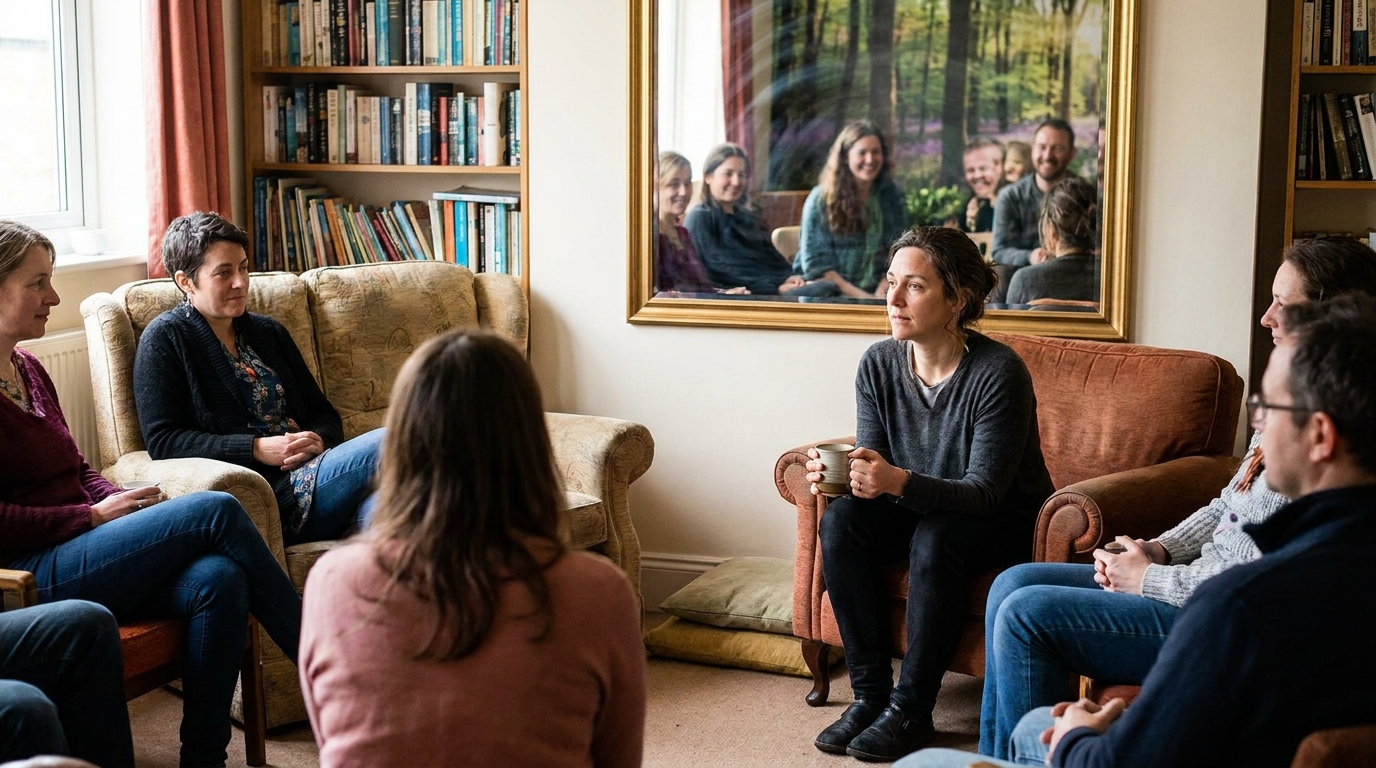
Devotional association is not simply social interaction. It is heart-to-heart encouragement in spiritual life.
Sometimes people imagine spiritual communities as places where everyone must appear perfect. But true Bhakti association is not about pretending. It is about sincerely helping one another turn toward God.
We Need People Who Remind Us of the Soul
The world constantly tells us we are the body, the mind, the job title, the relationship status, the bank account, the past mistake, or the future dream. Spiritual association gently reminds us: you are more than all of this.
You are a soul.
In Sanskrit, the word atma means the self, the eternal soul. The Bhagavad-gita teaches that the soul is not destroyed when the body is destroyed. The soul is eternal, conscious, and meant for loving relationship with Krishna, God.
When we forget this, we suffer deeply. When we remember it, even in small moments, peace begins to return.
Devotional association helps us remember again and again.
We Need People Who Make Spiritual Practice Feel Possible
Alone, we may think, “I cannot chant. I cannot pray. I cannot change. I am too distracted. I am too fallen. I am too busy.”
But in the company of sincere practitioners, spiritual life becomes possible.
We see mothers chanting while caring for children. We see students praying before exams. We see elders serving with patience. We see working people offering their food to God before eating. We see seekers stumbling, rising, and continuing.
This is encouraging. It reminds us that Bhakti Yoga is not only for monks, scholars, or saints. It is for everyone.
Bhakti is practical. We can begin with one mantra, one prayer, one act of kindness, one sacred meal, one moment of gratitude, one visit to a devotional gathering, one sincere conversation.
We Need People Who Correct Us With Compassion
Real spiritual association is not always comfortable. Sometimes it lovingly reveals where we are attached, proud, careless, or afraid.
This correction should never be abusive, controlling, or shaming. True Bhakti guidance is rooted in compassion, scripture, humility, and respect for the soul. It helps us grow without crushing the heart.
A good spiritual friend does not flatter our ego or reject us for our struggles. They help us remember our highest self. They encourage us to take responsibility while trusting in God’s mercy.
Sacred Sound: The Most Merciful Association
Among all forms of association, Bhakti Yoga gives special importance to sacred sound. Sound enters deeply. It can disturb us, heal us, awaken us, and connect us with the Divine.
The holy names of God are considered non-different from God in the Bhakti tradition. This means that when we chant sincerely, we are not merely repeating syllables. We are associating directly with divine presence.
Chanting Cleanses the Heart
A foundational teaching of Sri Chaitanya Mahaprabhu, the great teacher of divine love who spread congregational chanting in India over 500 years ago, is that chanting cleanses the mirror of the heart.
The heart is compared to a mirror because it is meant to reflect our true spiritual nature. But the mirror becomes covered by dust—selfishness, fear, anger, grief, and forgetfulness. The chanting of God’s names gradually clears this dust.
We may not feel everything immediately. But each sincere sound matters.
Even distracted chanting is still sacred. Even imperfect prayer is still heard. Even one humble “Please help me remember You” can begin to change the direction of a life.
Kirtan Creates a Field of Grace
Kirtan means glorification, often through call-and-response chanting. In kirtan, people gather and sing the names of God together. Some may sing loudly, some softly, some with tears, some with curiosity, some with doubt, some with deep faith. All are welcome.
The beauty of kirtan is that it carries us. When our own mind is restless, the voices of others help us continue. When our heart feels closed, the melody may soften it. When we feel alone, the shared prayer reminds us we belong.
Kirtan is not a performance. It is an offering.
In a world filled with noise, kirtan is sacred sound that brings the consciousness back home.
Japa Builds Personal Relationship
Japa is personal mantra meditation. Many practitioners chant on beads, repeating the Hare Krishna mantra or another sacred name of God. This practice can become a daily meeting with the Divine.
Japa teaches patience. Some days the mind wanders. Some days the heart feels dry. Some days the chanting feels sweet. The practice is to keep showing up.
Like any loving relationship, consistency matters. When we chant daily, we are choosing divine association again and again.
Choosing Association With Wisdom and Compassion
A common question arises: “If association affects me so much, should I avoid people who are not spiritual?”
Bhakti Yoga offers a balanced answer. We should not become proud, cold, or isolated. Every living being is sacred. Every person is worthy of respect. At the same time, we should understand our own spiritual strength and be thoughtful about intimacy and influence.
Respect Everyone, Choose Close Association Carefully
We can respect all people without allowing everyone equal access to our heart and habits.
This is a mature spiritual principle.
A doctor may care for sick patients but still take precautions to remain healthy. Similarly, a practitioner of Bhakti may serve and love widely, while choosing close association with those who support spiritual growth.
This is not superiority. It is humility. We admit, “I am influenced. I need support. I need uplifting company.”
Notice How You Feel After Association
One practical way to assess association is to notice its effect.
After spending time with someone or something, ask:
Do I feel closer to God or farther away?
Do I feel more peaceful or more agitated?
Do I feel inspired to serve or tempted to exploit?
Do I feel honest and humble or proud and restless?
Do I feel nourished or drained?
These reflections can guide us gently. They do not require harsh judgment. They simply help us become conscious.
Digital Association Matters Too
In modern life, much of our association happens online. Social media, videos, music, news, and entertainment all shape consciousness.
We may spend more time with online voices than with our closest friends. So it is wise to ask: Who is discipling my mind through my screen? What values are being normalized? What desires are being awakened?
This does not mean we must reject technology. Technology can also bring sat-sanga. We can listen to kirtan, attend online classes, read scripture, connect with devotees, and share uplifting messages.
The question is not just whether we use technology, but how we use it.
Association and the Three Modes of Nature
The Bhagavad-gita explains that material life is influenced by three qualities, called gunas in Sanskrit. Guna means a strand or quality that binds consciousness. These three modes are tamas, rajas, and sattva.
Understanding them can help us recognize how association affects our inner life.
Tamas: The Mode of Ignorance
Tamas is associated with darkness, confusion, laziness, violence, addiction, and forgetfulness. Association in tamas may leave us feeling dull, hopeless, careless, or disconnected.
Examples may include environments of intoxication, cruelty, apathy, or destructive habits. When consciousness is influenced by tamas, spiritual practice feels very difficult.
The remedy is not self-hatred. The remedy is gentle movement toward light: regulated habits, clean food, honest friendship, prayer, chanting, and supportive community.
Rajas: The Mode of Passion
Rajas is associated with restlessness, ambition, competition, intense desire, and constant activity. Association in rajas may make us feel driven but never satisfied.
Much of modern culture operates in rajas. We are encouraged to want more, produce more, compare more, and achieve more. While passion can be used in service, unchecked rajas keeps the mind agitated.
Bhakti helps transform passion into devotion. Our energy can be offered to God. Our work can become service. Our ambition can become a desire to uplift others.
Sattva: The Mode of Goodness
Sattva is associated with clarity, peace, wisdom, cleanliness, compassion, and balance. Association in sattva helps the mind become calm and receptive to spiritual truth.
Examples include sacred study, wholesome food, honest living, nature, prayer, and uplifting company.
Sattva is very helpful, but Bhakti goes even beyond sattva. Pure devotion is not just peaceful living; it is loving relationship with God. Still, sattva creates a healthy foundation for hearing, chanting, and serving with sincerity.
Building a Life of Uplifting Association
Spiritual association does not happen only by chance. We can intentionally build it into daily life.
Small choices, repeated with sincerity, become a spiritual culture.
Begin the Day With Sacred Sound
The morning is a powerful time to set consciousness. Before checking messages or entering the demands of the day, try offering a simple prayer or chanting a mantra.
You might say:
“Dear Lord, please guide my thoughts, words, and actions today. Please help me remember You and serve with love.”
Or chant the Hare Krishna mantra softly for a few minutes.
Even five minutes of sacred association in the morning can change the tone of the day.
Make Your Home a Place of Remembrance
A home does not need to be elaborate to become sacred. A small altar, a candle, a picture of Krishna or a form of God you love, a scripture, fresh flowers, or a quiet prayer corner can help create an atmosphere of devotion.
You can play kirtan while cooking. You can offer your food to God with gratitude before eating. You can read one verse from the Bhagavad-gita. You can gather with family or friends for a short prayer.
The home becomes spiritually powerful when love and remembrance are practiced there.
Seek Community, Even If You Feel Shy
Many people long for spiritual community but feel nervous to come forward. They may worry, “Will I belong? Do I know enough? What if I am different? What if I have doubts?”
Please know: sincere spiritual community is not for perfect people. It is for honest souls.
If you are new to Bhakti, you can begin simply. Attend a kirtan. Listen quietly. Ask a question. Share a meal. Introduce yourself to one person. Let the heart take its time.
Bhakti grows through relationship, and relationship grows through small sincere steps.
Serve With Others
Service, called seva in Sanskrit, means offering our time, energy, talents, and heart for the pleasure of God and the benefit of others.
Serving with others creates deep association. Whether cooking, cleaning, singing, teaching, gardening, organizing, welcoming guests, feeding people, or supporting a spiritual gathering, seva bonds hearts in a sacred purpose.
Service also purifies ego. Instead of asking, “What can I get?” we begin asking, “How can I help?” This question is transformative.
When Association Is Difficult
Not everyone has easy access to uplifting community. Some people live far from temples or devotional gatherings. Some are surrounded by family or coworkers who do not understand their spiritual path. Some have experienced hurt in religious spaces and are cautious.
Bhakti meets us with compassion in all circumstances.
Start With the Association Available to You
If you cannot attend in person, begin with what is available.
You can associate with scripture by reading daily. You can associate with saints through their teachings. You can associate with sacred sound through chanting. You can join online gatherings. You can listen to kirtan while driving or walking. You can pray for guidance.
Krishna sees sincerity. God is not limited by geography.
Become the Association You Are Seeking
Sometimes the best way to find spiritual association is to become a source of it.
Be the person who speaks kindly. Be the person who remembers to pray. Be the person who offers food with gratitude. Be the person who invites one friend to chant. Be the person who serves quietly.
This does not mean pretending to be advanced. It means offering whatever sincerity you have.
A small lamp can light another lamp.
Heal Slowly From Unhealthy Association
If past association has wounded your heart, please be gentle with yourself. Healing takes time. Some influences leave deep impressions. Bhakti Yoga does not demand instant transformation. It offers steady purification through grace.
Chant. Pray. Seek safe and wise support. Spend time with those who respect your dignity. Let scripture remind you of your eternal worth. Let service reconnect you with purpose.
No one is beyond mercy.
The Supreme Association: Remembering God
All uplifting association ultimately points us toward the highest association: loving remembrance of God.
In Bhakti Yoga, God is understood not as a distant force, but as a loving person who desires relationship with us. Krishna means “the all-attractive one,” the source of beauty, wisdom, strength, fame, wealth, and renunciation. Yet even more intimately, Krishna is the friend of every heart.
In the Bhagavad-gita, Krishna says:
“Always think of Me, become My devotee, worship Me, and offer your homage unto Me. Thus you will come to Me without fail.”
— Bhagavad-gita 18.65
This is a deeply personal invitation. Krishna is not asking for empty ritual. He is inviting loving remembrance.
Prayer Is Association
Prayer is not only asking for things. Prayer is turning toward God.
We can pray with formal words or simple honesty:
“Please help me.”
“Thank You.”
“I am confused.”
“Please let me serve.”
“Please guide my heart.”
“Please let me remember You.”
Every sincere prayer is association with the Divine.
Service Is Association
When we serve God’s children, we associate with God’s purpose. Service turns spiritual life into action. It helps love become practical.
We may serve by feeding others, listening with compassion, offering our skills, caring for the earth, supporting spiritual community, or helping someone take one step toward hope.
In Bhakti, service is not a burden. It is the natural expression of love.
Remembrance Can Enter Everything
The beauty of Bhakti Yoga is that remembrance of God can enter every part of life.
Cooking can become an offering.
Work can become service.
Music can become prayer.
Friendship can become spiritual encouragement.
Parenting can become sacred care.
Rest can become gratitude.
Struggle can become surrender.
Association with God is not limited to one hour a week. It can become the atmosphere of the heart.
Taking One Sincere Step
The impact of association on consciousness is profound. What we hear, who we walk with, what we watch, what we repeat, and what we love all shape the inner life.
Yet this truth is hopeful. If consciousness can be shaped by worldly influence, it can also be healed by divine influence. If the heart has learned fear, it can learn trust. If it has learned distraction, it can learn remembrance. If it has learned selfishness, it can learn service. If it has felt far from God, it can come close again.
Bhakti Yoga is a practical path of love. It invites us to chant, pray, serve, hear sacred wisdom, keep uplifting company, and gradually offer our lives to God with sincerity.
You do not have to do everything at once.
Begin with one step.
Chant one mantra. Offer one prayer. Read one verse. Join one kirtan. Serve one person. Choose one uplifting friendship. Reduce one harmful influence. Create one sacred moment in your day.
At The Bhakti House, all are welcome—wherever you come from, whatever your background, whatever questions you carry. Spiritual life begins not with perfection, but with sincerity. May we each take one humble step toward God, and may our association help one another remember the love we are all longing for.
FAQs
What is association?
Association is the mental process of linking two or more ideas, concepts, or experiences together. It is a fundamental aspect of human cognition and plays a crucial role in memory, learning, and problem-solving.
How does association change consciousness?
Association can change consciousness by influencing the way we perceive and interpret the world around us. When certain ideas or experiences become associated with specific emotions, memories, or beliefs, they can significantly impact our thoughts, feelings, and behaviors, ultimately altering our consciousness.
What are some examples of association changing consciousness?
An example of association changing consciousness is the way certain smells can evoke strong emotions or memories. For instance, the smell of freshly baked cookies may be associated with feelings of comfort and warmth, leading to a shift in consciousness towards a more positive and nostalgic state.
Can association be consciously manipulated to change consciousness?
Yes, association can be consciously manipulated to change consciousness. This can be achieved through various techniques such as cognitive restructuring, exposure therapy, and mindfulness practices, which aim to reframe associations and alter their impact on consciousness.
How can understanding association benefit our daily lives?
Understanding association can benefit our daily lives by allowing us to recognize and modify the associations that influence our thoughts, emotions, and behaviors. By gaining insight into how associations shape our consciousness, we can make more informed decisions, improve our mental well-being, and enhance our overall quality of life.

