
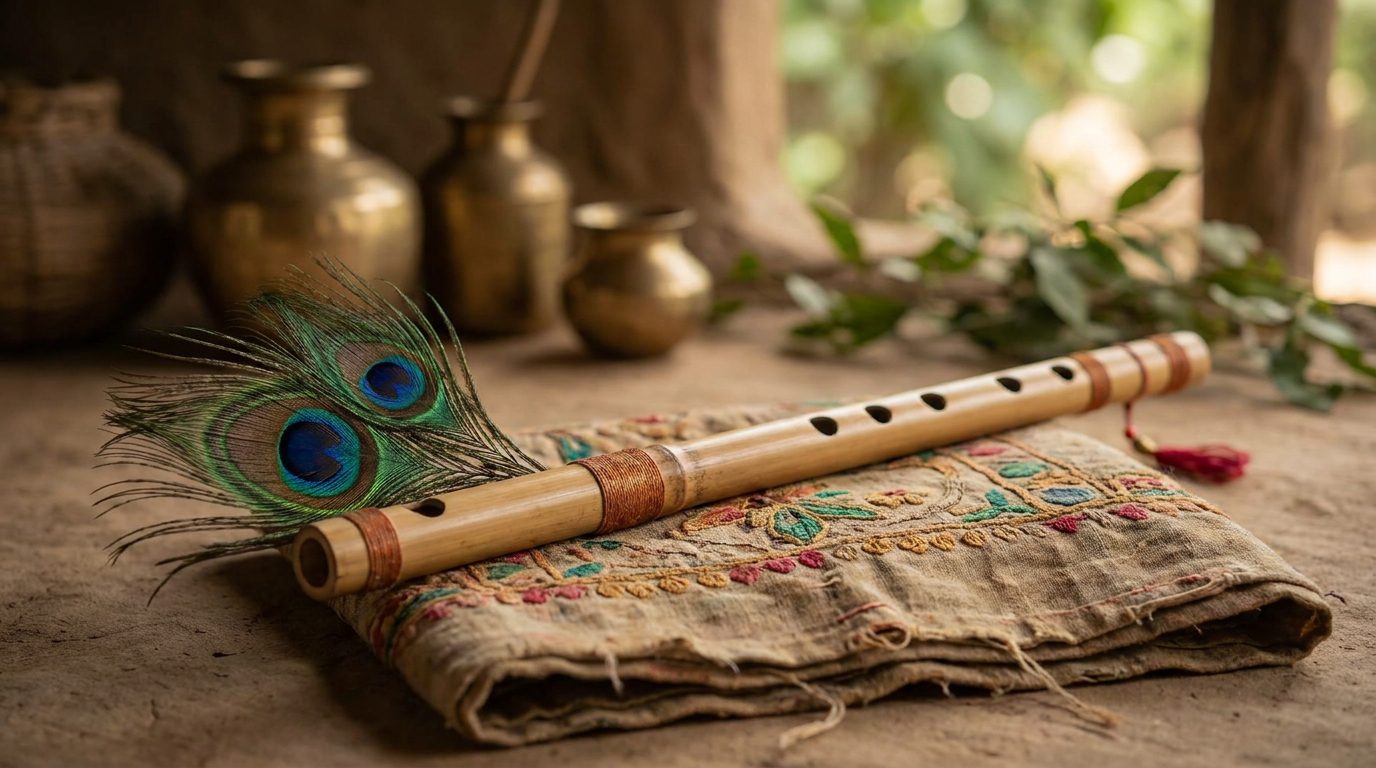
The sound of a flute drifting across a still evening — there is something about it that stops the mind and stirs the heart. In the tradition of Bhakti Yoga, the path of loving devotion, this is no ordinary instrument. Krishna’s flute, known in Sanskrit as the venu or murali, is one of the most beloved and mystical symbols in all of spiritual life.
But why a flute? Why not a drum, a horn, or a mighty weapon? The answer lives at the very heart of what it means to walk a path of love toward the Divine.
Whether you are new to Bhakti or have been chanting for years, the story of Krishna’s flute holds a deeply personal invitation — one that asks us to become empty enough, surrendered enough, and trusting enough to let God’s love flow through us like a song.
Let’s explore this beautiful symbol together.
In the Bhakti tradition, Lord Krishna is often depicted as a beautiful youth standing in a graceful posture, playing a flute. This image — sometimes called Venugopala (the cowherd who plays the flute) — is one of the most recognized and cherished forms of God in the world.
The flute is not just a decorative detail. It carries deep spiritual meaning.
A flute is a simple, hollow bamboo tube. It has no voice of its own. Yet when the Divine Musician places His lips upon it and breathes through it, the most enchanting music pours forth — a melody so sweet that it captivates all of creation.
In the Śrīmad-Bhāgavatam (1.5.11), the great sage Narada explains to Vyasadeva:
> “tad-vāg-visargo janatāgha-viplavo
> yasmin prati-ślokam abaddhavaty api
> nāmāny anantasya yaśo ‘ṅkitāni yat
> śṛṇvanti gāyanti gṛṇanti sādhavaḥ”
This verse tells us that any literature or sound that is filled with the glories and names of the Supreme Lord — even if imperfectly composed — is accepted by saintly persons who hear, sing, and speak about the Unlimited One. The flute song of Krishna is the purest expression of this principle: Divine sound that calls every soul home.
The Flute as a Symbol of Surrender
The flute teaches us one of Bhakti’s most essential lessons: surrender.
The bamboo flute is hollow. It has given up everything inside. It does not try to produce its own music. It simply allows the breath of the musician to pass through it, and the result is something breathtakingly beautiful.
This is the model for a devotee’s life. When we empty ourselves of false ego, selfish desires, and the need to control — when we become like that hollow flute — then the Divine can work through us. Our words become kind. Our actions become service. Our lives become a melody that brings comfort and joy to others.
The Flute’s Song Is an Act of Love
Krishna does not play the flute to show off His skill. He plays because He loves. His music is a call — a tender, irresistible invitation to every living being to return to a relationship of love with Him.
In the Bhakti tradition, this is called āhvāna, a loving summons. The flute song is God saying, “I am here. Come to Me. You are not forgotten.”
The Gopis and the Irresistible Call of the Flute
Perhaps no passage in all of Bhakti literature captures the power of Krishna’s flute more vividly than the Venu-gīta — the Song of the Flute — found in the Tenth Canto of the Śrīmad-Bhāgavatam (10.21).
In this chapter, the gopis (the cowherd women of Vrindavan, who represent the highest ideal of pure devotion) hear the sound of Krishna’s flute echoing through the forests. They are completely captivated. They describe to one another the effect of this divine music on all of creation.
Nature Itself Responds to the Flute
The gopis observe that when Krishna plays His flute, the rivers slow their currents, as if wanting to embrace His lotus feet with their waves. The clouds overhead provide gentle shade like an umbrella, and they offer soft rain as a shower of flowers. The cows stand still with ears raised, the grass on the hills seems to stand on end in ecstasy, and even the deer approach Krishna without any fear.
In Śrīmad-Bhāgavatam (10.21.15), the gopis say:
> “nadyas tadā tad upadārya mukunda-gītam
> āvarta-lakṣita-manobhava-bhagna-vegāḥ
> āliṅgana-sthagitam ūrmi-bhujair murārer
> gṛhṇanti pāda-yugalaṁ kamalopahāraḥ”
The rivers, upon hearing the song of Mukunda (Krishna), slowed their currents — their minds agitated by love — and with arms of waves, they embraced His lotus feet, offering lotus flowers.
This is not just poetic imagery. It tells us something profound: the call of Divine love reaches everyone and everything. No one is excluded. Every part of creation is invited to respond.
The Gopis as the Highest Devotees
The gopis did not study scripture for decades. They did not perform elaborate rituals. They simply loved Krishna with every fiber of their being. When they heard His flute, nothing else mattered — not social expectations, not fear of criticism, not personal comfort.
Their response to the flute is considered the highest standard of devotion in the Bhakti tradition. Srila Prabhupada, the founder-acharya of the International Society for Krishna Consciousness, often explained that the gopis’ love was completely selfless. They did not want anything from Krishna except the joy of serving Him and being in His presence.
This teaches us something beautiful and practical: Bhakti is not about being the most learned or the most qualified. It is about the sincerity and depth of our love.
The Spiritual Meaning Behind the Melody
On the surface, the image of a young cowherd playing a flute in a moonlit forest is enchanting. But Bhakti teachers throughout the centuries have revealed layers of deeper meaning within this divine pastime.
The Breath of God
The breath that Krishna uses to play the flute is understood to be pranava — the sacred syllable Om, the original sound vibration from which all creation flows. When Krishna breathes life into the flute, He is, in a sense, breathing life into all of existence.
In the Bhagavad-gītā (7.8), Krishna Himself says:
> “raso ‘ham apsu kaunteya
> prabhāsmi śaśi-sūryayoḥ
> praṇavaḥ sarva-vedeṣu
> śabdaḥ khe pauruṣaṁ nṛṣu”
“O son of Kuntī, I am the taste of water, the light of the sun and the moon, the syllable om in the Vedic mantras; I am the sound in ether and ability in man.”
Krishna is the essence behind every experience of beauty, sweetness, and meaning. His flute song is simply the purest, most concentrated expression of that essence.
The Holes in the Flute
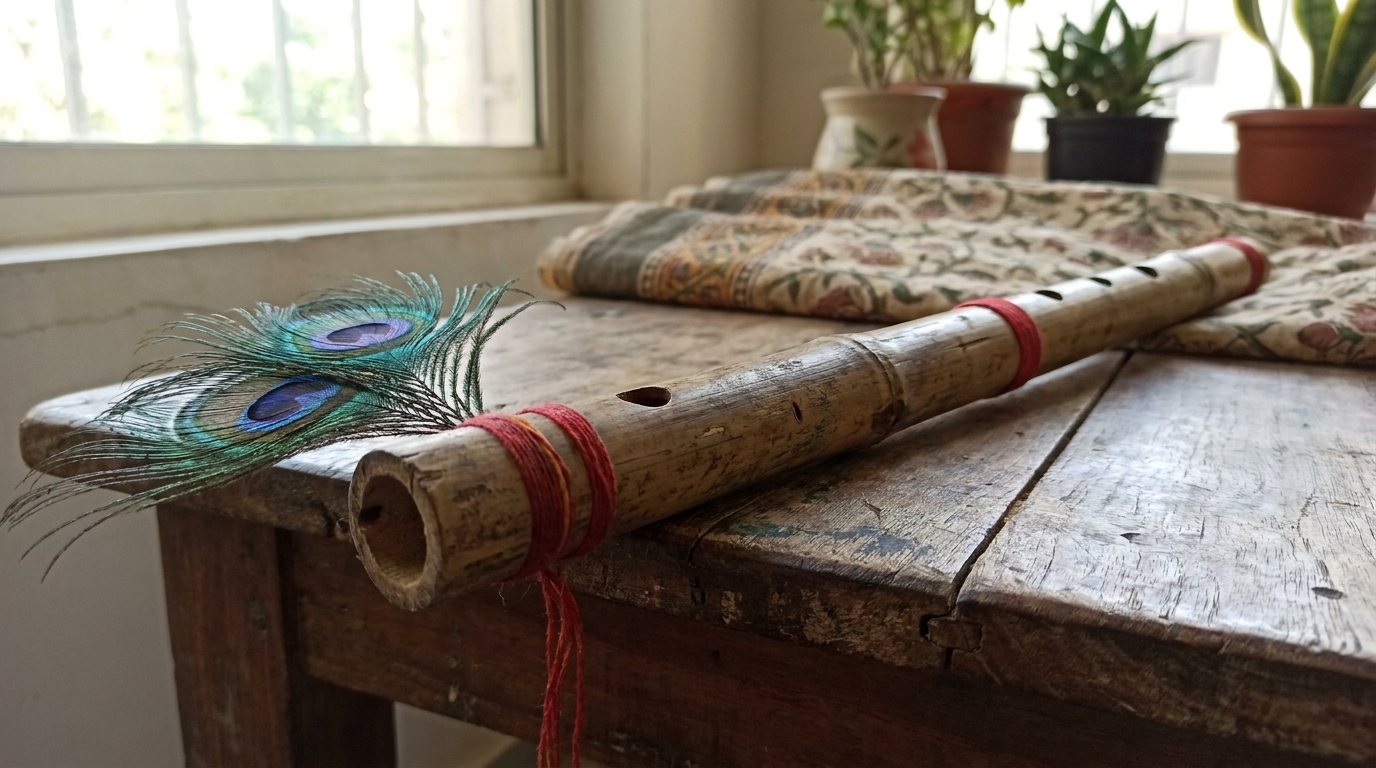
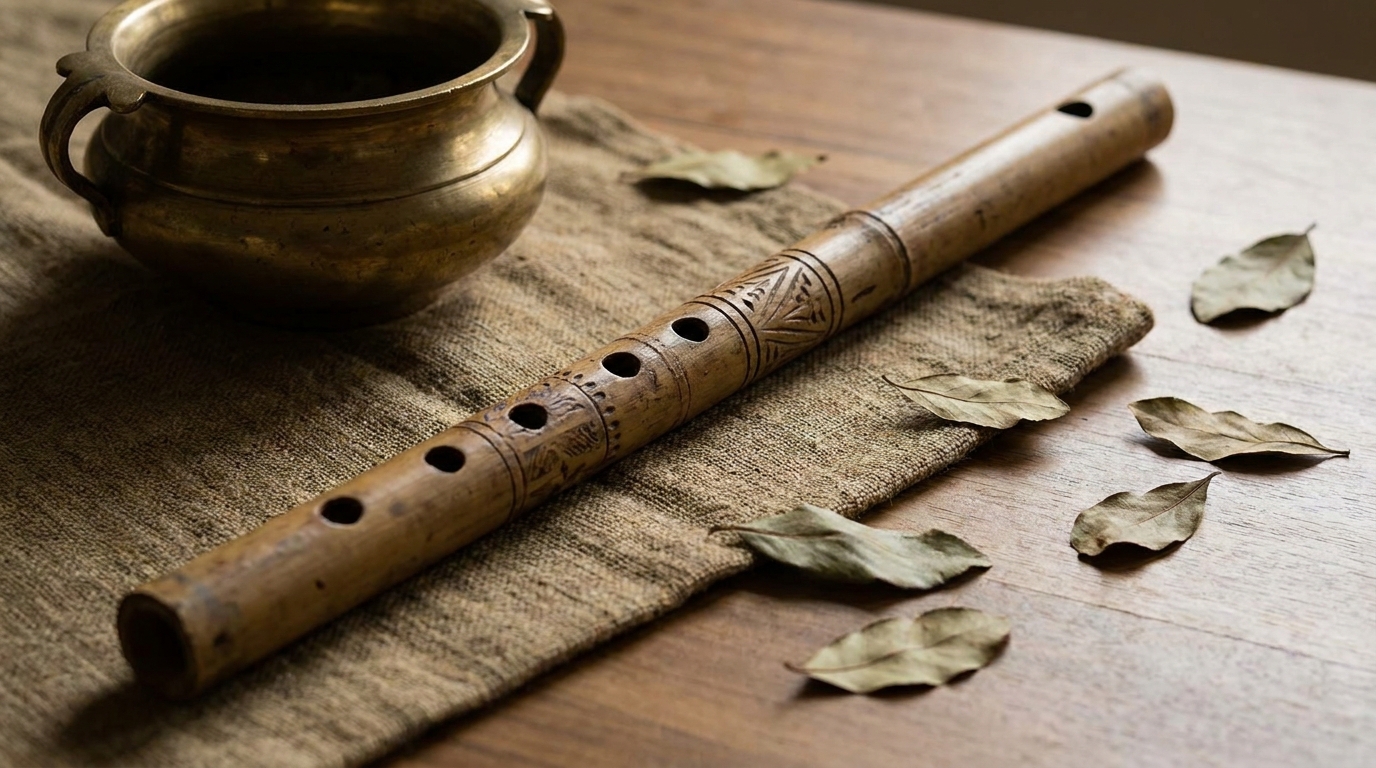
Some Bhakti teachers have lovingly compared the holes in the flute to the trials and challenges we face in life. A flute without holes cannot produce music. It is the openings — the places where something has been carved away — that allow the melody to emerge.
Similarly, the difficulties we encounter can hollow us out, making space for grace to flow. Our heartbreaks, our struggles, our moments of feeling lost — these can become the very openings through which the Divine plays the most beautiful song of our lives.
This is not to romanticize suffering. It is to offer hope: nothing in your life is wasted on the path of devotion.
The Music That Connects All Beings
Krishna’s flute does not play one note for the cows, another for the rivers, and another for the gopis. The same melody reaches all, yet each listener experiences it uniquely according to their own relationship with Krishna.
This reflects a core teaching of Bhakti: God has a personal, unique relationship with every single soul. You do not have to fit into someone else’s mold of devotion. Your relationship with the Divine is yours — intimate, irreplaceable, and eternally cherished.
Check out our website for more articles: more articles.
How Krishna’s Flute Inspires Our Daily Practice
The story of the flute is not just theology. It is a practical guide for how to live a life of devotion, right here and now.
Chanting as Hearing the Flute
In this age, the Bhakti tradition teaches that the most accessible and powerful spiritual practice is sankirtana — the congregational chanting of God’s holy names. When we chant the Hare Krishna maha-mantra — Hare Krishna, Hare Krishna, Krishna Krishna, Hare Hare / Hare Rama, Hare Rama, Rama Rama, Hare Hare — we are, in essence, hearing the call of Krishna’s flute.
The Śrīmad-Bhāgavatam (2.1.5) urges us:
> “tasmād bhārata sarvātmā
> bhagavān īśvaro hariḥ
> śrotavyaḥ kīrtitavyaś ca
> smartavyaś cecchatābhayam”
“O descendant of King Bharata, one who desires to be free from all miseries must hear about, glorify, and also remember the Supreme Lord, who is the Supersoul, the controller, and the savior from all miseries.”
Chanting is our way of responding to the flute. Every time we sit down with our beads, every time we sing together in kirtan, we are like the gopis running toward the sound of that irresistible melody.
Service as Becoming the Flute
Another practical application is seva, or loving service. When we serve others — whether by cooking a meal for someone in need, listening to a friend with full attention, helping in our community, or offering our talents in God’s service — we become instruments of the Divine.
We become the flute.
This does not require perfection. It requires willingness. A flute does not need to be made of gold. Simple bamboo, offered with love, is more than enough.
Prayer as Honest Conversation
The gopis did not hold back their feelings when they heard the flute. They spoke openly, passionately, and with complete honesty about what they experienced. Their prayers were raw, real, and drenched in love.
We can bring this same spirit to our own prayer life. You do not need fancy words to pray. You simply need an honest heart. Tell God what you feel. Tell Him what you need. Tell Him you want to hear His flute, even if your ears are not yet attuned.
He is listening. He always has been.
The Flute Song Never Stops
Here is perhaps the most comforting teaching about Krishna’s flute: it never stops playing.
The Bhakti tradition teaches that Krishna’s pastimes are eternal. Right now, in the spiritual world of Vrindavan, Krishna is standing beneath a kadamba tree, playing His flute, calling to every soul in creation.
The question is not whether the music is playing. The question is whether we are listening.
The noise of daily life — our worries, our distractions, our endless to-do lists — can drown out the sound. But the melody is always there, just beneath the surface, waiting for a quiet moment when we turn our attention inward and say, “Yes, I hear You. I’m coming.”
In the Bhagavad-gītā (18.66), Krishna gives His most intimate and reassuring promise:
> “sarva-dharmān parityajya
> mām ekaṁ śaraṇaṁ vraja
> ahaṁ tvāṁ sarva-pāpebhyo
> mokṣayiṣyāmi mā śucaḥ”
“Abandon all varieties of religion and just surrender unto Me. I shall deliver you from all sinful reactions. Do not fear.”
This is the message of the flute, distilled into a single, breathtaking promise: Come to Me. I will take care of everything. Do not be afraid.
You Are Invited to Hear the Melody
Wherever you are in your spiritual journey — whether you have been practicing for decades or are just beginning to feel a gentle tug in your heart — the song of Krishna’s flute is playing for you.
You do not need to be perfect. You do not need to have all the answers. You do not need to belong to any particular background, culture, or tradition.
All you need is one sincere step.
Maybe that step is chanting the Hare Krishna mantra softly to yourself today. Maybe it is picking up the Bhagavad-gītā and reading a single verse. Maybe it is simply sitting in silence and saying, “Krishna, if You are there, I want to hear Your flute.”
He is there. And He has been waiting for you — with a flute at His lips and a smile on His face — since the very beginning.
Everyone is welcome at The Bhakti House. Come as you are. Take one sincere step toward God, and watch how He takes a hundred steps toward you.
FAQs
What is Krishna’s Flute?
Krishna’s Flute, also known as the Murali, is a legendary flute associated with the Hindu deity Krishna. It is said to be a divine instrument that Krishna used to enchant and mesmerize people with its melodious tunes.
What is the significance of Krishna’s Flute?
The flute is a symbol of divine love and the enchanting music produced by Krishna’s Flute is believed to represent the call of the divine to the human soul. It is also associated with Krishna’s pastoral and romantic adventures, as well as his role as a divine lover.
What is the story behind Krishna’s Flute?
According to Hindu mythology, Krishna’s Flute was created from a piece of bamboo by Lord Brahma, the creator of the universe. The flute is said to have been blessed with the ability to produce the most enchanting and captivating music, which captivated not only humans but also animals and even nature itself.
What does the sound of Krishna’s Flute symbolize?
The sound of Krishna’s Flute is said to symbolize the call of the divine to the human soul, drawing devotees towards the path of spiritual enlightenment and divine love. It is also associated with the idea of transcendence and the ability to rise above worldly attachments.
How is Krishna’s Flute depicted in art and literature?
In art and literature, Krishna’s Flute is often depicted as a simple bamboo flute with intricate carvings and decorations. It is also portrayed as an essential attribute of Lord Krishna, often shown in his hands as he plays enchanting melodies to captivate the hearts of his devotees.

