
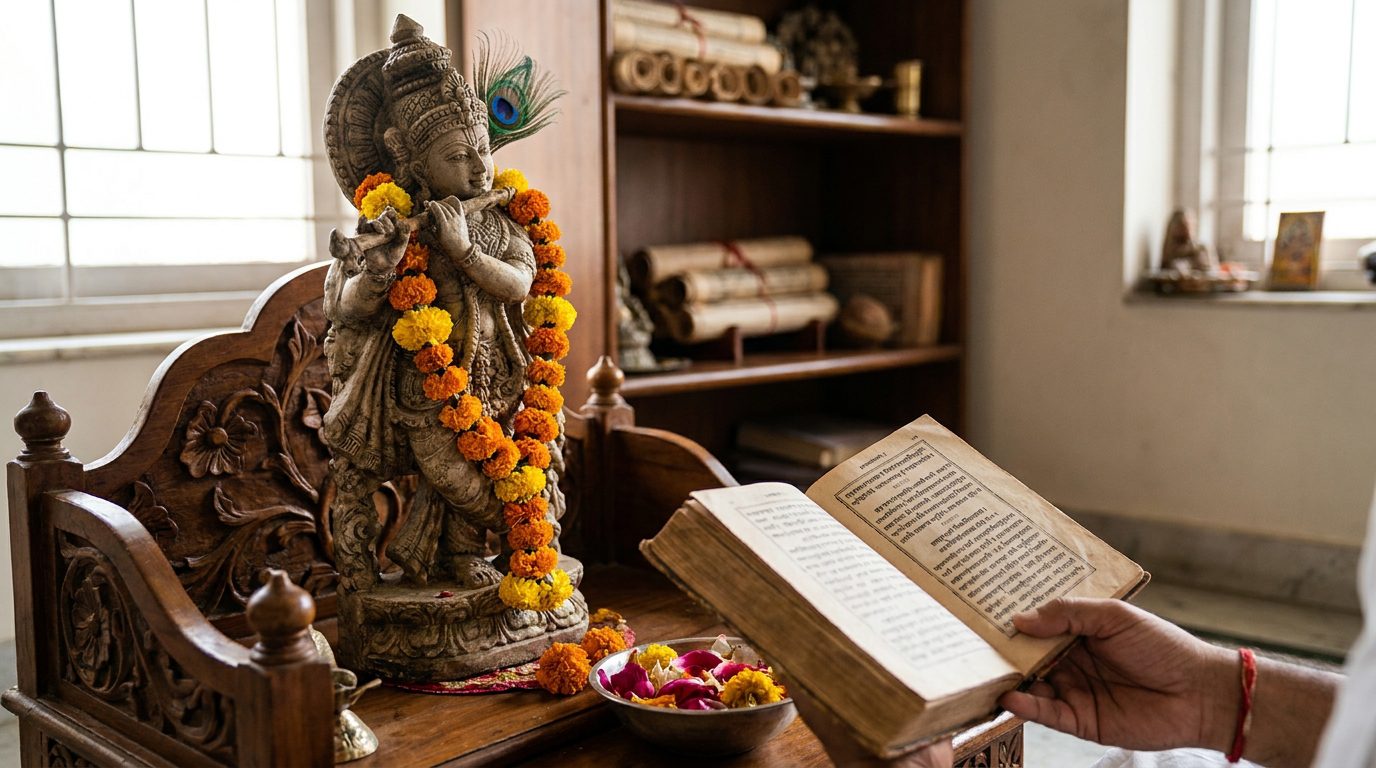
Every name of Krishna is like a window into the infinite. When we hear His names, chant them, or simply whisper them in the quiet of our hearts, something extraordinary begins to happen — we start to remember who we truly are, and who we truly belong to.
In the Bhakti tradition, the names of God are not ordinary labels. They are living, breathing invitations. Each name carries the full presence, personality, and power of the Supreme Person. And the beautiful thing is, you don’t need to be a scholar or a lifelong practitioner to experience this. You just need a sincere heart.
Whether you’re brand new to Bhakti Yoga or you’ve been chanting for years, exploring the meaning behind Krishna’s names can deepen your love, your understanding, and your connection to the Divine in ways that are both profound and deeply personal.
Let’s walk through some of Krishna’s most beloved names together — not as an academic exercise, but as a devotional journey.
In Bhakti Yoga — the path of loving devotion — chanting God’s names is considered the most powerful and accessible spiritual practice, especially in this age. This isn’t just a tradition or cultural ritual. The scriptures tell us that Krishna’s name is non-different from Krishna Himself.
In the Padma Purāṇa, it is stated:
> “There is no difference between the holy name of the Lord and the Lord Himself. As such, the holy name is as perfect as the Lord Himself in fullness, purity, and eternity.”
This means that when you chant “Krishna,” you are not merely saying a word. You are inviting the Supreme Person into your life. You are making contact with the Absolute Truth in the most intimate, loving way possible.
Understanding the meanings behind these names transforms our chanting from something mechanical into something deeply relational. When you know that a name describes Krishna’s beauty, His compassion, His playfulness, or His love for every living being, your heart naturally opens wider when you say it.
The Power of Hearing and Chanting
Śrīla Prabhupāda, the founder-ācārya of the International Society for Krishna Consciousness, often emphasized that simply hearing Krishna’s names with attention and affection purifies the heart. In his purport to Śrīmad-Bhāgavatam 1.2.17, he explains how hearing about the Lord cleanses the heart of all accumulated misgivings.
You don’t have to chant perfectly. You don’t have to understand every syllable right away. The name itself does the work — like the sun that dispels darkness simply by rising.
Krishna — The All-Attractive One
The name “Krishna” is perhaps the most intimate and complete name of God. The word Krishna comes from the Sanskrit root that means “all-attractive.” It signifies the Supreme Person who attracts everyone and everything because He possesses all beauty, all strength, all knowledge, all wealth, all fame, and all renunciation in full.
In the Bhagavad-gītā 7.7, Lord Krishna tells Arjuna:
> “O conqueror of wealth, there is no truth superior to Me. Everything rests upon Me, as pearls are strung on a thread.”
This verse reveals that Krishna is not one god among many, nor simply a cultural figure. He is the source of everything — the thread upon which all of existence is lovingly strung.
When we chant the name “Krishna,” we are calling out to the one Person who can fully satisfy the deepest longing of every heart. That longing is for love — pure, unconditional, eternal love. And Krishna is the reservoir of all love.
Krishna as a Personal Name
What makes “Krishna” so special in the Bhakti tradition is that it is deeply personal. It’s not an abstract concept or a title of power. It’s the name His mother Yaśodā called Him when He was a little boy in Vṛndāvana. It’s the name His cowherd friends shouted when they played together in the fields. It’s the name the gopīs, His most devoted lovers, cried out in the anguish and ecstasy of divine love.
This name tells us that the Supreme Truth is not cold, distant, or impersonal. He is a person — the Supreme Person — who has relationships, who plays, who loves, and who longs for our love in return.
Govinda — The One Who Gives Pleasure to All
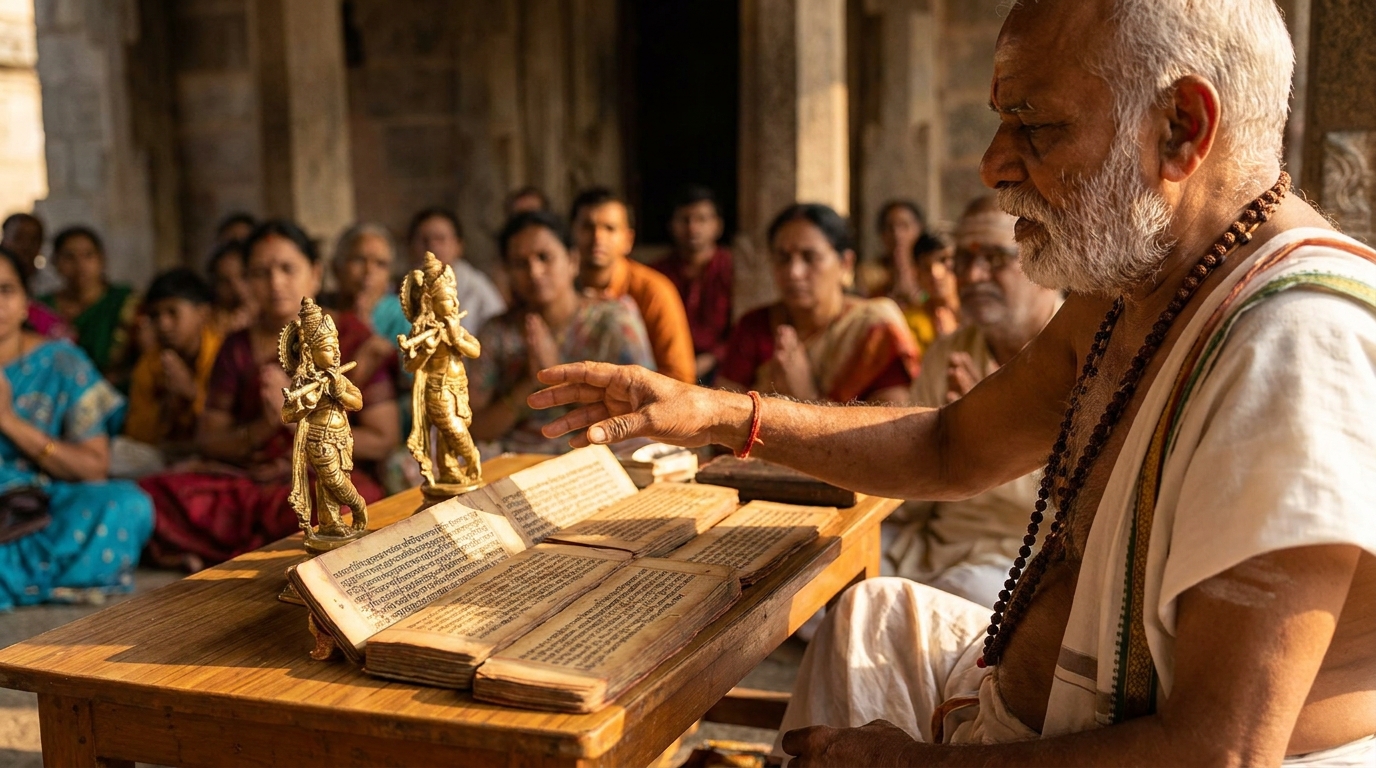
The name Govinda is one of Krishna’s most cherished names. It means “one who gives pleasure to the senses,” “one who gives pleasure to the cows and the land,” and “one who is known through Vedic knowledge.”
In the Brahma-saṁhitā 5.1, Lord Brahmā, the creator of this universe, offers this beautiful prayer:
> “Kṛṣṇa who is known as Govinda is the Supreme Godhead. He has an eternal blissful spiritual body. He is the origin of all. He has no other origin and He is the prime cause of all causes.”
Govinda paints a picture of Krishna as the one who nourishes all of creation. Just as a good father provides for his family or a gentle rain nourishes the earth, Govinda sustains every living being — physically, emotionally, and spiritually.
Govinda and the Cows of Vṛndāvana
In Krishna’s eternal pastimes in Vṛndāvana, He is a cowherd boy. He tends the cows with great affection, and the cows love Him in return. The image of Govinda with His cows is one of the most tender in all of spiritual literature. It tells us that God cares for even the simplest creatures with love and attention.
When we chant “Govinda,” we are remembering that Krishna is not just the Lord of the universe — He is the gentle protector who cares for each of us individually, just as He cares for each cow in His pasture.
Check out our website for more articles: more articles.
Gopāla — The Protector and Friend

Gopāla means “protector of the cows” or, more broadly, “protector of all living beings.” This name highlights Krishna’s role as the supreme caretaker — the one who watches over us, guides us, and keeps us safe on our spiritual journey.
The name Gopāla also carries the sweetness of Krishna’s childhood pastimes. As a young boy in Vṛndāvana, He would take the calves out to graze, play His flute under the shade of the trees, and share His lunch with His friends. These pastimes are not mythological stories — they are descriptions of the eternal activities of the Supreme Person in His spiritual abode.
Gopāla and Our Relationship with God
One of the most revolutionary teachings of Bhakti Yoga is that our relationship with God is not limited to awe and reverence. We can relate to Krishna as a friend, as a child, as a beloved — and He reciprocates with each of us according to our love.
The name Gopāla reminds us that God is approachable. He is not sitting on a distant throne, waiting to judge us. He is walking beside us, carrying a flute, smiling, and waiting for us to turn toward Him.
Madhusūdana — The Destroyer of the Demon Madhu
The name Madhusūdana means “the slayer of the demon Madhu.” On one level, this refers to Krishna’s pastime of defeating a powerful demon. But on a deeper level, it speaks to Krishna’s ability to destroy the demons within us — our pride, our anger, our envy, our fear, and the ignorance that keeps us from knowing who we truly are.
In the Bhagavad-gītā 1.35, Arjuna addresses Krishna as Madhusūdana during his moment of greatest confusion and despair on the battlefield of Kurukṣetra. By using this name, Arjuna is expressing faith that Krishna can help him overcome his inner enemies, even when he feels lost and overwhelmed.
Finding Courage Through Krishna’s Names
We all face battles — maybe not on a literal battlefield, but in our daily lives. We struggle with doubt, with old habits, with the feeling that we are not good enough. The name Madhusūdana reminds us that Krishna is not only our friend and lover but also our protector. He has the power to remove every obstacle on our path back to Him.
When we chant this name, we are asking Krishna to help us conquer the things that keep us separated from His love.
Hṛṣīkeśa — The Master of the Senses
Hṛṣīkeśa means “the master of the senses” or “the Lord of the senses.” This name teaches us that our senses — our ability to see, hear, touch, taste, and smell — ultimately belong to Krishna. He is the original source of all perception and all experience.
In the Bhagavad-gītā 1.15, this name is used when Krishna blows His divine conchshell, Pāñcajanya. The sound of that conchshell is not an ordinary sound — it is the call of the Supreme Person, awakening the soul to its true purpose.
Engaging Our Senses in Devotion
In Bhakti Yoga, we don’t reject or suppress the senses. Instead, we learn to use them in Krishna’s service. We use our tongue to chant His names and taste prasādam (sanctified food offered to Him). We use our ears to hear about His glories. We use our eyes to see His beautiful Deity form in the temple. We use our hands to serve His devotees.
This is the practical genius of Bhakti. It takes everything we already have — our bodies, our senses, our talents, our desires — and offers them back to the One who gave them to us in the first place.
Śrīmad-Bhāgavatam 1.2.6 states:
> “The supreme occupation [dharma] for all humanity is that by which men can attain to loving devotional service unto the transcendent Lord. Such devotional service must be unmotivated and uninterrupted to completely satisfy the self.”
This is what it means to be guided by Hṛṣīkeśa — to allow the master of the senses to direct our senses toward their highest and most joyful purpose.
Other Beloved Names of Krishna
The ocean of Krishna’s names is truly unlimited. Here are a few more names that devotees hold dear, each one a doorway into a deeper relationship with the Supreme Person.
Murāri — The Enemy of the Demon Mura
This name celebrates Krishna’s victory over the demon Mura and reminds us of His supreme power to protect those who surrender to Him.
Vāsudeva — The Son of Vasudeva
This name connects Krishna to His earthly father, Vasudeva, and reminds us that the Supreme Lord chose to appear in a human family, making Himself accessible and relatable to all of us. In Bhagavad-gītā 7.19, Krishna says:
> “After many births and deaths, he who is actually in knowledge surrenders unto Me, knowing Me to be the cause of all causes and all that is. Such a great soul is very rare.”
The name Vāsudeva points to this ultimate surrender — recognizing Krishna as the source of everything.
Dāmodara — The One Bound by Love
Perhaps one of the sweetest names of all, Dāmodara means “one whose belly is bound by a rope.” It refers to the pastime where Mother Yaśodā tied little Krishna to a grinding mortar with a rope because He had been mischievous. The Supreme Lord — whom no force in the universe can bind — allowed Himself to be bound by the love of His devotee.
This name teaches us the most extraordinary truth in all of spiritual life: love is more powerful than power itself. Krishna, who controls everything, is controlled by love.
Jagannātha — The Lord of the Universe
This majestic name reminds us that the same Krishna who plays in Vṛndāvana is also the Lord of the entire cosmos. He holds all worlds within Himself while remaining the intimate friend of every soul.
How to Begin Exploring Krishna’s Names in Your Own Life
You don’t need to memorize all of Krishna’s names at once. You don’t need to pronounce them perfectly. You don’t need to pass a test. All you need is sincerity.
Here are a few simple, practical ways to begin:
Chant the Hare Krishna mahā-mantra. This great chant — Hare Krishna, Hare Krishna, Krishna Krishna, Hare Hare / Hare Rāma, Hare Rāma, Rāma Rāma, Hare Hare — contains the most powerful names of God. You can chant it anywhere, anytime. On a walk. In the shower. Before bed. In the car. There are no hard and fast rules.
Learn one name at a time. Pick a name that resonates with you. Maybe it’s Govinda, or Dāmodara, or simply Krishna. Learn what it means. Sit with it. Let it become a friend.
Listen to devotional music (kīrtana). One of the easiest and most joyful ways to absorb Krishna’s names is through music. Let the melodies carry you closer to Him.
Read the scriptures. Books like the Bhagavad-gītā As It Is and the Śrīmad-Bhāgavatam are filled with Krishna’s names, pastimes, and the loving exchanges between Him and His devotees.
Offer a prayer. Even if it’s just one sentence — “Dear Krishna, please help me know You” — that prayer is heard. He is always listening.
You Are Welcome Here
No matter where you come from, what you believe, or where you are on your journey, you are welcome to explore the beautiful names of Krishna. This path of Bhakti is not about perfection — it is about love. It is about one small, sincere step toward the One who has been waiting for you all along.
As Lord Krishna promises in the Bhagavad-gītā 9.22:
> “But those who always worship Me with exclusive devotion, meditating on My transcendental form — to them I carry what they lack, and I preserve what they have.”
He will meet you wherever you are. He will carry what you lack. All He asks is that you take one sincere step toward Him.
Why not let that step be the chanting of His holy name?
Hare Krishna.
FAQs
What are the different names of Krishna?
Krishna is known by various names such as Govinda, Gopala, Madhava, Keshava, and many more. Each name carries a specific meaning and significance in the Hindu tradition.
What is the significance of Krishna’s names?
The names of Krishna are considered to be sacred and are believed to embody his various qualities, attributes, and pastimes. Devotees often chant these names as a form of worship and meditation.
How are Krishna’s names explained in Hindu scriptures?
The explanations of Krishna’s names can be found in various Hindu scriptures such as the Bhagavad Gita, Srimad Bhagavatam, and Vishnu Sahasranama. These texts provide insights into the meanings and significance of each name.
What is the practice of chanting Krishna’s names?
The practice of chanting Krishna’s names, known as “kirtan” or “bhajan”, is a common form of devotional worship in Hinduism. It is believed to purify the mind and soul, and bring about spiritual upliftment.
How do devotees benefit from understanding Krishna’s names?
By understanding the meanings and significance of Krishna’s names, devotees can develop a deeper connection with the divine and cultivate qualities such as love, compassion, and devotion. This understanding can also lead to spiritual growth and enlightenment.

