

A Loving Look at the Divine Relationships That Shape Bhakti
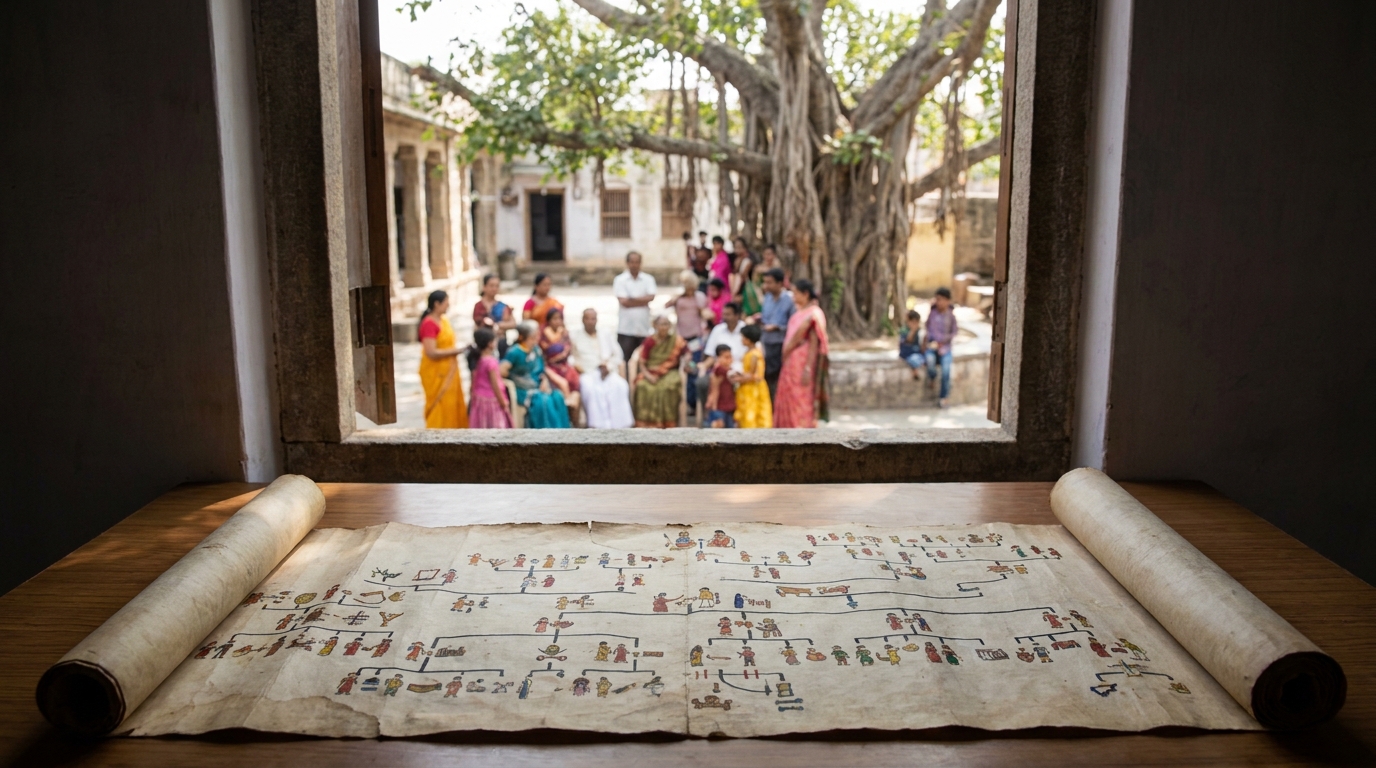
Have you ever wondered about the family of Krishna — the Supreme Person whom millions of devotees worship, sing to, and love with all their hearts? Understanding Krishna’s family tree is not just a historical exercise. It is a deeply devotional journey that reveals how God Himself enters into loving relationships, and how those relationships become doorways for us to experience divine love.
At The Bhakti House, we believe that everyone — regardless of background, culture, or tradition — can find inspiration in these sacred connections. Whether you are new to Bhakti Yoga or have been chanting the Holy Names for years, exploring Krishna’s family helps us understand that love is the very essence of the spiritual world.
So let us walk together through this beautiful family tree, learning the names, stories, and spiritual significance of the personalities who surround Krishna with devotion.
Krishna appears in what is known as the Yadu Dynasty (also called the Yadava lineage), one of the most celebrated royal families in the Vedic tradition. This dynasty traces its origins all the way back to the moon god, Chandra, which is why it is sometimes called the Chandra Vamsha, or Lunar Dynasty.
From King Yadu to Krishna
The dynasty gets its name from King Yadu, who was one of the sons of King Yayati. Yadu chose to accept his father’s old age in an act of filial devotion, and from his lineage arose a long succession of powerful and righteous kings. Over many generations, this family line eventually produced Vasudeva and Devaki — the blessed father and mother of Krishna.
The Srimad Bhagavatam (Bhagavata Purana) dedicates entire chapters to tracing this lineage, reminding us that Krishna’s appearance is not random. He chose this family, this time, and this place with perfect divine intention.
Why Does God Have a Family Tree?
This is a beautiful question. In Bhakti philosophy, Krishna is the Supreme Personality of Godhead — He is not forced to take birth the way ordinary souls are. As He Himself explains in the Bhagavad Gita (4.6):
“Although I am unborn and My transcendental body never deteriorates, and although I am the Lord of all living entities, I still appear in every millennium in My original transcendental form.”
Krishna’s family tree exists not because He needs a family, but because He delights in loving relationships. Every member of His family is an eternal associate, a liberated soul who plays a specific role in His divine pastimes, known as lila. Understanding this helps us see that family, love, and relationship are not obstacles to spiritual life — they are at its very heart.
Krishna’s Immediate Family: Parents, Siblings, and Childhood
Vasudeva and Devaki: The Birth Parents
Krishna’s father is Vasudeva (sometimes written as Vasudeva with a long “a” to distinguish him from his son, Vāsudeva, a name for Krishna Himself). His mother is Devaki, the sister of the tyrannical King Kamsa.
The story of Krishna’s birth is one of the most beloved narratives in all of Bhakti literature. Kamsa, having heard a prophecy that Devaki’s eighth child would destroy him, imprisoned both Vasudeva and Devaki and killed their first six children. The seventh child, Balarama, was mystically transferred to the womb of Rohini, another wife of Vasudeva. Then Krishna appeared as the eighth child, and Vasudeva miraculously carried baby Krishna across the Yamuna River to the safety of Gokula.
This story teaches us something profound: even in the darkest circumstances, divine love finds a way. Krishna’s appearance in a prison cell reminds every one of us that no matter how confined or hopeless our situation may feel, God can appear right in the middle of it.
Nanda and Yashoda: The Foster Parents
While Vasudeva and Devaki are Krishna’s birth parents, it is Nanda Maharaja and Mother Yashoda of Vrindavan who raised Him. And in Bhakti tradition, the love of Nanda and Yashoda is considered one of the highest expressions of devotion.
Yashoda’s love for Krishna is so pure, so unconditional, that even the Supreme Lord allows Himself to be bound by her rope of affection. The Srimad Bhagavatam (10.9.19) beautifully states:
“The Supreme Personality of Godhead, Krishna, the son of mother Yaśodā, is accessible to devotees engaged in spontaneous loving service, but He is not as easily accessible to mental speculators, to those striving for self-realization by severe austerities and penances, or to those who consider the body the same as the self.”
This verse reminds us that love — simple, heartfelt, parental love — can bind God Himself. What a breathtaking teaching for all of us who practice Bhakti Yoga.
Balarama: Krishna’s Beloved Elder Brother
Lord Balarama (also known as Baladeva) is Krishna’s elder brother and His first expansion. In spiritual terms, Balarama is the original guru — the one who serves Krishna and helps all souls connect with Him. He is the source of all spiritual strength, and His presence in Krishna’s pastimes adds depth, sweetness, and power.
Balarama grew up alongside Krishna in Vrindavan, and together they herded cows, played with the cowherd boys, and protected the residents from demons. Their brotherhood is a model of divine companionship and mutual love.
Subhadra: The Beloved Sister
Subhadra is Krishna’s younger sister, and she holds a very special place in Bhakti devotion. She is famously worshipped alongside Krishna (as Jagannath) and Balarama in the great temple of Puri, India, where millions of devotees gather each year for the Ratha Yatra festival.
Subhadra later married Arjuna, the great warrior and Krishna’s dear friend, further weaving together the families of the Yadavas and the Pandavas in a tapestry of divine love.
Krishna’s Wives and Children: The Household of God

The Queens of Dvaraka
When Krishna moved from Vrindavan to the majestic city of Dvaraka, He established His role as a king and householder. He married 16,108 queens, each of whom He loved uniquely and completely. Among these, eight principal queens are most celebrated.
The Eight Principal Queens
The eight principal queens, known as the Ashtabharya, are:
- Rukmini — considered the foremost queen and an incarnation of Lakshmi, the goddess of fortune
- Satyabhama — spirited and deeply devoted
- Jambavati — daughter of the great bear-king Jambavan
- Kalindi — the personified Yamuna River
- Mitravinda — a princess whom Krishna won in a svayamvara ceremony
- Nagnajiti (also called Satya) — won by Krishna after He tamed seven wild bulls
- Bhadra — Krishna’s cousin, a princess of the Kaikeya kingdom
- Lakshmana — won in another svayamvara
Each queen had ten sons and one daughter with Krishna, meaning Krishna had over 161,000 children. This may seem extraordinary, but it illustrates a profound Bhakti teaching: God’s love is unlimited. He does not divide His attention — He expands Himself fully for each relationship.
As the Srimad Bhagavatam (1.11.35-36) describes Krishna’s life in Dvaraka, it shows that the Lord perfectly reciprocated with every single queen as if she were His only beloved.
Sure, here is the sentence with the clickable link:
Check out our website for more articles: more articles.
The Extended Family: Pandavas, Kauravas, and Beyond
Krishna and the Pandavas
Some of the most important figures connected to Krishna’s family are the Pandavas — the five sons of Pandu. Krishna’s aunt Kunti (also known as Pritha) was the mother of three of the Pandavas: Yudhishthira, Bhima, and Arjuna. This makes the Pandavas Krishna’s cousins, and this family bond is central to the great epic, the Mahabharata.
Krishna’s relationship with the Pandavas, especially Arjuna, gives us the Bhagavad Gita — the most beloved scripture in the world for many devotees. On the battlefield of Kurukshetra, Krishna serves as Arjuna’s charioteer and spiritual guide, delivering teachings that continue to transform hearts thousands of years later.
In the Bhagavad Gita (18.65), Krishna offers this intimate instruction:
“Always think of Me, become My devotee, worship Me and offer your homage unto Me. Thus you will come to Me without fail. I promise you this because you are My very dear friend.”
This is not just advice for Arjuna. This is Krishna speaking to each of us through the medium of family love and friendship.
Kunti Devi: The Devoted Aunt
Queen Kunti’s prayers to Krishna in the Srimad Bhagavatam are among the most moving passages in all devotional literature. Despite enduring unimaginable hardship — exile, persecution, and war — Kunti remained steadfast in her devotion. She actually prayed for more difficulties, because they kept her focused on Krishna.
Her example teaches us that devotion does not require a perfect life. It requires a sincere heart.
The Kauravas and the Lesson of Choice
On the other side of the family are the Kauravas, led by Duryodhana. Though related to Krishna through extended family ties, Duryodhana chose envy and pride over devotion. His story serves as a powerful reminder that proximity to God — even family connection — is not enough. We must also choose love.
Spiritual Lessons from Krishna’s Family
Every Relationship Is a Path to God
One of the most beautiful teachings we can draw from Krishna’s family tree is that every kind of relationship — parental, fraternal, romantic, friendly — can become a vehicle for divine love. In Bhakti Yoga, these different moods of love are called rasas, and they include:
- Shanta rasa — peaceful admiration
- Dasya rasa — loving service
- Sakhya rasa — friendship (like the cowherd boys)
- Vatsalya rasa — parental love (like Yashoda and Nanda)
- Madhurya rasa — conjugal love (like the queens and gopis)
No matter what kind of love comes most naturally to you, there is a place for you in Krishna’s family.
God Is Not Distant
Krishna’s family tree shatters the idea that God is far away, untouchable, or impersonal. He plays, eats, laughs, cries, and loves within a family. He allows Himself to be scolded by His mother, teased by His friends, and embraced by His beloved. This is the sweetness of Bhakti — God is the most approachable person in existence.
How Krishna’s Family Inspires Our Practice Today
Understanding Krishna’s family tree is not merely academic — it enriches our daily practice of Bhakti Yoga in tangible ways.
When we chant the Hare Krishna maha-mantra — Hare Krishna, Hare Krishna, Krishna Krishna, Hare Hare / Hare Rama, Hare Rama, Rama Rama, Hare Hare — we are calling out to Krishna and Balarama (Rama) and to Hare, the divine energy represented by Radharani and all of Krishna’s devotees. We are, in a sense, calling out to the whole family.
When we offer food to Krishna and share it as prasadam (sacred food), we are participating in the same hospitality that Yashoda showed in her kitchen.
When we serve others selflessly, we are following the example of the Pandavas, who served Krishna with everything they had.
And when we simply pray — even with stumbling words and an imperfect heart — we are joining the chorus of Kunti, Devaki, and countless other family members who turned to Krishna in both joy and sorrow.
You Are Part of This Family
Here is perhaps the most important truth of all: Krishna’s family is not closed. It is not exclusive. It is ever-expanding and all-welcoming. In the Bhagavad Gita (9.29), Krishna says:
“I envy no one, nor am I partial to anyone. I am equal to all. But whoever renders service unto Me in devotion is a friend, is in Me, and I am also a friend to him.”
You do not need to be born into a particular culture, race, or tradition to be part of Krishna’s family. You simply need a sincere desire to love and be loved by God.
So wherever you are today, whatever your background, whatever doubts or questions you may carry — please know that you are welcome here. Take one sincere step toward Krishna. Chant one prayer. Offer one moment of your day to the Divine. That is enough to begin.
Krishna’s family tree is vast and ancient, but there is always room for one more. There is always room for you.
With love and devotion,
The Bhakti House �DiamondSuit
FAQs
What is Krishna’s family tree?
Krishna’s family tree is a genealogical chart that traces the lineage of the Hindu deity Krishna, including his parents, siblings, and descendants.
Who are Krishna’s parents?
Krishna’s parents are Vasudeva and Devaki. Vasudeva was a prince of the Yadava dynasty, and Devaki was the sister of the cruel king Kamsa.
Who are Krishna’s siblings?
Krishna had several siblings, including Balarama, Subhadra, and eight other sisters. Balarama is considered to be Krishna’s elder brother and an incarnation of the serpent Shesha.
Who are Krishna’s descendants?
Krishna’s descendants include his grandson Vajra, who became the king of Mathura, and the Yadava dynasty, which played a significant role in the Mahabharata epic.
What is the significance of Krishna’s family tree in Hindu mythology?
Krishna’s family tree is significant in Hindu mythology as it provides a historical and mythological context for the life and actions of Krishna, and it also illustrates the interconnectedness of various divine and mortal beings in Hindu cosmology.

