

In the gentle path of Bhakti Yoga, every sincere step toward God matters. Whether we are new to spiritual life, returning after a long time, or already practicing daily, the heart is always invited to grow softer, humbler, and more loving.
One beautiful practice in Bhakti Yoga is called pāda-sevanam. In Sanskrit, pāda means “feet,” and sevanam means “service.” So, pāda-sevanam means “serving the feet of the Lord.” At first, this may sound symbolic or unfamiliar, especially if we come from a different spiritual background. But in the Bhakti tradition, the feet of God represent shelter, guidance, humility, and loving service.
To serve the Lord’s feet means to approach God not with pride, demand, or fear, but with a heart that says, “I am here to love. I am here to serve. Please guide me.”
Pāda-sevanam is not only an ancient devotional practice. It is also deeply practical. It teaches us how to live with humility, how to care for others, how to remember God in everyday life, and how to turn simple acts into sacred offerings.
Bhakti Yoga is the path of loving devotion to God. The word bhakti means devotion, love, and heartfelt service. It is not only a philosophy; it is a way of living. Through chanting, prayer, hearing sacred wisdom, worship, community, and service, the heart gradually awakens its natural relationship with the Divine.
Pāda-sevanam is one of the nine main practices of Bhakti described in the Śrīmad-Bhāgavatam, one of the most beloved scriptures in the Bhakti tradition. These nine practices are:
- Hearing about God
- Chanting God’s names
- Remembering God
- Serving the Lord’s feet
- Worshiping the Lord
- Offering prayers
- Becoming a servant of the Lord
- Becoming a friend of the Lord
- Surrendering everything to the Lord
In Sanskrit, these are known as śravaṇam, kīrtanam, smaraṇam, pāda-sevanam, arcanam, vandanam, dāsyam, sakhyam, and ātma-nivedanam.
Each of these practices helps us reconnect with God in a personal, loving way. Pāda-sevanam especially helps us cultivate humility.
The Meaning of Serving the Lord’s Feet
In many spiritual traditions, the feet symbolize the foundation. They carry us. They support us. They touch the earth. In Bhakti, the feet of the Lord are understood as the place of ultimate shelter.
When devotees speak of taking shelter at the Lord’s lotus feet, they are expressing a prayerful mood: “Dear Lord, please let me rest my heart in You. Please let me walk in Your direction. Please let my life become aligned with Your will.”
The word “lotus” is often used because the lotus flower grows in muddy water but remains pure and beautiful. Similarly, God’s presence can uplift us even while we live in a complicated world. The Lord’s lotus feet represent purity, compassion, and protection.
Humility Is Not Weakness
Pāda-sevanam teaches humility, but humility does not mean thinking we are worthless. True humility means seeing clearly: “I am a soul, loved by God. I am not the supreme controller. I am here to serve with love.”
Humility brings freedom. When we no longer need to prove ourselves constantly, we can serve more naturally. We can listen more deeply. We can forgive more easily. We can receive grace.
In the Bhagavad-gītā, Lord Krishna describes humility as one of the qualities of true knowledge. He begins His list with amānitvam, which means freedom from the hunger for honor. This is not a call to self-hatred. It is an invitation to live with spiritual dignity, free from the heavy burden of ego.
Pāda-sevanam in Scripture and Sacred Tradition
The practice of pāda-sevanam appears throughout Bhakti scriptures in both direct and symbolic ways. Devotees serve the Lord’s feet through worship, remembrance, prayer, and heartfelt surrender.
Lakshmi Devi and the Mood of Service
In the Bhakti tradition, Lakshmi Devi, the goddess of fortune and divine grace, is often described as eternally serving the feet of Lord Vishnu. Lord Vishnu is a name of God meaning “the all-pervading one,” and He is worshiped as the Supreme Lord who maintains and protects creation.
Lakshmi Devi’s service is not forced. It is loving, joyful, and intimate. Though she is worshiped by many as the goddess of wealth and beauty, her deepest happiness is found in serving the Lord.
This teaches us something profound: the highest spiritual wealth is not possession, recognition, or status. The highest wealth is loving service.
Bharata Maharaja and Devotional Reverence
In the Rāmāyaṇa, a sacred epic centered on Lord Rama, we see a powerful example of devotion connected to the Lord’s feet. When Lord Rama is exiled to the forest, His brother Bharata refuses to take the throne for himself. Instead, Bharata places Lord Rama’s sandals on the throne and rules only as His representative.
This is a beautiful expression of pāda-sevanam. Bharata does not seek power for himself. He serves the Lord’s feet by honoring Rama’s sandals, symbolizing his complete devotion and humility.
For us, this example can become very practical. We may ask: “Am I trying to be the owner of my life, or can I become a caretaker of what God has given me? Can I use my role, my home, my work, and my talents in service?”
The Gopis and Loving Surrender
The gopis, the cowherd devotees of Krishna in Vrindavan, are honored in Bhakti scriptures as examples of the highest love for God. Their devotion is pure, spontaneous, and free from selfish desire.
They long to serve Krishna in every way, including His lotus feet. Their love teaches us that the heart’s deepest fulfillment is found not in taking from God, but in loving God.
This does not mean we imitate their advanced spiritual emotions. Rather, we learn from their direction: love grows when we place God at the center.
Serving with the Body, Mind, and Heart
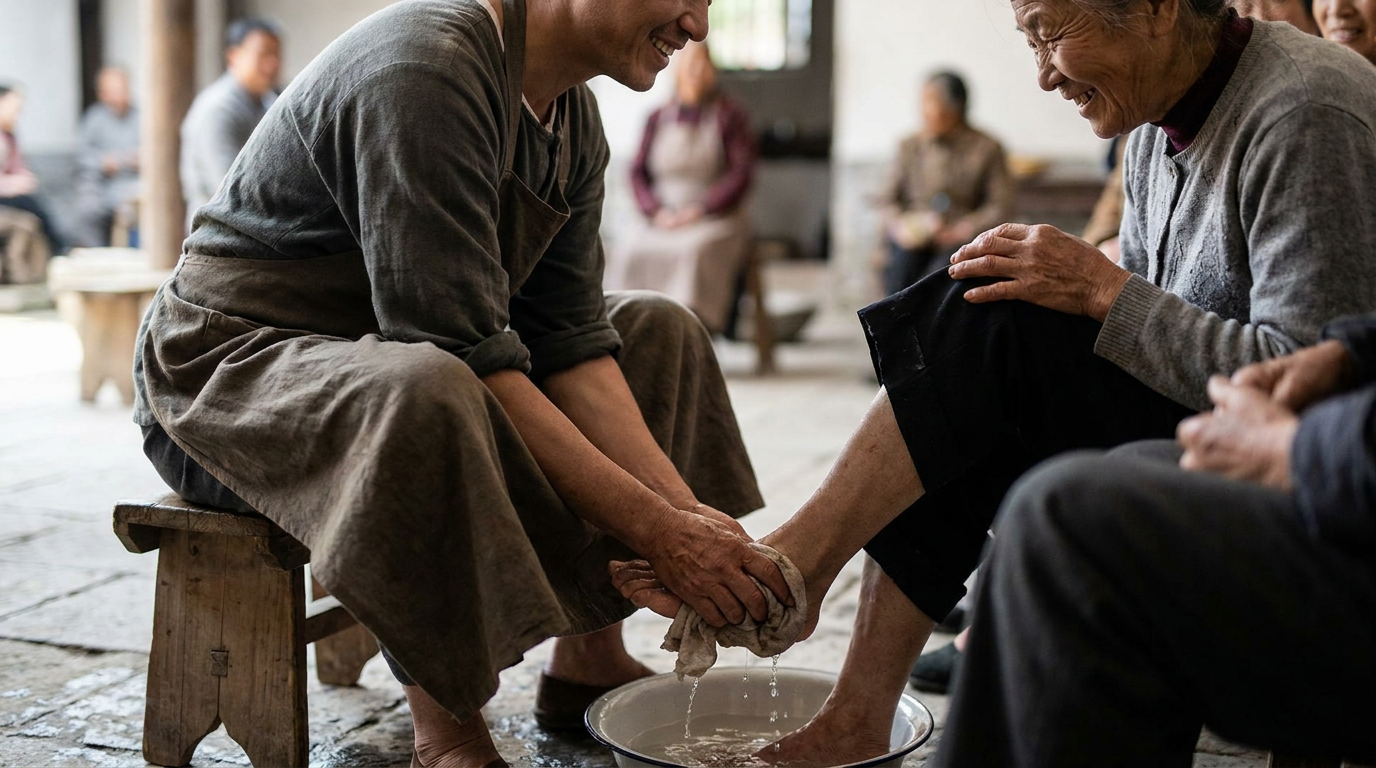
Pāda-sevanam can be practiced outwardly and inwardly. Some devotees may physically worship the feet of the Lord’s deity form in a temple. Others may meditate on the Lord’s feet during prayer. Others may serve the devotees, clean a sacred space, cook an offering, chant God’s names, or care for someone in need.
The essence is loving humility.
Serving with the Body
Our bodies can become instruments of devotion. In Bhakti Yoga, spiritual life is not limited to thoughts or beliefs. It includes action.
We can serve with the body by:
- Cleaning a temple, altar, home shrine, or shared spiritual space
- Preparing food with love and offering it to God
- Helping set up for kirtan, a gathering where God’s names are sung
- Offering flowers, water, incense, or a lamp in worship
- Bowing down in prayer as a gesture of surrender
- Caring for people, animals, and the earth as part of God’s creation
These simple acts may seem ordinary. But when they are offered with devotion, they become sacred.
In Bhakti, the intention matters deeply. Washing a floor can become worship. Cooking a meal can become prayer. Greeting someone kindly can become service to God.
Serving with the Mind
The mind often wants control, praise, and comfort. Pāda-sevanam gently retrains the mind to remember: “I am here to serve.”
Serving with the mind may include:
- Meditating on the Lord’s lotus feet
- Remembering that God is guiding us
- Offering our plans and worries in prayer
- Seeing others as souls loved by God
- Practicing gratitude throughout the day
- Letting go of resentment and asking for a softer heart
The mind becomes peaceful when it has a higher shelter. Instead of constantly circling around fear and desire, the mind can rest in remembrance.
Serving with the Heart
Ultimately, pāda-sevanam is a heart practice. We may perform many actions externally, but the real offering is our sincerity.
A simple prayer can open the heart:
“Dear Lord, I do not know how to serve perfectly, but I want to learn. Please accept this small offering. Please help me become humble, kind, and steady.”
God is not looking for performance. God is looking for love.
Please visit our website for more information on our articles: articles.
Humility as the Doorway to Spiritual Growth

Many of us come to spiritual life carrying pain, confusion, disappointment, or pride. Sometimes we want God to fix everything immediately. Sometimes we want spiritual practice to make us feel special. But Bhakti patiently teaches us another way.
The heart grows through humility.
Humility Helps Us Receive Grace
Grace is always flowing, but pride can close the heart. When we think, “I already know,” it becomes difficult to learn. When we think, “I am the doer of everything,” it becomes difficult to feel God’s support.
Humility opens the heart to receive.
In the Bhagavad-gītā, Krishna invites Arjuna to learn spiritual truth by approaching those who have realized it with humility, inquiry, and service. This is a very important combination. We are not asked to blindly accept. We are invited to ask sincere questions, but with a respectful heart and a willingness to serve.
This mood protects us from both arrogance and spiritual confusion.
Humility Makes Relationships Sacred
Pāda-sevanam also transforms how we relate to others. If we are practicing serving the Lord’s feet, we begin to see that every person is connected to God. Every soul is worthy of respect.
This does not mean we ignore healthy boundaries or allow harm. Bhakti is not sentimental. But it does mean we practice honoring the spiritual dignity of others.
In daily life, humility may look like:
- Listening without interrupting
- Apologizing when we cause harm
- Serving without needing recognition
- Letting someone else be appreciated
- Asking, “How can I help?”
- Remembering that everyone is on a journey
When we serve others in a God-centered mood, the heart becomes purified.
Humility Protects Us from Spiritual Pride
Sometimes, after practicing for some time, we may begin to think, “I am more spiritual than others.” This is a subtle trap. Spiritual pride can be even more dangerous than ordinary pride because it hides behind religious language.
Pāda-sevanam keeps us grounded.
To serve the Lord’s feet means we remain learners. We remain grateful. We remember that every moment of devotion is a gift.
The great saints of Bhakti often prayed not for fame, power, or mystical experiences, but for service. They wanted to remain at the feet of the Lord, close to His mercy.
Practical Ways to Practice Pāda-sevanam Today
You do not need to live in a monastery or temple to practice pāda-sevanam. You can begin exactly where you are. Bhakti Yoga is wonderfully practical. It can enter the kitchen, workplace, car, school, hospital room, garden, and quiet corner of your home.
Create a Small Sacred Space
If possible, create a simple place for prayer and remembrance. It may be a small altar with a picture of Krishna, Rama, Vishnu, or another form of God you feel drawn to. You may also include sacred texts, flowers, a candle, or beads for chanting.
Each day, spend a few minutes there. Offer your respect. Bow your head if that feels natural. Speak honestly to God.
You might say:
“Please let me serve today. Please guide my steps. Please help me remember You.”
This simple daily practice helps the heart take shelter.
Offer Water, Flowers, or Food
In the Bhagavad-gītā, Krishna says that if someone offers Him a leaf, a flower, fruit, or water with love and devotion, He accepts it. This verse is deeply encouraging. God is not asking for expensive offerings. He is asking for love.
You can offer a cup of water, a flower, a piece of fruit, or a home-cooked meal. Before eating, pause and offer the food to God with gratitude. In Bhakti, food offered to God becomes prasadam, which means mercy or grace.
Receiving prasadam reminds us that life is not just consumption. It is relationship. Even eating can become sacred.
Clean as an Act of Devotion
Cleaning is a powerful form of pāda-sevanam. In many temples, devotees joyfully clean the floors, altar areas, kitchens, and gathering spaces. This is not “low” work. It is sacred service.
At home, you can clean with the prayer: “May this space become peaceful. May this home welcome God’s presence. May the people who enter here feel cared for.”
Cleaning also has an inner meaning. As we clean outside, we can pray for the cleaning of the heart—removing envy, anger, selfishness, and forgetfulness.
Serve the Devotees and Community
In Bhakti, serving God’s devotees is considered especially dear to the Lord. This does not mean we only care for people in our own spiritual community. Rather, it begins with honoring those who are walking toward God and expands into compassion for all beings.
You might serve by:
- Helping at a kirtan or satsang gathering
- Welcoming newcomers
- Supporting someone who is struggling
- Cooking for others
- Offering your skills in service
- Donating time or resources
- Praying for the wellbeing of others
Satsang means spiritual association—coming together with others who are seeking truth and devotion. Good company strengthens our practice. It helps us remember what matters.
Chant with a Servant’s Heart
Chanting is central to Bhakti Yoga. The chanting of God’s names is called kirtan when sung together, and japa when repeated softly or personally, often on beads.
A widely practiced mantra in the Bhakti tradition is the Hare Krishna maha-mantra:
Hare Krishna Hare Krishna
Krishna Krishna Hare Hare
Hare Rama Hare Rama
Rama Rama Hare Hare
Maha-mantra means “great mantra.” A mantra is a sacred sound that helps free the mind and awaken the heart. “Hare” calls upon the divine energy of the Lord, and “Krishna” and “Rama” are names of God meaning the all-attractive one and the source of spiritual joy.
When we chant, we can do so in the mood of pāda-sevanam:
“Please let me serve You. Please let me remember You. Please let my heart become clean.”
Chanting is not about having a perfect voice. It is about sincerity.
Pāda-sevanam and the Inner Journey
Serving the Lord’s feet is not only about external rituals. It is an inner journey from ego-centered living to God-centered love.
This transformation takes time. We may still struggle with impatience, pride, distraction, or doubt. That is normal. Bhakti is a path of practice, not instant perfection.
From Control to Surrender
Many of us try to control everything—our future, relationships, image, success, and even our spiritual progress. But life repeatedly teaches us that we are not fully in control.
Pāda-sevanam offers a gentle alternative: surrender.
Surrender does not mean giving up responsibility. It means acting responsibly while remembering that God is the ultimate shelter. We do our best, offer the results, and trust divine wisdom.
This can bring great peace.
A simple surrender prayer is:
“Dear Lord, I offer this situation to You. Please guide me. Please help me act with love and wisdom.”
From Self-Importance to Service
The ego asks, “How can I be seen?”
The soul asks, “How can I love?”
Pāda-sevanam helps us move from self-importance to service. This shift is not always easy. The ego may resist. It may want appreciation. It may feel offended when unnoticed.
But every time we serve quietly, we water the seed of devotion.
In Bhakti, this seed is called bhakti-latā-bīja, the seed of the creeper of devotion. Through hearing, chanting, prayer, and service, that seed grows. Eventually, the heart becomes filled with love for God.
From Restlessness to Shelter
Modern life can make the heart restless. So much noise, comparison, anxiety, and speed can leave us feeling spiritually dry. Pāda-sevanam invites us to slow down and come back to shelter.
To meditate on the Lord’s feet is to remember: “I do not have to carry everything alone. I am held. I am guided. I belong to God.”
This remembrance can become a refuge in difficult times.
Serving Others as Service to God
One of the most beautiful fruits of pāda-sevanam is compassion. When we learn to serve God humbly, we naturally become more willing to serve others.
Bhakti is personal, but not private in a selfish way. Love for God should soften our dealings with the world.
Seeing Every Soul as Sacred
The Bhagavad-gītā teaches that the wise see with equal vision. They recognize the spiritual soul within all beings, beyond outer labels and temporary differences.
This vision is not artificial sameness. It is spiritual respect. Each person has a unique story, culture, background, and path. Yet beneath all of that, each of us is a soul, part of God, longing for love.
Pāda-sevanam teaches us to approach others without superiority. We may think, “This person also belongs to God. How can I honor them?”
Service in Family Life
Family life offers countless opportunities for pāda-sevanam. Sometimes the most difficult service is not in public, but at home—being patient, forgiving, attentive, and kind with the people closest to us.
Serving family does not mean losing ourselves or accepting unhealthy behavior. It means bringing a devotional mood into our responsibilities.
We can cook with love, listen with care, pray together, speak gently, and create a home atmosphere where God is remembered.
Even changing a diaper, caring for an elder, washing dishes, or working to support loved ones can become sacred when offered to God.
Service in Work and Daily Duties
Many people wonder, “How can I practice Bhakti when I have a job, studies, or many responsibilities?”
The answer is: begin by offering what you already do.
Before work, pray: “May my efforts today be honest and helpful. May I serve through my work.”
During the day, remember God’s names quietly. Treat coworkers, customers, patients, students, or clients with respect. Offer the results of your work to God.
Bhakti does not require us to escape life. It teaches us how to spiritualize life.
The Mood of Bowing Down
In many Bhakti settings, devotees bow down before the deity, sacred scriptures, teachers, or other devotees. For newcomers, this may feel unfamiliar. It is helpful to understand the heart behind it.
Bowing is not about shame. It is about reverence.
Bowing the Body Softens the Heart
Our body and mind are connected. When we bow physically, we remind the mind to become humble. We acknowledge that there is something greater than our ego.
Even if we do not physically bow, we can bow inwardly. We can pause, breathe, and say, “I honor the Divine presence here.”
Bowing to the Path
To bow also means to honor the path itself. We are not the inventors of Bhakti Yoga. We are receiving a sacred tradition carried by saints, teachers, and sincere practitioners over many generations.
This gratitude protects us. It helps us approach spiritual life not as consumers, but as servants.
Bowing in Times of Difficulty
Sometimes life brings us to our knees through grief, loss, illness, or uncertainty. In those moments, pāda-sevanam becomes very real.
We may not have polished prayers. We may only be able to say, “God, please help me.”
That prayer is enough.
The Lord’s feet are a place of shelter for the tired heart.
Common Misunderstandings About Pāda-sevanam
Because pāda-sevanam involves the language of service and humility, it can be misunderstood. It is important to approach it with clarity and balance.
It Is Not Blind Submission
Spiritual humility does not mean turning off intelligence. Bhakti encourages sincere inquiry. We should ask questions, study scripture, seek healthy community, and use discernment.
True service is offered with love, not coercion.
It Is Not About Human Exploitation
Serving God’s feet should never be used to justify manipulation or abuse. Authentic Bhakti service increases dignity, compassion, and freedom from selfishness. It does not make people tools for someone else’s ego.
If service is demanded without care, humility, or accountability, something is wrong.
It Is Not Only Ritual
Ritual can be beautiful and powerful, but pāda-sevanam is not limited to ritual. If we worship in the temple but remain harsh, proud, or uncaring, we have missed the heart of the practice.
The real test is how we live.
Do we become kinder? More patient? More prayerful? More willing to serve without pride?
That is the fruit of pāda-sevanam.
Bringing Pāda-sevanam into a Daily Bhakti Practice
A daily practice does not need to be complicated. The most important thing is sincerity and consistency. Even a few minutes each day can gradually transform the heart.
A Simple Morning Practice
You might begin your day like this:
- Sit quietly for a few moments.
- Offer a prayer of gratitude.
- Chant God’s names, even for five or ten minutes.
- Read one verse from the Bhagavad-gītā or another sacred text.
- Ask, “How can I serve today?”
This simple rhythm can change the direction of the whole day.
A Simple Evening Reflection
Before resting, you may reflect:
- Where did I remember God today?
- Where did I forget?
- Did I serve with humility?
- Is there someone I need to forgive or ask forgiveness from?
- What can I offer to God before sleeping?
Then pray:
“Dear Lord, thank You for carrying me today. Please forgive my mistakes. Please let me wake tomorrow with a heart ready to serve.”
Practicing in Community
Spiritual community helps nourish devotion. At The Bhakti House and in many Bhakti communities, people gather for chanting, discussion, prayer, prasadam, and service. These gatherings remind us that we are not alone.
Everyone comes with a different background and story. Some know Sanskrit. Some do not. Some grew up with spiritual practices. Some are just beginning. What matters most is sincerity.
In community, pāda-sevanam may look like welcoming someone new, washing a pot after a meal, singing with others, listening with respect, or helping create a sacred atmosphere.
Small services become big when offered with love.
The Blessing of Serving with Humility
Pāda-sevanam is a doorway into the heart of Bhakti Yoga. It teaches us to come before God with tenderness and honesty. It reminds us that love is expressed through service. It helps us move from pride to gratitude, from restlessness to shelter, from isolation to relationship.
To serve the Lord’s feet is to let our life become guided by divine love.
We may begin imperfectly. That is completely okay. No one becomes humble overnight. No one serves purely without practice and grace. But every sincere effort is seen by God.
A flower offered with love matters. A whispered prayer matters. A floor cleaned with devotion matters. A meal served with kindness matters. A mantra chanted with longing matters. A moment of humility matters.
Bhakti Yoga is not about being spiritually impressive. It is about becoming real before God.
And the beautiful truth is that God meets us there.
Wherever you are from, whatever your background, whatever you believe or are still discovering, you are welcome on this path of love. Take one sincere step today—chant one name of God, offer one prayer, serve one person, bow your heart in gratitude—and trust that the Lord’s lotus feet are always a place of shelter.
FAQs
What is Pāda-sevanam?
Pāda-sevanam is a concept in Hinduism that refers to serving with humility, particularly in the context of serving the guru or spiritual teacher.
What is the significance of Pāda-sevanam?
Pāda-sevanam is considered a crucial aspect of spiritual practice in Hinduism, as it emphasizes the importance of humility, devotion, and selfless service in the spiritual journey.
How is Pāda-sevanam practiced?
Pāda-sevanam is practiced through acts of service and devotion to the guru or spiritual teacher, such as performing menial tasks, offering assistance, and showing respect and reverence.
What are the benefits of practicing Pāda-sevanam?
Practicing Pāda-sevanam is believed to purify the mind, cultivate humility, and deepen one’s spiritual connection with the guru or spiritual teacher. It is also seen as a way to overcome the ego and develop selflessness.
Are there any specific rituals or customs associated with Pāda-sevanam?
While there are no specific rituals or customs associated with Pāda-sevanam, it is often practiced within the framework of traditional Hindu rituals and customs, such as offering flowers, performing aarti, and seeking the guru’s blessings.

